
I have replaced two walkways and three garden beds over the past six years, and the same question keeps coming back: pea gravel or river rock?
Let’s walks through the real differences in how each material behaves underfoot, how it holds up in rain, what it costs to install, and where each one actually makes sense so you can choose without guessing.
| Feature | Pea Gravel | River Rock |
| Typical Size | 1/4 to 3/8 inch | 1 to 3 inches or larger |
| Shape & Texture | Small, very rounded, smooth | Larger, rounded, water-smoothed |
| Average Cost | Lower per cubic yard | Higher per cubic yard |
| Drainage | Excellent, fast | Very good, slightly slower |
| Walkability | Comfortable for paths | Uneven, better for low-traffic areas |
| Stability | Shifts easily | Stays put better |
| Weed Resistance | Moderate with fabric | Better once settled |
| Best Primary Use | Paths, patios, filler | Borders, dry creek beds, accents |
| Color Options | Limited natural tones | Wide range of natural colors |
| Installation Effort | Easier to spread by hand | Heavier, often needs equipment |
Also Read: Free Online Paver Sand Calculator.
Key Differences Between Pea Gravel and River Rock
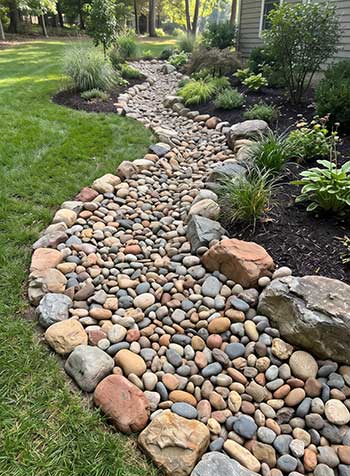
- Size and how the stones interact: Pea gravel stones are small enough that they can nestle into the spaces between their neighbors, creating a somewhat interlocking surface. River rock pieces sit more independently; each one rests on the ones below it without much interlocking. That difference shows up when you try to rake or when a dog runs across the area.
- Stability under repeated use: On a path that sees daily traffic, pea gravel develops low spots and high spots within weeks unless you refresh it. River rock stays level longer because the individual stones are harder to displace. I switched one high-traffic shortcut from pea gravel to river rock and stopped filling holes every month.
- Visual scale next to plants: Small pea gravel recedes and lets foliage dominate. Larger river rock competes for attention and can make small perennials look even smaller. In a new perennial bed I used pea gravel as the filler and reserved the river rock for the outer edge so the plants stayed the focus.
- Heat retention on sunny days: The greater mass of river rock holds more heat. Barefoot walking on dark river rock in mid-afternoon felt noticeably warmer than the same walk on pea gravel. If you have pets that spend time outdoors, the difference can matter.
- Amount of material needed to cover the same area: You generally need less volume of pea gravel to achieve full coverage because the small stones fill gaps more efficiently. With river rock you often order extra to avoid seeing fabric or soil between the larger pieces.
- Ease of future removal or redesign: Pea gravel can be shoveled and screened if you change your mind. River rock is heavier to move and harder to separate from soil once it has settled. I still have a pile of leftover pea gravel I can reuse; the river rock leftovers required a trailer.
Also Read: Comparison of Paver And Concrete Patio.
Key Features of Pea Gravel
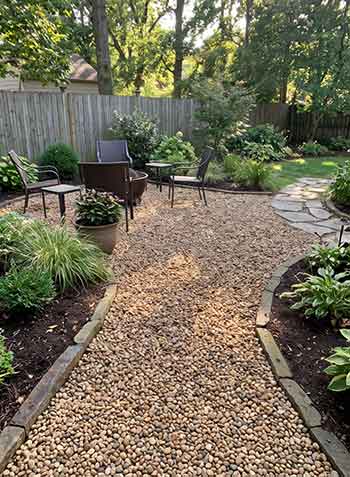
- Particle size and consistency: The small diameter lets the stones pack together while still leaving air spaces. You can walk on a two-inch layer without feeling like you are stepping on marbles, yet the same layer still lets rain move downward instead of pooling. I measured a section of my old path after a heavy rain and the surface stayed firm enough for a wheelbarrow.
- Color and visual uniformity: Most pea gravel arrives in muted beige, gray, or light brown tones. The even size creates a soft, continuous surface that does not compete with nearby plants. When I paired it with dark mulch in a mixed bed, the contrast looked intentional rather than busy.
- Drainage speed: Water moves through a pea-gravel layer faster than through most other common ground covers. In a low spot near my downspout I laid four inches of pea gravel over fabric; the area that used to stay muddy now dries within a few hours.
- Ease of hand placement: One person can dump and rake a yard of pea gravel without special tools. I finished a thirty-foot path in a single afternoon using only a wheelbarrow and a landscape rake.
- Compatibility with edging: Plastic, metal, or stone borders hold the small stones in place. Without edging the gravel creeps onto lawn or patio surfaces within a few months.
- Comfort under bare feet: On a hot day the small stones do not hold as much heat as larger rock, and the rounded shape avoids sharp edges. Children and pets walked the path without complaint once I added a thin top layer of the finest grade.
Pros of Pea Gravel
- Lower material cost for large areas: In most regions a cubic yard of pea gravel costs less than the same volume of river rock. When I priced a two-hundred-square-foot patio base, the pea gravel option saved enough money to cover the fabric and edging.
- Fast, effective drainage: The small gaps between stones let water pass quickly, which helps prevent standing water around foundations or in low garden spots. My side-yard path no longer turns into a puddle after summer storms.
- Comfortable walking surface: Once compacted slightly, the rounded stones form a surface that feels stable under shoes and bare feet. Guests rarely comment on the texture, which is usually a good sign.
- Simple to spread and level by hand: You do not need heavy equipment for most residential projects. I have finished entire beds with just a rake and a level.
- Soft visual texture that blends with many styles: The uniform small size creates a calm background that works with both formal and informal plantings. It does not shout for attention the way bold river rock can.
- Easy to top up later: If a section thins out, you can add a fresh bag or two without matching exact colors or sizes. The new material blends in quickly.
Cons of Pea Gravel
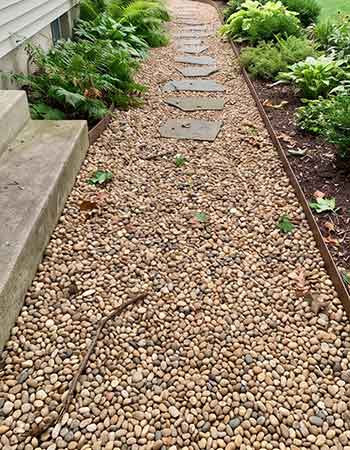
- Tendency to migrate without solid containment: Even with edging, pea gravel can work its way onto adjacent lawn or into mulch beds. I spend a few minutes each spring sweeping stones back into the path.
- Can feel unstable on steep slopes: On anything steeper than a gentle grade the small stones slide underfoot. I abandoned a pea-gravel idea on a short hillside and switched to larger rock.
- Weeds can still appear: Seeds that land on the surface germinate in the fine dust that collects between stones. Fabric underneath slows the problem but does not eliminate it.
- Not ideal for high-traffic vehicle areas: Car tires displace the stones and leave ruts. I tried a short driveway apron and had to rake it weekly.
- Requires occasional raking to stay neat: Leaves and debris settle into the gaps and need to be removed by hand or with a leaf blower on low speed.
- Can track into the house more easily: The tiny stones stick to shoes and end up on indoor floors. A simple boot brush at the door reduced the problem for me.
Key Features of River Rock
- Larger individual stone mass: Each piece weighs enough that ordinary foot traffic rarely moves it. In a dry creek bed I installed two years ago, the stones have stayed exactly where I placed them through several storms.
- Natural color range: Suppliers often offer mixed river rock that includes blues, reds, tans, and grays in the same load. The variety lets you match existing stone on the house or create a deliberate multi-tone look without buying several separate products.
- Surface texture after weathering: Fresh river rock already feels smooth. After a season outdoors the edges soften further, so the stones do not catch on shoes or mower blades the way crushed rock sometimes does.
- Depth needed for coverage: Because the stones are bigger, you usually need a thicker layer to hide the ground completely. I found that three to four inches of two-inch river rock covered fabric better than the same depth of pea gravel.
- Sound and visual weight: Larger stones create a more substantial appearance. Guests notice the border before they notice the plants, which can be useful when you want the hardscape to read clearly from the street.
- Longevity under freeze-thaw cycles: The solid mass of each stone resists cracking better than thinner materials. My river-rock border has shown no breakage after four winters with repeated freezing.
Also Read: Comparison of Landscape Fabric And Geotextile.
Pros of River Rock
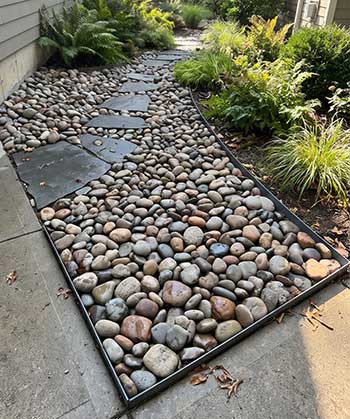
- Greater long-term stability: Once the stones settle, ordinary foot traffic and light rain do not move them much. My front border still looks the same after two full seasons.
- Strong visual presence: The larger size and color variation create an immediate finished look. Even before plants mature, the bed reads as intentional landscaping.
- Better resistance to displacement by pets or children: Dogs running across the area kick fewer stones out of place compared with pea gravel. The weight of each piece works in your favor.
- Lower frequency of replenishment: Because the material stays put, you rarely need to add more. I have not topped up the river-rock border since the original install.
- Works well in decorative dry creek or drainage swales: The stones look natural while still allowing water to move. A shallow swale I lined with mixed river rock handles roof runoff without eroding.
- Fewer small pieces to track indoors: Larger stones stay outside. Shoes pick up almost nothing compared with pea gravel.
Cons of River Rock
- Higher purchase price: The cost per cubic yard is usually greater, and you often need more depth for full coverage. My last river-rock project ran about thirty percent more than a comparable pea-gravel area.
- Heavier to move and place: A single wheelbarrow load feels substantial. Larger projects benefit from a helper or a small machine.
- Uneven surface for walking: The gaps between stones make the surface less comfortable for regular foot traffic. I keep river rock out of main paths for that reason.
- Can look sparse if the layer is too thin: Soil or fabric shows through more easily than with pea gravel. I had to add an extra inch in one section to hide the base completely.
- Harder to adjust later: Moving or removing settled river rock takes more effort. Planning the layout carefully the first time saves work.
- May retain more heat in full sun: Darker stones in particular can become warm to the touch. In a south-facing bed I mixed lighter colors to reduce the effect.
Performance After Several Seasons
After living with both materials, the biggest practical difference I notice is how much time each one asks for once it is installed. The pea-gravel path needs a quick rake every few weeks and an occasional top-up.
The river-rock borders need almost nothing beyond pulling the occasional weed that finds a crack. Drainage has been excellent in both cases; neither has created standing water.
The choice has come down to whether I want a surface people walk on regularly or a surface that mainly frames plants and handles water.
Also Read: Free Online Mulch Installation Cost Calculator.
Frequently Asked Questions (FAQ)
Avoid pea gravel on steep slopes, in areas with heavy vehicle traffic, or anywhere you cannot install solid edging. It also performs poorly as a primary walking surface if you dislike occasional raking.
Pea gravel is almost always cheaper per cubic yard. River rock typically costs more both for the material itself and for the extra volume often needed to achieve full coverage.
River rock is heavier to install, more expensive upfront, less comfortable to walk on, and harder to move later if you change the design. Thin layers can also look incomplete until plants fill in.
Yes, weeds can sprout in the dust that settles between the stones. Landscape fabric underneath greatly reduces the problem, but occasional hand-pulling or spot treatment is still normal.
Wrapping Up
I have ended up using both materials in the same yard because each solves a different problem. Pea gravel handles the paths where people walk every day and where I want fast drainage without a hard surface.
River rock frames the beds and manages water in the places I rarely step.
You will probably find the same split useful: put the smaller stones where feet and wheels move regularly, and keep the larger stones where stability and appearance matter more than walkability.
Measure the area, price both options locally, and decide which maintenance tasks you are willing to accept. The material that matches the way you actually live in the yard will feel like the right one long after the installation weekend is over.