
I have worked with both chipboard and plywood on dozens of furniture builds, shelving units, and cabinet projects over the years.
Choosing between them always comes down to balancing cost, strength, moisture behavior, and the final look I want.
In the pages that follow I break down every practical difference I have observed so you can match the right panel to your specific job without wasting money or ending up with a weak result.
| Aspect | Chipboard | Plywood |
| Core Composition | Wood chips + resin binder | Cross-laminated wood veneers |
| Typical Thickness Range | 9–25 mm | 3–25 mm and thicker |
| Relative Cost | Lower | Higher |
| Strength-to-Weight | Moderate | High |
| Moisture Resistance | Poor | Moderate to good |
| Edge Appearance | Rough, needs covering | Clean layered look |
| Screw-Holding Power | Fair in center, weak at edges | Strong throughout |
| Common Finish Options | Melamine, laminate, veneer | Paint, stain, clear coat, veneer |
| Best Everyday Uses | Budget cabinets, temporary shelves | Structural shelves, lasting furniture |
| Weight (approx. 18 mm) | Heavier for same size | Lighter for same strength |
Key Differences Between Chipboard and Plywood

- Manufacturing process and internal structure Chipboard is a compressed mass of random particles held by resin; plywood is a stack of continuous veneers oriented at right angles. The difference shows up the moment a panel is loaded: chipboard fails by crumbling, while plywood fails by gradual delamination only after extreme force.
- Bending strength and stiffness On a simple shelf test spanning six hundred millimeters, an eighteen-millimeter plywood board supports roughly twice the weight of the same thickness of chipboard before permanent sag appears. I rely on plywood for any span longer than four hundred millimeters when books or dishes are involved.
- Behavior when exposed to water Unsealed chipboard absorbs water within minutes and swells permanently. Exterior-grade plywood tolerates the same spill with only temporary surface roughening if dried promptly. In kitchens and bathrooms the margin of safety is decisive.
- Edge appearance and finishing needs Chipboard edges look unfinished and crumbly; they almost always require banding or solid-wood lipping. Plywood edges can be sanded smooth and left visible or painted, saving both time and material.
- Screw and nail performance near edges Driving a screw within ten millimeters of a chipboard edge often causes the particles to break away. The same screw in plywood holds securely because continuous fibers run across the edge.
- Weight for equivalent strength To match the stiffness of twelve-millimeter plywood I usually need eighteen-millimeter or thicker chipboard. The extra thickness adds mass that affects transport, wall fixings, and overall furniture weight.
- Cost per square meter Standard chipboard remains significantly cheaper. When a project requires large hidden panels or temporary structures, the savings add up quickly. For visible, load-bearing, or moisture-prone work the higher plywood price buys long-term reliability.
- Surface hardness and dent resistance High-density chipboard can feel harder under a fingernail, yet a dropped tool still leaves a permanent crater. Plywood dents less readily and the damage is easier to sand out because the surface is continuous wood.
- Suitability for outdoor or semi-outdoor use Even the best interior chipboard fails outdoors within months. Exterior plywood, especially marine grade, survives years of weather when properly sealed and maintained.
- Acoustic and vibration damping The denser particle matrix of chipboard absorbs sound and vibration slightly better. In speaker cabinets or workshop benches where resonance matters, chipboard sometimes outperforms plywood of similar thickness.
Also Read: Comparison of Plasterboard And Drywall.
Key Features of Chipboard
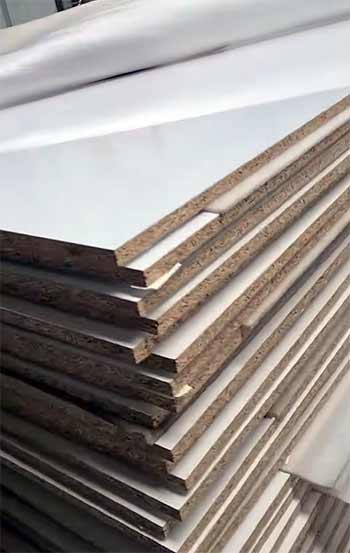
- Uniform density from edge to edge Because the particles are mixed and pressed as a homogeneous mass, every square centimeter of a chipboard sheet feels the same. When I cut a large panel for a cabinet side, the saw encounters consistent resistance and the resulting edges stay square without the soft spots or hard knots I sometimes find in solid timber.
- Factory-sanded faces ready for covering Both sides of a standard chipboard sheet leave the mill already smooth. I can apply iron-on edge banding or contact-cemented laminate with almost no additional sanding, which shortens the finishing cycle on budget kitchen runs.
- Tight thickness tolerance Manufacturing presses keep the final thickness within a narrow range. When I assemble a run of identical carcasses, the panels line up cleanly and the doors sit flush without shimming.
- Good dimensional stability indoors In a climate-controlled room the random particle orientation limits seasonal movement across the face. Shelves and cabinet sides stay flat for years as long as humidity stays moderate.
- Acceptable screw retention in the panel center Pilot holes and the right screw length allow me to fasten hardware and secondary rails with reasonable security, provided I stay at least twenty millimeters away from any edge.
- Compatibility with common woodworking adhesives PVA glue, contact cement, and polyurethane adhesives all bond well to the resin-rich surface. I rely on this when laminating two thinner sheets together for a thicker worktop core.
- Wide availability of pre-finished sheets Melamine-faced and foil-wrapped chipboard arrive already colored or patterned. For rental-property kitchens or temporary office fit-outs I simply cut and edge-band, skipping the entire finishing stage.
- Low raw-material cost Using waste chips and sawdust keeps the price per square meter well below equivalent plywood. That economy lets me stretch a tight project budget further.
- Predictable machining with sharp carbide tools A sharp circular-saw blade or router bit produces clean cuts and smooth grooves. Dull tools, however, tear the surface and leave a fuzzy edge that requires extra sanding.
- Heavy weight relative to its strength An eighteen-millimeter chipboard sheet feels noticeably heavier than a plywood sheet of the same size. I factor the extra mass into transport and wall-fixing calculations.
Also Read: Comparison of Sheetrock And Blue Board.
Pros of Chipboard
- Lower purchase price For large runs of kitchen carcasses or office storage the material cost difference is substantial. I stretch limited budgets by using chipboard for all internal panels that will never see moisture or heavy loads.
- Smooth, consistent surface for laminate The factory sanding and uniform density accept contact cement and high-pressure laminate without telegraphing defects. Melamine-faced sheets arrive ready to cut, reducing labor dramatically.
- Minimal seasonal movement indoors In heated homes and air-conditioned offices the random particle orientation keeps panels dimensionally stable. Doors and drawers continue to fit year after year.
- Easy availability in pre-finished form Colored and patterned melamine chipboard eliminates painting or staining. Rental properties and temporary installations benefit from the speed.
- Good flatness for large table tops and shelves When kept dry, full sheets stay flatter than many solid-wood alternatives, simplifying assembly of wide units.
- Acceptable performance in purely decorative applications Wall cladding, room dividers, and non-structural furniture backs work well with chipboard because strength demands are low.
- Reduced waste during cutting The absence of knots and grain defects means almost every off-cut remains usable for smaller parts.
- Compatibility with standard hardware Shelf pins, cam locks, and confirmat screws designed for particleboard perform reliably when manufacturer guidelines are followed.
Cons of Chipboard
- Poor resistance to moisture Even a short exposure to standing water causes irreversible swelling and loss of strength. Kitchens, bathrooms, and laundry rooms demand extreme care or alternative materials.
- Weak edges that crumble under fasteners Screws near the perimeter pull out easily and the particles break away. Edge banding becomes mandatory for any visible or structural edge.
- Lower bending strength Shelves sag under moderate loads and long spans require additional support or thicker panels, offsetting some of the cost advantage.
- Difficulty repairing surface damage Dents and chips cannot be sanded smooth the way solid wood or plywood can. Touch-up is limited to fillers that rarely match the original surface.
- Higher weight for comparable stiffness Transport and wall mounting become more demanding, and the finished furniture feels heavier than an equivalent plywood piece.
- Limited outdoor usefulness Even sealed chipboard deteriorates rapidly when exposed to weather cycles.
- Dust and particle release during cutting Fine dust requires good extraction; prolonged exposure without protection is unpleasant and unhealthy.
- Shorter service life in demanding conditions High-traffic commercial settings or homes with fluctuating humidity shorten the useful life compared with plywood.
Key Features of Plywood

- Cross-laminated veneer construction Alternating grain directions create a panel that resists bending in both length and width. When I span a shelf between two uprights, plywood deflects less than chipboard of equal thickness under the same book load.
- Excellent fastener holding power Screws and nails bite firmly even close to the edge. I can attach hinges, drawer slides, and hanging brackets with confidence that the joint will not loosen over time.
- Superior performance in damp conditions Exterior and marine grades use waterproof phenolic resins. Occasional spills or high bathroom humidity raise the grain slightly but rarely cause the permanent swelling I see in chipboard.
- Attractive layered edge when left exposed The striped pattern of the veneers can become part of the design. On open shelving or mid-century style cabinets I often leave the edges raw or lightly oiled rather than covering them.
- High strength-to-weight ratio A twelve-millimeter plywood panel often carries more load than an eighteen-millimeter chipboard panel while weighing less. That advantage matters when I build wall-mounted units or portable furniture.
- Ability to form gentle curves Thin plywood flexes without cracking. I use three-millimeter and six-millimeter sheets for curved cabinet doors and radius ends that would shatter if attempted with chipboard.
- Wide choice of face veneers Birch, oak, walnut, and many exotic species are available as outer layers. Matching an existing interior or creating a high-end appearance is straightforward.
- Formal structural ratings on many sheets Flooring and roofing grades carry stamped span tables. When I build loft platforms or temporary site workbenches I select rated plywood and follow the published limits.
- Resistance to warping under normal humidity cycles The balanced construction keeps panels flatter than solid timber and far more stable than chipboard once moisture enters the picture.
- Versatility in joinery methods I can screw, nail, biscuit, domino, or glue plywood with equal success. The continuous wood fibers support almost any traditional or modern connection.
Also Read: Comparison of Tongue and Groove And Beadboard.
Pros of Plywood
- High strength and stiffness Cross-laminated construction lets thinner sheets carry heavier loads with less deflection. I use twelve-millimeter plywood where eighteen-millimeter chipboard would otherwise be required.
- Reliable fastener holding Hinges, drawer slides, and wall brackets stay tight for years. Repairs and adjustments remain possible without the panel crumbling.
- Better moisture tolerance Exterior and marine grades survive occasional wetting and high humidity when properly finished. Bathrooms and covered outdoor structures become practical.
- Attractive natural appearance Face veneers and layered edges can be stained or clear-finished to highlight the wood grain. High-end furniture and visible shelving benefit directly.
- Ability to form curves Thin sheets bend into gentle radii without special equipment, opening design options closed to chipboard.
- Longer service life under stress Structural applications such as loft floors, workbenches, and load-bearing cabinets remain serviceable for decades.
- Easier surface repair Sanding removes dents and scratches; the continuous wood fibers accept fillers and touch-up stains more successfully.
- Formal engineering data available Span ratings and glue-bond classifications give clear guidance for safety-critical work.
Cons of Plywood

- Higher material cost The price per sheet can be double or triple that of comparable chipboard. Large projects feel the difference immediately.
- Possible voids in lower grades Inexpensive plywood sometimes contains internal gaps that weaken the panel or telegraph through thin face veneers. Careful selection or higher grades avoid the problem.
- Surface can telegraph core irregularities If the inner veneers are rough, the face may show slight waves after finishing. Extra sanding or a thicker face veneer is needed for mirror-smooth results.
- Edges require finishing if appearance matters Although the layered look can be attractive, many projects still need edge banding or solid-wood lipping for a refined finish.
- Weight still significant in thicker sheets While lighter than chipboard of equal strength, thick structural plywood remains heavy to handle alone.
- Quality varies widely by source Not every sheet labeled “plywood” meets the same standards. Checking grade stamps and supplier reputation is essential.
- More demanding cutting technique Cross-grain layers can cause tear-out on the underside if the blade is dull or the feed rate is wrong. Scoring cuts or zero-clearance inserts become necessary for clean results.
Practical Working Differences I Notice Daily
When I rip a full sheet on the table saw, chipboard produces a finer dust that clogs filters faster, while plywood yields larger chips that are easier to collect. Router bits last longer in plywood because the continuous fibers do not abrade the carbide as aggressively as the resin and silica in chipboard.
Edge-banding chipboard demands careful temperature control; too much heat scorches the particles, too little fails to activate the adhesive. Plywood accepts both iron-on and solid-wood edges with fewer failures.
Screw pilots in chipboard must be precise—slightly undersized holes cause splitting, oversized holes lose grip. Plywood forgives small variations in pilot diameter.
Also Read: Comparison of Hardie Board And LP SmartSide.
Frequently Asked Questions (FAQ)
It swells and loses strength when wet, holds screws poorly near edges, and sags under heavy loads more readily than plywood.
Most manufacturers and suppliers label it particleboard or particle board.
Budget indoor furniture, cabinet carcasses, and any dry application where cost matters more than maximum strength.
When the project is temporary, purely decorative, or must stay within a tight budget and will never face moisture or heavy structural loads.
Final Thoughts
I have laid out every practical difference I have observed between chipboard and plywood so you can weigh cost against performance for your own work.
You now know which panel stays flat, which holds screws, which survives a spill, and which keeps the budget intact.
Choose chipboard when the job is dry, hidden, and short-term; choose plywood when strength, longevity, or moisture resistance matter. The right decision saves both money and frustration on the next build.