
I’ve spent months testing cordless air dusters to replace those wasteful canned air options, and the Wolfbox MF50 versus MF100 matchup stood out as the one most people ask about.
My goal here is to give you a clear, no-nonsense breakdown so you can decide which model actually fits your cleaning routine, whether that’s weekly keyboard touch-ups, deep PC builds, car detailing, or occasional outdoor jobs.
| Feature | Wolfbox MF50 | Wolfbox MF100 | Edge Goes To |
| Max Motor Speed | 110,000 RPM | 150,000 RPM | MF100 |
| Max Wind Speed | Around 35 m/s | 45 m/s | MF100 |
| Battery Capacity | 5000 mAh | 6000 mAh | MF100 |
| Weight | 0.45 lb (205 g) | 0.66 lb (300 g) | MF50 |
| Nozzles & Accessories | 4 nozzles | 5 nozzles + 2 brushes + inflation tip | MF100 |
| Runtime on Low | Up to 240 minutes | Up to 100 minutes | MF50 |
| Runtime on High | 15-19 minutes | 10-16 minutes | MF50 (slight) |
| Charging Time | About 3.5 hours | About 2.5 hours | MF100 |
| Airflow (approx) | 50 CFM | 70 CFM | MF100 |
| Approx. Price | $40-55 | $72-80 | MF50 |
| Best For | Everyday light to medium dusting | Heavy buildup, versatility, inflation | Depends on needs |
Key Differences Between The Wolfbox MF50 And MF100
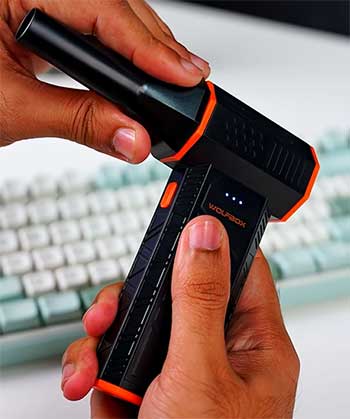
- Power delivery feels noticeably different in real sessions. The MF100 spins its brushless motor up to 150,000 RPM and pushes air at 45 m/s, so it moves stubborn dust and debris faster with less back-and-forth motion from you. On my dusty PC tower after a few months of no cleaning, the MF100 cleared vents and fans in under a minute where the MF50 needed a bit more angle work and time to get the same result.
- Battery size gives the MF100 a small capacity advantage, yet real-world runtime tells another story because the stronger motor draws more power. On the lowest setting the MF50 easily hits four hours of continuous use, perfect when you have a long list of keyboards and laptops to freshen up in one go. The MF100 tops out around 100 minutes on low before you reach for the cable, which matters if you clean away from outlets often.
- Accessory kits change how versatile each tool feels day to day. The MF50 comes with four solid nozzles that cover most electronics and car interior jobs. The MF100 adds a fifth nozzle specifically shaped for inflating air mattresses, pool floats, and similar gear plus two brushes that help loosen packed dust before blowing it away. If you ever camp or deal with inflatables, that single extra piece on the MF100 removes the need for a separate pump.
- Weight and balance affect how your hand feels after twenty minutes of use. At just 0.45 pounds the MF50 stays light and nimble for overhead work like ceiling vents or car headliners. The MF100 at 0.66 pounds carries a bit more mass, which actually helps dampen vibration on high power but can tire you faster during extended sessions. Both sit flat on their bases so you can set them down without tipping.
- Charging speed favors the MF100 when you need to get back to work quickly. A full top-up takes roughly 2.5 hours compared with 3.5 hours on the MF50. Both support USB-C from power banks, laptops, car ports, or wall adapters, so neither leaves you stranded, yet the faster cycle on the bigger model matters during back-to-back projects.
- Airflow volume and reach separate the two for tougher jobs. The MF100 moves about 70 CFM, giving it longer effective reach and better ability to push dust out of deep crevices or across wider surfaces like car dashboards. The MF50’s roughly 50 CFM still handles keyboards, camera bodies, and light workshop dust without issue, but you sometimes need to work closer or use shorter bursts.
- Noise and vibration profiles surprised me during side-by-side tests. The MF100 delivers more force so it can feel punchier in your hand, yet the overall tone stays manageable with a firm grip. The MF50 runs a touch quieter on medium settings and produces less hand buzz, which makes it nicer for late-night PC cleaning when others are sleeping nearby.
- Build and safety features stay consistent across both. Each uses a brushless motor with overheat protection and an intelligent standby mode that powers down after inactivity. The flat-bottom design lets either unit stand upright between tasks, and the included lanyard keeps the tool handy around your wrist during ladder work or car detailing.
- Price-to-performance math comes down to how often you clean and how demanding the jobs are. The MF50 delivers 80-90 percent of the cleaning punch at roughly half the cost, making it the smarter buy for most households and hobbyists. The MF100 justifies its higher price only when you regularly face heavy dust, need the inflation function, or simply want the strongest blast available in this compact size.
- Long-term value and reusability line up similarly. Both models are built to last hundreds of cycles as a true alternative to disposable air cans. You will save money and cut waste either way, though the MF50’s lower upfront cost and longer low-power runtime stretch your dollar further on routine maintenance.
Performance I Saw in Daily Tasks
I ran both units through the same jobs on the same days to keep conditions fair. Keyboard cleaning with crumbs and pet hair went fast on either model, but the MF50’s lighter weight let me work longer without switching hands.
For a grimy car interior after a muddy camping trip, the MF100’s extra reach and stronger push cleared floor mats and vents with fewer passes.
PC case maintenance showed the clearest gap: the MF100 knocked out months of fine dust from radiators and fan blades quicker, while the MF50 still got the job done if I took an extra minute and used the right nozzle angle.
Outdoor use around the garage and mower deck highlighted the MF50’s endurance advantage. I could finish blowing off an entire workbench and tools on one low-to-medium charge without hunting for a power source.
The MF100 shone when I needed to clear thick sawdust from a table saw; its higher output moved the heavier particles without me having to get right on top of the mess.
Pros of the Wolfbox MF50
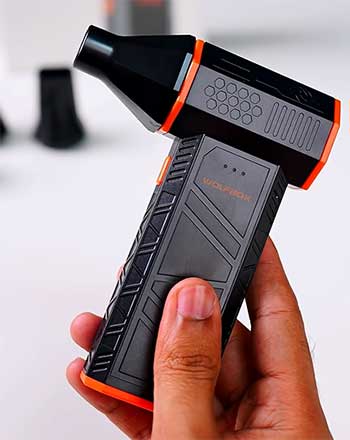
- Lower purchase price opens the door for anyone tired of buying canned air every few weeks. At roughly half the cost of the MF100 you can own a capable cordless duster without stretching the budget, and the money saved adds up fast when you factor in years of reusable use.
- Exceptional low-speed runtime means you can tackle multiple devices or an entire car interior on a single charge. I regularly cleaned three keyboards plus a laptop and still had battery left, something the MF100 cannot match on its lowest setting.
- Lighter overall weight reduces fatigue during longer sessions or when working overhead. After twenty minutes of detail work on car headliners or ceiling fixtures my hand felt fresher with the MF50 than with the heavier sibling.
- Quieter operation on medium settings makes it more neighbor-friendly for apartment use or late-night tech cleaning. The lower power draw translates to less motor whine, so you can focus without the constant high-pitched reminder that a tool is running.
- Four well-chosen nozzles cover the vast majority of everyday jobs from tight electronics gaps to wider surface dusting. You rarely feel limited unless you specifically need an inflation function or brush attachments.
- Strong value retention because the performance gap only shows up on the heaviest tasks. For most people the MF50 delivers everything they need at a price that feels like a no-brainer.
- Faster to maneuver in tight spaces thanks to the compact size and lower mass. I found it easier to snake around cables inside a PC case or reach behind car pedals without bumping into surrounding parts.
- Lower power draw on high still gives respectable 15-19 minute bursts, enough for quick deep cleans without draining the battery completely before you finish.
- Excellent build quality at the price point with the same safety protections and flat-stand design as the more expensive model. You do not sacrifice durability or basic usability to save money.
- Great entry point into cordless air dusting that still outperforms most cheaper no-name units on the market. Once you experience the convenience you will wonder why you ever used canned air.
Cons of the Wolfbox MF50
- Lower peak power means extra time and passes on heavy or packed dust. Thick workshop grime or months-old PC radiator buildup requires more deliberate technique and sometimes a second go-over compared with the MF100.
- Fewer included accessories limit versatility if your needs expand later. Without the dedicated inflation nozzle or brushes you may eventually want to buy add-ons or keep a separate tool for those specific jobs.
- Slightly longer charging time can interrupt workflow if you forget to plug it in overnight. The 3.5-hour cycle is not terrible, yet it feels slower when you compare it directly to the MF100’s quicker turnaround.
- Less effective reach on high speed for wide or deep surfaces. You sometimes need to position the nozzle closer or use shorter angled bursts to move debris the same distance the MF100 achieves in one steady pass.
- Battery life advantage shrinks dramatically once you move to medium or high settings. For demanding jobs the runtime edge over the MF100 narrows, so the lighter model does not always win on endurance when power matters most.
Also Read: Are Costco Window Shades Worth It?
Pros of the Wolfbox MF100
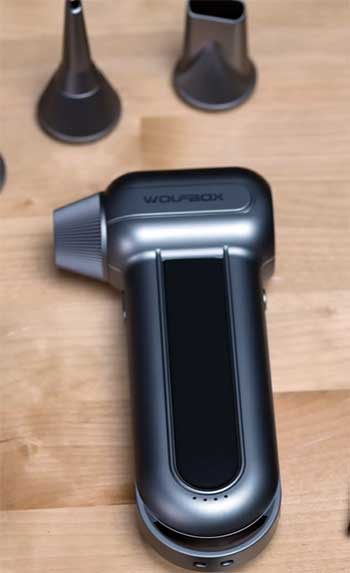
- Higher RPM and airflow deliver faster, more thorough cleaning on stubborn messes. Heavy dust, pet hair embedded in car carpets, or fine particles in PC cooling fins clear with noticeably less effort and fewer repeated strokes.
- Extra nozzles plus two brushes and the inflation tip expand what one tool can handle. I used the brush attachments to loosen baked-on dust before blowing and the inflation nozzle to top up an air mattress during a weekend trip without carrying extra gear.
- Faster full charge gets you back in action sooner after heavy use. The 2.5-hour cycle means you can top up during a lunch break and still have plenty of power for evening projects.
- Stronger sustained output on high speed maintains cleaning momentum without the motor feeling like it is laboring. This matters when you have multiple large jobs back to back.
- Slightly larger battery capacity provides a safety margin even though high-power runtime stays similar. You finish jobs with a bit more reserve before the low-battery indicator appears.
- Better performance-to-size ratio for users who want maximum power without stepping up to bulkier shop-style blowers. It still fits in a glovebox or tool bag yet outperforms many larger competitors on focused tasks.
- Future-proofing if your cleaning demands grow. Starting with the MF100 means you already own the stronger unit and the extra attachments, so you avoid upgrading later.
- Solid build that handles the extra power without feeling cheap or fragile. The added mass actually helps control the stronger airflow, reducing the chance of accidental over-blowing delicate components.
- Good choice for mixed-use households where one person cleans electronics lightly and another tackles car or outdoor jobs. The versatility reduces the need for multiple specialized tools.
- Strong long-term savings once you factor in time saved and the ability to handle more job types without buying additional equipment or canned air refills.
Cons of the Wolfbox MF100
- Higher upfront cost can feel steep if your cleaning needs stay light and occasional. Many users end up paying extra for power they rarely tap into on a daily basis.
- Heavier weight leads to quicker hand fatigue during extended detail work or overhead cleaning. After a full car interior session I noticed more wrist tiredness compared with switching to the MF50 for the same tasks.
- Shorter runtime on low power limits how many devices or large surfaces you can finish before recharging. The 100-minute ceiling on the gentlest setting means planning around power access for big projects.
- Stronger kick and vibration require a firmer grip, especially on the highest setting. New users sometimes need a short adjustment period before the tool feels completely natural in hand.
- Overkill for simple keyboard or laptop dusting where the extra power does not translate into meaningful time savings. You pay for capability that stays unused in lighter routines.
- Slightly higher noise on maximum output can draw attention in quiet environments. While still far quieter than a shop compressor, the MF100’s stronger motor produces more sound than the MF50 when both run wide open.
Who Should Buy Which Model?

If your routine involves mostly keyboards, laptops, occasional PC dusting, and light car touch-ups, the MF50 gives you 90 percent of the benefit at half the price and with longer battery life for marathon sessions.
You will appreciate the lighter feel and lower cost without missing much performance.
Choose the MF100 when you regularly face heavier dust, want the ability to inflate gear on the go, or simply prefer having the strongest compact option available.
The extra accessories and faster charging make it the more complete package for frequent or varied use, and the power difference becomes obvious the moment you tackle a truly dirty job.
Both models beat canned air on cost, convenience, and environmental impact.
The real decision comes down to how much power and versatility you actually need versus how much you want to spend upfront.
Also Read: Comparison of Vinyl Blinds And Faux Wood Blinds.
Frequently Asked Questions (FAQ)
Yes for most people. It delivers strong everyday performance, long low-speed runtime, and excellent value that quickly pays for itself by replacing canned air.
It is the more powerful and versatile choice, but “best” depends on your tasks. If you need maximum blast and extra nozzles it wins; otherwise the MF50 offers better everyday balance.
The MF100 runs at higher RPM with stronger airflow, includes more nozzles and brushes plus an inflation tip, charges faster, and weighs a bit more. The MF50 lasts longer on low power and costs less.
It reaches 110,000 RPM with effective wind speeds around 35 m/s on high, fast enough to clear keyboards, electronics, and light car dust in seconds per pass.
Wrapping Up
After putting both the Wolfbox MF50 and MF100 through real daily use on PCs, keyboards, car interiors, and garage jobs, the choice comes down to what you actually need.
The MF50 gives you strong everyday performance, lighter handling, and much longer runtime on low power at a friendlier price. The MF100 brings noticeably stronger airflow, more accessories including an inflation nozzle, and faster charging when you want maximum power and versatility.
You should go with the MF50 if most of your cleaning stays light to medium and you value battery endurance plus value. Pick the MF100 if you regularly tackle heavier dust or want one tool that handles more job types without compromise.
Either way, both beat canned air on cost, convenience, and waste, so you will end up with a reusable cleaner that actually lasts.