
If you’re serious about upgrading your laundry game, stop scrolling and pay attention — the LG ThinQ washer might just be the smartest investment you make for your home this year.
I’ve spent considerable time with this machine, and I’m here to give you the full, unfiltered picture so you can walk into that purchase with complete confidence.
My Experience With The LG ThinQ Washer
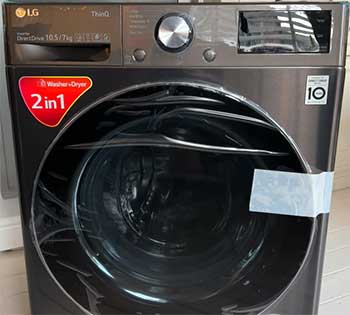
Let me paint you a picture.
I was done with my old top-loader — it shook the entire house during the spin cycle, ate through electricity like a teenager eats pizza, and had absolutely zero smart features.
When I finally pulled the trigger on the LG ThinQ washer, I genuinely didn’t know what to expect beyond the marketing fluff.
The first thing that hit me was the setup process. Pairing the washer with the LG ThinQ app took me under ten minutes. Seriously.
You download the app, follow the on-screen prompts, and your phone basically becomes the control panel for your entire laundry setup. That alone felt like a leap into the future.
I started with a regular mixed load — jeans, t-shirts, a couple of towels — using the AI DD (Direct Drive) feature. What this technology does is detect the weight and fabric softness of your load before selecting the optimal wash motion.
And here’s what surprised me: my clothes actually came out better. The colors on my darker shirts stayed richer, and my towels felt fluffier without any fabric softener.
The steam function was another moment where I genuinely said “okay, this thing is different.” I had a dress shirt that had been sitting in the laundry basket for a week, wrinkled beyond what I thought an iron could fix.
Twenty minutes on the steam cycle, and it came out looking like it had just been professionally pressed. That’s not an exaggeration — I wore it to a meeting the same day.
Remote start became part of my daily routine faster than I expected. I’d toss a load in before leaving for work, set the delayed start through the app, and by the time I got home, the laundry was fresh and waiting.
No more forgetting wet clothes sitting in the drum all afternoon.
The quiet operation also genuinely impressed me. My laundry room shares a wall with my home office, and during video calls, I could run a full cycle without anyone on the other end knowing.
The TrueBalance Anti-Vibration system actually works — it’s not just a marketing claim.
Where I did notice limitations was with heavily soiled loads. The machine sometimes needed a second pass, and the cycle times on the more thorough settings ran long — sometimes over two hours.
If you’re in a rush household, you’ll need to plan around that.
Overall, after several months of daily use, my electricity bills dropped noticeably, my clothes have held up better, and the convenience factor has genuinely changed how I approach laundry. It stopped being a chore I dreaded and became something I barely had to think about.
Also Read: Is Tide Washing Machine Cleaner Worth It?
The Pros of The LG ThinQ Washer
Getting into what makes this machine genuinely shine, there’s a lot to unpack here. This isn’t a machine where the pros list reads like a manufacturer’s brochure — these are benefits you’ll feel every single week.
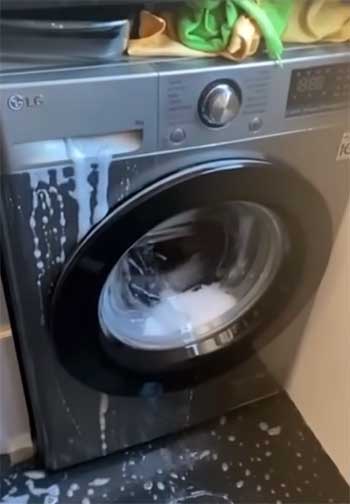
- Smart Connectivity That Actually Makes Sense: The LG ThinQ app isn’t just a gimmick. You get real-time notifications when your cycle finishes, the ability to start or pause a cycle remotely, and access to a library of wash cycles that go way beyond what the physical dial offers. The app even sends you maintenance reminders so you’re never caught off guard by a funky smell or a clogged filter.
- AI DD Technology Protects Your Clothes: The Artificial Intelligence Direct Drive system analyzes load weight and fabric texture, then customizes the wash motion accordingly. What this means for you practically is less wear and tear on your clothes over time. Delicates stay delicate. Workout gear comes out actually clean without getting stretched.
- Steam Technology Eliminates Allergens: The TurboWash 360 with steam doesn’t just clean — it sanitizes. Independent testing has shown that steam cycles eliminate up to 99.9% of bacteria and reduce common allergens significantly. If you have kids, pets, or anyone in the house with sensitivities, this feature alone justifies serious consideration.
- Impressive Energy Efficiency: LG ThinQ washers carry Energy Star certification, and you’ll see it reflected in your utility bills. The direct drive motor, which also comes with a 10-year manufacturer’s warranty, uses significantly less electricity compared to traditional agitator-based machines.
- TurboWash Technology Saves Real Time: The TurboWash feature can cut full cycle times by up to 30 minutes without compromising clean quality. For a busy household running multiple loads on weekends, that time saving is tangible.
- Whisper-Quiet Operation: With noise levels as low as 49 decibels during washing, this machine is among the quietest in its class. You can run it at night without disturbing anyone, which is a genuine lifestyle upgrade.
The Cons of The LG ThinQ Washer
No honest review skips the downsides, and I’m not going to sugarcoat them for you.
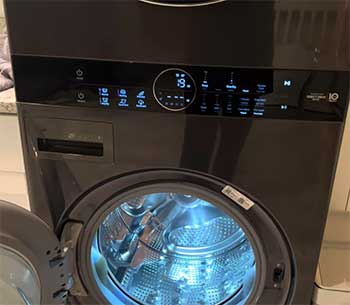
- Higher Upfront Cost: LG ThinQ washers typically start around $900 and can push past $1,400 for premium configurations. That’s a significant investment compared to budget alternatives. You’re paying for longevity and features, but the sticker price is real.
- Long Cycle Times On Intensive Settings: The deep clean and sanitize cycles can run over two hours. If you’ve got a large family pushing through laundry all weekend, you’ll need to be strategic about sequencing your loads.
- App Dependency Can Be Frustrating: If your Wi-Fi goes down or you’re dealing with a software glitch, some of the smart features become inaccessible. The machine still works manually, but you lose a chunk of what you paid for in those moments.
- Repair Costs Can Be High: Because the technology is sophisticated, professional repairs outside of warranty can be expensive. Not every local appliance technician is fully trained on LG’s direct drive system either, which can mean longer wait times for service.
Maintenance Tips For Your LG ThinQ Washer
Taking care of this machine properly is what separates owners who love it for a decade from those who start having problems by year three. Here’s what you need to stay on top of.
- Clean The Drum Monthly Without Fail: Run the Tub Clean cycle every 30 days. The machine will actually remind you via the app if you’ve got notifications enabled. Use LG’s recommended cleaning tablets or a cup of white vinegar with the drum empty. Skipping this allows mold and mildew to build up, which is the number one cause of that musty laundry smell people complain about.
- Wipe The Door Gasket After Every Wash: The rubber door seal on front-load washers traps moisture, hair, and detergent residue. After each cycle, take thirty seconds to wipe it down with a dry cloth. Leave the door slightly open between uses so air can circulate inside the drum.
- Use Only HE Detergent And Use Less Than You Think: High-Efficiency washers require HE-formulated detergent. Using regular detergent creates excessive suds that can actually reduce cleaning performance and trigger error codes. Even with HE detergent, most people use too much — check the dosing guide on your detergent packaging and then use a touch less than recommended.
- Check And Clean The Drain Pump Filter Every Three Months: This one surprises most people because they didn’t even know the filter existed. Located at the bottom front of the machine behind a small panel, this filter catches coins, lint, and debris. If it gets clogged, you’ll see drainage issues and error codes. Cleaning it takes about ten minutes and prevents a lot of headaches.
- Inspect Hoses Annually: Check the water inlet hoses at the back of the machine once a year for cracks, bulging, or mineral buildup. Replace them every five years as a preventative measure. A burst hose can cause serious water damage, and it’s a simple, inexpensive thing to stay ahead of.
- Level The Machine Properly From The Start: If your washer isn’t perfectly level, the TrueBalance system can’t do its job properly, and you’ll get more vibration and noise than the machine should be producing. Use a bubble level and adjust the feet until the machine sits perfectly flat.
How The LG ThinQ Compares To Other Brands?
- Speed Queen TR7
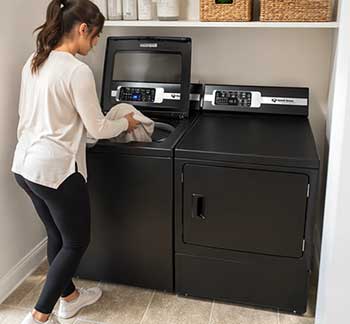
Speed Queen has been building washers for commercial laundromats for decades, and that industrial DNA runs straight through the TR7.
This machine is built like a tank — literally.
The TR7 uses a stainless steel wash basket, a robust mechanical transmission, and components engineered to handle punishment that would break a residential machine in half.
The 7-year warranty isn’t just a marketing number; it reflects genuine confidence in the hardware.
Where things get interesting is when you put the Speed Queen TR7 next to the LG ThinQ in a real-world household context. The TR7 has no smart connectivity, no app integration, no steam function, and no AI-powered cycle customization.
What it does have is an agitator-based wash action that some users swear by for getting heavily soiled work clothes genuinely clean. If you’re a tradesperson, a parent of young kids who play in mud, or someone who just wants a machine that runs the same way for fifteen years without you thinking about it, Speed Queen makes a compelling argument.
But here’s where LG ThinQ separates itself. The energy consumption gap between the two is meaningful over time. Speed Queen TR7 uses significantly more water and electricity per cycle compared to LG’s front-load direct drive models.
Over five years of regular use, that difference in utility costs can offset a significant portion of LG’s higher purchase price. Add in the fabric care advantage — LG’s AI DD technology genuinely reduces wear on clothing — and the ThinQ makes more financial sense for households focused on long-term value rather than just upfront simplicity.
The Speed Queen wins on repairability and brute toughness. LG wins on intelligence, efficiency, and clothing protection.
- Asko Washer And Dryer
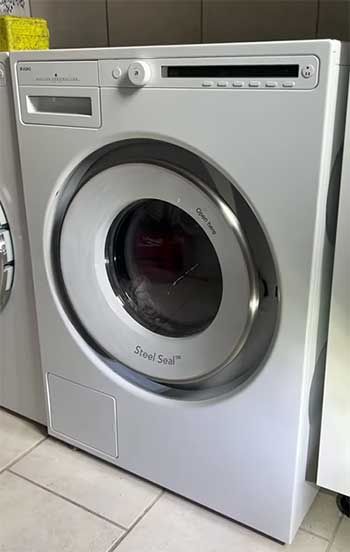
Asko is a brand that doesn’t get enough conversation in North American appliance discussions, and that’s genuinely a shame because these Scandinavian machines are remarkable pieces of engineering.
Built in Sweden with an emphasis on precision manufacturing, Asko washers operate with a quietness and mechanical smoothness that feels different from most American or Asian-manufactured alternatives.
The spin speeds on Asko models are among the highest available in residential machines, which means clothes come out of the wash noticeably drier — reducing dryer time and further cutting your energy costs.
Asko’s build quality is exceptional.
The drum capacity, the door hinge quality, the control panel responsiveness — everything about an Asko washer communicates that it was designed to last twenty years with proper maintenance.
For buyers who prioritize European craftsmanship and are willing to pay a premium for it, Asko absolutely delivers.
So where does LG ThinQ have the edge? A few places, and they matter depending on your lifestyle. First, smart home integration. LG’s ThinQ ecosystem connects not just your washer but your dryer, refrigerator, air conditioner, and other compatible appliances into a single unified app experience.
Asko’s smart features, while present in newer models, don’t offer the same depth of ecosystem connectivity or the AI-driven cycle optimization that LG has developed over years of machine learning refinement.
Second, and this is practical rather than technical — parts availability and service network. If your Asko develops an issue outside of warranty in a mid-sized American city, finding a certified technician who stocks the right parts can be genuinely frustrating.
LG’s service infrastructure in North America is significantly more developed, meaning faster repairs and lower service call costs. For most buyers, LG ThinQ offers a better balance of premium performance and real-world ownership practicality.
- Roper Washing Machine
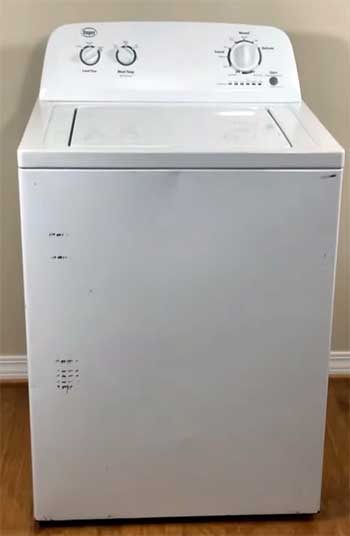
Roper is Whirlpool’s value-focused sub-brand, and it occupies a very specific space in the market — straightforward, no-nonsense washing at a price point that makes appliance ownership accessible for households on tighter budgets.
Roper machines use traditional top-load agitator designs, which are simple to repair, easy to understand, and generally reliable for basic laundry needs.
If all you need is a machine that gets clothes wet, agitates them clean, and spins them out, a Roper gets the job done without asking you to think too hard about it.
But let’s be real about the gap here. Comparing a Roper washing machine to an LG ThinQ is like comparing a rotary phone to a smartphone.
The Roper has no energy efficiency certification to speak of in most models, no steam capability, no smart connectivity, and a wash action that is fundamentally rougher on fabrics than LG’s direct drive system.
Over time, that rougher wash action shows up in your wardrobe — colors fade faster, fabrics pill earlier, and delicate items simply don’t survive as well.
Where this comparison becomes most useful is for buyers who are genuinely weighing cost versus capability. A Roper machine might run you $400 to $600 fully installed. An LG ThinQ starts closer to $900.
That $300 to $500 gap is real money. But when you factor in lower electricity and water bills with the LG, reduced clothing replacement costs over five years, and the convenience value of smart features, the math often tips toward LG being the better total-cost investment.
Roper makes sense for rental properties, guest homes, or households that genuinely don’t need anything beyond basic function. For a primary household washer that you’ll use daily for the next decade, LG ThinQ is in a completely different league.
- Midea Washing Machine
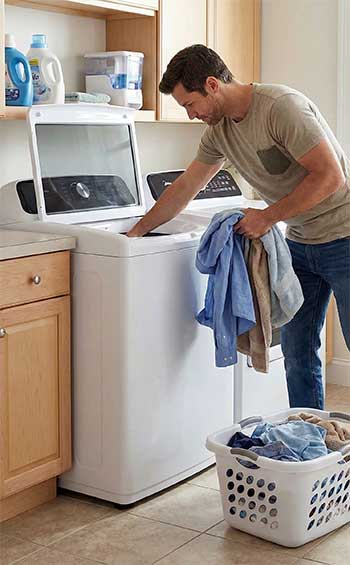
Midea is one of the most fascinating stories in the global appliance industry right now.
This Chinese manufacturer has quietly become one of the largest appliance producers in the world, and its North American push has been aggressive, strategic, and increasingly effective.
Midea washers have improved dramatically in the past few years — newer models offer front-load designs, decent energy efficiency ratings, smartphone connectivity, and cycle variety that would have seemed impossible at their price points just five years ago.
For budget-conscious buyers who want smart features without paying LG prices, Midea has become a genuinely interesting option.
Some Midea front-loaders now come with app connectivity, multiple wash programs, and steam functions that mirror LG’s feature list on paper.
If you’re comparing spec sheets, the gap can look surprisingly narrow.
Here’s where reality diverges from the spec sheet though. LG has been refining its direct drive motor technology, TurboWash system, and AI DD algorithms for years — and that depth of development shows in real-world performance.
The wash results are more consistent across different load types. The app experience is more polished and more reliable. The long-term reliability data, gathered from millions of machines in households worldwide, supports LG’s quality claims in a way that Midea simply hasn’t had enough time or market presence to match yet.
There’s also the ecosystem consideration. LG’s ThinQ platform connects to a genuinely broad range of smart home devices and supports more third-party integrations. Midea’s smart platform, while functional, is still maturing in North American market conditions.
If you’re building a connected home and you want your washer to communicate meaningfully with other smart appliances, LG ThinQ is the more capable foundation. Midea is a brand to watch — and in two or three years, this comparison might be closer.
But right now, for primary household use where you want proven performance and a developed support network, LG ThinQ remains the stronger investment.
Frequently Asked Questions (FAQ)
Yes — it’s one of the top-performing washers in its class, offering strong cleaning results, smart connectivity, and excellent energy efficiency that justifies the price for most households.
The most commonly reported issue is the UE error code, which indicates an unbalanced load during the spin cycle. This is usually resolved by redistributing clothes more evenly inside the drum.
Absolutely, especially if you value remote control, real-time notifications, and access to AI-powered wash cycles. The app genuinely adds convenience to daily laundry routines.
Speed Queen consistently ranks among the most reliable brands based on repair frequency data, though LG also performs well above the industry average in long-term reliability surveys.
Wrapping Up
The LG ThinQ washer isn’t a perfect machine, but it’s one of the most thoughtfully engineered washers you can buy right now. If you want smart home integration, fabric protection, energy savings, and whisper-quiet operation wrapped in one appliance, this is where your money should go.
Head to LG’s official site or a trusted appliance retailer and see which configuration fits your household — you won’t regret making the switch.