
I’ve spent a lot of time in professional-grade kitchens, standing in front of high-end rangetops and asking myself the same question you’re probably asking right now: Wolf or Thermador?
Both brands carry legendary reputations, both cost more than most people’s first car, and both will make your kitchen look like it belongs in a Michelin-starred restaurant.
In this article, I’m breaking down every meaningful difference between these two powerhouse rangetops — performance, design, heat output, usability, and long-term value — so you can walk into that showroom (or click “add to cart”) with genuine confidence.
| Feature | Wolf Rangetop | Thermador Rangetop |
| Brand Parent | Sub-Zero Group | BSH Home Appliances (Bosch) |
| BTU Output (Max) | Up to 20,000 BTU | Up to 22,000 BTU (ExtraLow® burners) |
| Simmer Capability | Dual-stacked burners (simmer to full flame) | ExtraLow® (as low as 100°F) |
| Burner Configuration | 4, 6, or specialty options | 4 or 6 burner options |
| Signature Feature | Dual-stacked sealed burners | Star-shaped burners |
| Griddle Option | Yes (infrared) | Yes (gas) |
| Ignition System | Dual-stacked sealed burner ignition | Auto re-ignition |
| Surface Material | Porcelain drip trays, stainless grates | Continuous grates, stainless |
| Available Widths | 30″, 36″, 48″, 60″ | 30″, 36″, 48″ |
| Price Range | $3,000 – $10,000+ | $3,500 – $9,500+ |
| Warranty | 2-year full, lifetime on certain parts | 2-year full |
| Country of Manufacture | USA (Madison, WI) | USA & International |
| Self-Clean | N/A (rangetop only) | N/A (rangetop only) |
| Color Options | Stainless, Red (specialty) | Stainless |
| Resale Value | Exceptionally high | High |
Key Differences Between Wolf And Thermador Rangetops
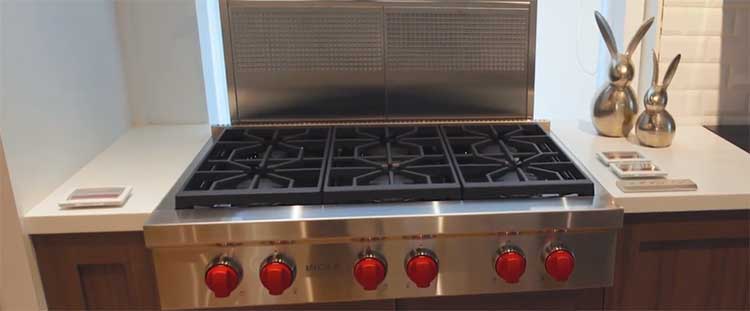
This is where I want to slow down and really spell out the distinctions that matter most when you’re standing at a decision point between these two brands.
- Burner Technology
Wolf uses dual-stacked sealed burners — two concentric rings of flame in a single unit — giving you a wide BTU range from a single burner position without compromise.
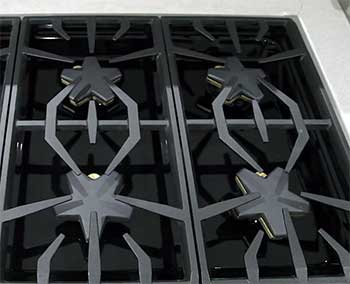
Thermador counters with its patented star-shaped burner, a five-point flame pattern that prioritizes even heat coverage across the base of your cookware.
Wolf’s approach favors cooks who transition frequently between delicate and aggressive heat within a single dish.
Thermador’s approach favors cooks who run multiple pots simultaneously and want consistent, even performance across all of them.
- Simmer Performance
Wolf’s simmer floor sits at 300 BTU — extremely low and genuinely useful for delicate preparations like chocolate ganache or beurre blanc.
Thermador’s ExtraLow® technology goes even further, reaching as low as 100°F, which represents the best simmer capability currently available in residential cooking.
Thermador wins on absolute minimum temperature, but the caveat is real: ExtraLow® is not available on every burner across every Thermador model. Wolf wins on consistency — dual-stack capability comes standard on every single burner, every single model.
- High-Heat Output
Wolf maxes out at 20,000 BTU per burner, which is more than sufficient for virtually any home cooking scenario you can name. Thermador pushes to 22,000 BTU on its power burners, giving it a marginal advantage for the most aggressive high-heat applications — rapid boiling, wok cooking, large-batch searing.
For most home cooks, this 2,000 BTU gap is largely academic. You’ll rarely push either brand to its absolute ceiling, but if you cook at extremes regularly, that headroom matters.
- Griddle Performance
Wolf’s infrared griddle is technically the stronger performer.
Infrared technology eliminates hot spots more effectively than conventional gas, delivering flat, even, predictable surface temperatures across the entire griddle area.
Thermador’s gas griddle is more familiar to cooks transitioning from conventional equipment — it responds faster to temperature changes and behaves more like what most people are used to.
If griddle cooking is a major part of your routine, Wolf’s infrared solution wins on consistency. If you prefer intuitive, responsive heat control, Thermador’s gas griddle is easier to dial in quickly.
- Configuration and Width Options
Wolf goes up to 60 inches wide and offers specialty configurations — French tops, wok burners, custom burner layouts — that Thermador simply doesn’t match. Thermador maxes out at 48 inches but covers the most common residential configurations thoroughly and without compromise.
For large custom kitchen builds where surface area is a genuine priority, Wolf is the only real choice. For most kitchen renovations, Thermador’s range of configurations is more than adequate.
- Design and Aesthetics
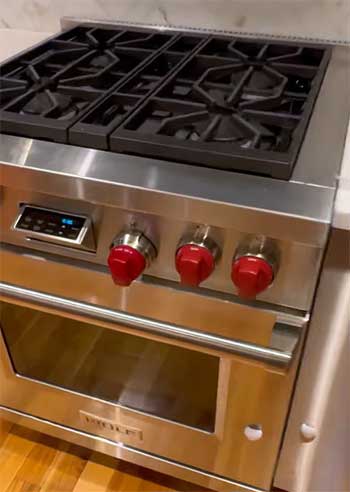
Wolf’s red knobs are one of the most recognizable design signatures in the luxury appliance world. They announce the brand from across the room and function as a design statement as much as a control mechanism.
Thermador’s star burners are visually distinctive up close — the five-point geometry is elegant and purposeful — but they don’t carry the same across-the-room brand presence. Wolf’s aesthetic is bolder and more assertive.
Thermador’s is cleaner, more restrained, and arguably more versatile in kitchen design contexts where you don’t want the appliance to dominate.
- Value and Pricing
Both brands occupy a similar price tier for comparable configurations — expect $3,000 to $10,000 or more depending on size and features. Where Thermador pulls ahead on value is through its bundled appliance promotions: free dishwashers and multi-appliance package deals can meaningfully reduce the net cost of a full kitchen renovation.
Wolf carries slightly stronger resale brand equity, which matters in luxury real estate markets where appliance brands are part of the home’s selling story.
Key Features of The Wolf Rangetop
- Dual-stacked sealed burners — This is Wolf’s signature technology. Each burner has two rings of flame: an outer ring for high-heat cooking and an inner ring for precise, controlled low-heat simmering. The result is extraordinary versatility from a single burner without ever having to swap out components or accessories.
- BTU range of 300 to 20,000 — Wolf’s burners span an impressive range. That 300 BTU floor is genuinely useful — you can melt chocolate, hold a beurre blanc, or keep a delicate sauce warm without scorching it. The 20,000 BTU ceiling gives you a serious, rolling boil on a stock pot in minutes.
- Infrared griddle option — Wolf’s infrared griddle (available on 36″, 48″, and 60″ models) heats incredibly evenly and gets ripping hot fast. If you do a lot of smash burgers, pancakes, or searing, this is a game-changer.
- Robust grates — Wolf grates are heavy, continuous, and designed to move pots across the surface smoothly without lifting. They’re coated to resist staining and hold up to serious daily use.
- Iconic red knobs — It might sound cosmetic, but the red control knobs are an industry landmark. They’re also dual-function: pull to activate the flame, then turn to adjust. This two-step safety mechanism prevents accidental ignition.
- Built in the USA — Wolf rangetops are manufactured in Wisconsin. For buyers who care about domestic manufacturing and quality control, this is a meaningful differentiator.
- Available in widths up to 60″ — Wolf offers more configuration options than most competitors, including specialty burner layouts that incorporate French tops and wok burners.
- Exceptional resale and home value impact — Real estate agents consistently report that Wolf appliances in a home increase buyer interest and sale price. The brand carries that kind of weight.
- Certified service network — Wolf has a robust authorized service network across the United States, which matters when something eventually needs attention on a $6,000 appliance.
Also Read: Is IKTCH Range Hood Worth It?
Wolf Rangetop Pros
- Dual-stacked burners are genuinely unmatched for cooking flexibility — you get precision simmering and aggressive high heat from the same unit without compromise or add-ons.
- American manufacturing means tighter quality control, easier parts sourcing, and a brand that stands behind its product with real domestic accountability.
- Best-in-class simmer performance — The ability to drop to 300 BTU on a burner that also hits 20,000 is something you feel every single time you cook. Other brands simulate low heat; Wolf actually delivers it.
- Wider model selection — Going up to 60″ wide with French top and wok burner options makes Wolf the most configurable choice for serious kitchen builds.
- Iconic design aesthetic — The red knobs, the heavy stainless construction, the clean lines — Wolf looks unmistakably premium and holds that appearance for years.
- Strong brand equity — Wolf consistently ranks at or near the top of luxury appliance brand perception studies. That matters for your home’s resale value.
- Infrared griddle performance — Wolf’s infrared griddle heats more evenly and holds temperature more consistently than conventional gas griddles found in competing brands.
- Excellent customer service — The Sub-Zero Group is known for standing behind its products. Extended service programs and authorized technician networks are widely available.
Wolf Rangetop Cons
- Price premium is real — Wolf rangetops consistently sit at the higher end of the luxury market. A fully spec’d 48″ Wolf rangetop with griddle can push well past $8,000. You’re paying for the name as much as the technology.
- Limited color options — Beyond stainless steel and the specialty red models, Wolf doesn’t offer much in terms of color variation. If you want a statement kitchen in a non-traditional palette, Wolf won’t cooperate.
- Heavier than competitors — Wolf’s build quality is a feature, but it’s also a logistical challenge. Installation often requires reinforced cabinetry and professional handling.
- No self-cleaning elements — As a rangetop (not a range), there’s no oven component, so self-cleaning isn’t applicable — but the burner grates and drip trays do require manual cleaning, which takes effort given their size.
- Learning curve on dual-stack burners — New users sometimes find the pull-and-turn knob system counterintuitive. It’s not complicated, but it requires a brief adjustment period.
- Service availability varies regionally — While the authorized service network is solid in major metros, buyers in rural areas sometimes face longer wait times for certified Wolf technicians.
Key Features of The Thermador Rangetop
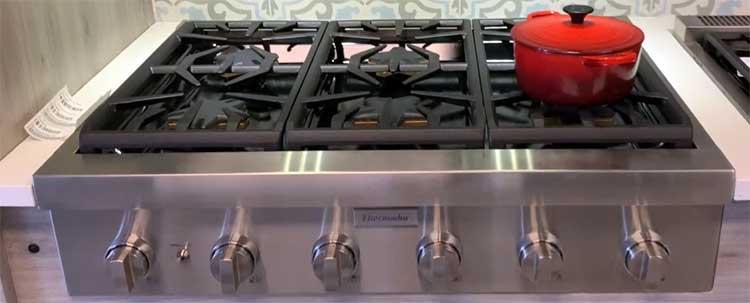
- Star-shaped burners — Thermador’s patented star burner design features five points instead of the traditional circular arrangement. The star shape creates more flame contact points, which Thermador claims results in up to 56% more coverage area compared to a round burner. In practice, this translates to more even heating across the bottom of your cookware.
- ExtraLow® simmer technology — This is Thermador’s answer to the simmer challenge, and it’s genuinely impressive. ExtraLow® burners can maintain a temperature as low as 100°F, which is exceptional. You can literally leave a chocolate fondue or a delicate custard sauce on an ExtraLow® burner indefinitely without intervention.
- Up to 22,000 BTU — Thermador edges past Wolf on maximum BTU output, which matters when you’re trying to get a large cast iron wok absolutely screaming hot or boiling 8 quarts of water in under five minutes.
- Auto re-ignition — If a flame gets blown out by a draft or a spill, Thermador’s burners re-ignite automatically. It’s a practical safety and convenience feature that Wolf does not match on most configurations.
- Continuous grates — Thermador rangetops feature continuous cast iron grates that allow you to slide pots across the entire surface without lifting. This is a genuine ergonomic advantage during active, multi-pot cooking.
- Pedestal Star Burner available on select models — The elevated center burner on certain Thermador configurations gives you dedicated high-heat positioning for wok cooking or large-stock-pot work.
- Gas griddle included on wider models — Thermador’s griddle option uses conventional gas rather than Wolf’s infrared, which some cooks actually prefer for its familiar cooking behavior.
- Free Dishwasher Program — Thermador runs ongoing promotions where purchasing qualifying appliance packages includes free dishwasher(s). This isn’t a cooking feature, but it’s a real value-add for kitchen renovation projects where you’re buying multiple appliances at once.
- Compatible with Thermador Home Connect — Select Thermador appliances integrate with smart home systems, though rangetop connectivity is more limited than their oven and refrigerator lineup.
Also Read: Is Hauslane Range Hood Worth It?
Thermador Rangetop Pros
- Star burners deliver exceptional even heating — The five-point flame configuration genuinely improves heat distribution, particularly on round-bottomed cookware and woks. If you cook a lot of stir-fry or use traditional cookware shapes, you’ll notice the difference.
- ExtraLow® is arguably the best simmer in the market — Getting to 100°F is an extraordinary capability. Thermador’s ExtraLow® burners maintain temperature so gently that you can keep cream-based sauces, tempered chocolate, and delicate reductions stable for extended periods without babysitting them.
- Higher ceiling BTU (22,000) — That extra 2,000 BTU over Wolf’s 20,000 ceiling isn’t huge, but in high-heat cooking scenarios — stir-frying, searing, rapid boiling — it gives Thermador a marginal edge.
- Auto re-ignition is genuinely useful — In busy kitchens where steam, drafts, and spills are common, the auto re-ignition feature eliminates a small but recurring frustration. It’s also a safety feature worth appreciating.
- Value-add promotions — Thermador’s free dishwasher programs and bundled appliance packages make the overall kitchen investment more competitive, even when the rangetop itself is comparably priced.
- Continuous grates reduce workflow friction — Sliding a 12-quart stock pot from burner to burner without lifting is something you don’t know you want until you have it. Continuous grates make the cooking surface feel more like a professional line.
- Strong design aesthetic — Thermador’s stainless finish and star-burner visual are distinctive. The brand has its own recognizable look that appeals to kitchen designers and renovation clients.
- BSH engineering depth — Being part of the Bosch/Siemens ecosystem means Thermador benefits from substantial engineering and manufacturing investment that independent luxury brands can’t always match.
Thermador Rangetop Cons
- Star burners can be harder to clean — The five-point configuration means more surface geometry for grease and food debris to collect in. Cleaning a star burner requires more attention and more time than a round burner, particularly after heavy cooking sessions.
- ExtraLow® is not universal across all burners — Not every burner on a Thermador rangetop features ExtraLow® capability. Buyers sometimes assume all burners have this feature and are surprised post-purchase. Always check the specific model configuration.
- Gas griddle heats less evenly than Wolf’s infrared — If griddle cooking is a priority, Thermador’s conventional gas griddle doesn’t match Wolf’s infrared in terms of surface temperature consistency. You’ll see hot spots and cool zones more readily on the Thermador griddle.
- No 60″ configuration — Thermador maxes out at 48″ for rangetop width, which limits options for very large kitchen builds or buyers who want expansive cooking surface area.
- International manufacturing at some price points — While Thermador maintains quality standards, some components and configurations are not manufactured domestically, which matters to buyers focused on American-made products.
- Service network depth varies — BSH’s service network is broad, but some users report longer response times for rangetop-specific repairs compared to Wolf’s more dedicated service infrastructure.
- Less differentiated design identity — Thermador’s stainless look, while attractive, is more generic than Wolf’s iconic red knobs. The star burner is recognizable up close, but from a distance, Thermador blends in with other premium stainless appliances.
Also Read: Is Proline Range Hood Worth It?
Frequently Asked Questions (FAQ)
No. They’re completely separate brands. Thermador is owned by BSH Home Appliances (a Bosch/Siemens joint venture), while Wolf is part of the Sub-Zero Group. They have no corporate relationship.
The most commonly reported issues are igniter failures on older models, control board malfunctions, and oven door seals wearing over time. Overall, Wolf ovens are considered highly reliable and their service network handles most repairs efficiently.
Wolf. Viking suffered serious quality control problems and a bankruptcy filing in 2012, which significantly damaged its reputation. Wolf maintained consistent quality through the same period and commands stronger brand equity and higher resale value today.
They serve different priorities. A cooktop installs flush with the counter for a sleeker look. A rangetop sits above the counter, offers higher BTU output, and delivers a more professional aesthetic. For performance and configuration flexibility, the rangetop wins. For visual integration, the cooktop does.
Wrapping Up
Both Wolf and Thermador make rangetops that will genuinely transform how you cook — the differences come down to cooking philosophy, not quality. Choose Wolf if you want American manufacturing, wider configuration options, and iconic brand presence.
Choose Thermador if you want the lowest simmer on the market, star-burner heat coverage, and better bundled value on a full kitchen renovation. Either way, you’re making a great call.
Go touch both in a showroom before you decide — at this price point, your hands should have a vote too.