
I’ve spent a lot of time thinking about kitchen knives, and few brands spark as much debate as Cutco. You pick one up, feel that solid weight in your hand, and then someone tells you the price — and suddenly you’re standing in the kitchen questioning every life decision you’ve ever made.
So why exactly does a single Cutco knife cost more than some people’s entire knife block?
That’s exactly what I’m going to break down for you in this article. From the materials and manufacturing to the sales model and lifetime warranty, every piece of the puzzle matters — and once you see the full picture, the price starts to make a lot more sense.
Reasons For Cutco Knives Being So Expensive
- American manufacturing and labor costs
- High-carbon stainless steel and premium materials
- The Double-D recessed edge and proprietary blade technology
- The Forever Guarantee and lifetime sharpening service
- The direct sales model and how it affects pricing
- Ergonomic handle design and engineering
- Brand heritage, reputation, and perceived value
- The cost of quality control and consistency
American Manufacturing and Labor Costs
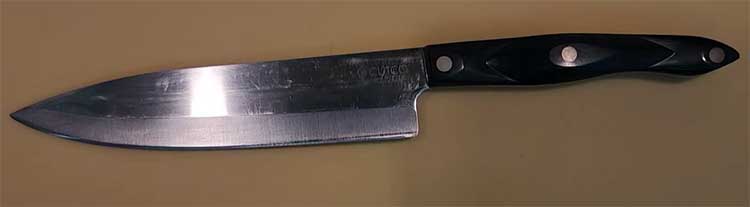
Let me start with something that often gets overlooked: Cutco knives are made in Olean, New York. Not overseas. Not in a factory where labor costs a fraction of what it does in the United States. Right here in America.
That matters more than most people realize. American manufacturing comes with American wages, American safety standards, American overhead, and American regulatory compliance.
When you factor all of that in, the cost of producing each knife is significantly higher than what a comparable-looking knife made in a low-cost manufacturing country would cost to produce.
Cutco’s parent company, Alcas Corporation, has been rooted in Olean since the brand launched in 1949. They’ve kept production domestic for over seven decades. That’s not an accident — it’s a deliberate commitment to domestic craftsmanship.
And that commitment has a price. When companies offshore production, they cut costs. When they keep it home, they pass some of those real costs onto the consumer.
To be fair, I think that’s something worth paying for. There’s a genuine difference in consistency and accountability when a product is made under strict domestic oversight. And for a knife you’re planning to use for decades, that consistency is part of what you’re buying.
High-Carbon Stainless Steel and Premium Materials
Not all steel is created equal, and Cutco doesn’t cut corners here — no pun intended.
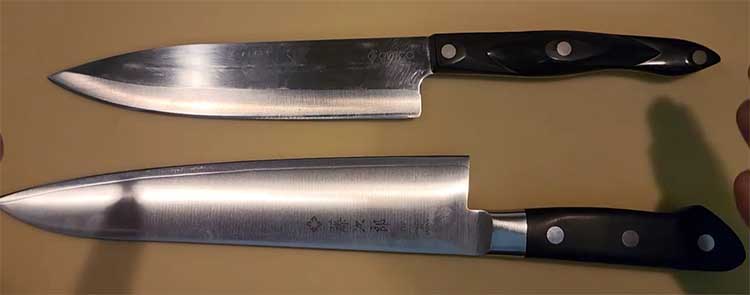
Cutco uses high-carbon stainless steel for its blades, specifically a 440A stainless steel alloy. This grade of steel is chosen because it strikes a solid balance between edge retention, corrosion resistance, and ease of resharpening.
High-carbon steel is denser and harder than standard stainless, which means the edge holds up better over time and under real-world kitchen conditions.
The handles are made from a thermo-resin material that Cutco refers to as their “Classic” handle. It’s designed to resist moisture, warping, and cracking — all the things that kill cheap handles over years of use.
The handle material also has a slight texture that improves grip, which is a small but meaningful detail when you’re working with wet hands.
Premium material costs are baked into that sticker price. When a manufacturer sources better steel, better handle materials, and better finishing components, the bill of materials goes up. You’re not paying for a logo — you’re paying for the actual stuff the knife is made from.
The Double-D Recessed Edge and Proprietary Blade Technology
This is one of Cutco’s most distinctive features, and it’s a big reason why the brand has such loyal fans.
The Double-D edge is Cutco’s proprietary blade geometry. Instead of a traditional smooth or serrated edge, the Double-D design features a series of small, recessed sharp points running along the edge of the blade.
The result is a cutting surface that grabs food more effectively, resists slipping, and stays sharp through repeated use without the maintenance demands of a traditional straight edge.
What makes this genuinely interesting from a manufacturing standpoint is that this edge profile is harder to produce than a standard grind. It requires specialized equipment and precision.
You can’t just run a blade through a generic belt grinder and call it a Double-D edge. The geometry has to be machined and finished with care, and that adds cost.
Beyond just the geometry, the blade is finished to a specific polish level that balances sharpness with durability. Cutco also engineers different blade profiles for different knives in their lineup — the chef’s knife, the paring knife, the bread knife, and the hunting knives all have geometry optimized for their specific purpose.
That level of product differentiation takes engineering time, testing, and tooling — all of which rolls into the price you pay.
The Forever Guarantee and Lifetime Sharpening Service
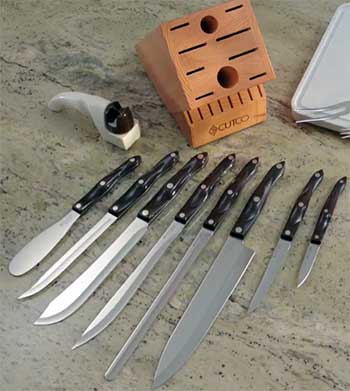
Here’s something that genuinely separates Cutco from most of the competition: the Forever Guarantee.
Cutco offers to repair or replace any knife — for any reason, at any time — for the life of the product. That’s not a marketing gimmick.
Customers actually use it.
People send in knives that are decades old and get them resharpened, repaired, or replaced. The company absorbs that cost.
Think about what that actually means from a business perspective.
For every knife sold, Cutco is taking on an indefinite future obligation to service it. That cost has to be built into the initial sale price. It’s essentially an insurance premium built into every purchase.
On top of the Forever Guarantee, Cutco offers free lifetime sharpening. You can send your knives back to the factory, and they’ll return them sharpened and in good condition. Again, that’s a real operational cost — labor, shipping, handling — that the company carries in perpetuity for every product it sells.
When people compare the upfront price of a Cutco knife to a cheaper knife and say Cutco is overpriced, they’re often ignoring this completely. A $30 knife that you throw away and replace every few years might actually cost more over 20 years than a $200 Cutco knife that lasts forever and gets serviced for free.
Also Read: Is Hunter Dual Knife Set Worth It?
The Direct Sales Model and How It Affects Pricing
This is where things get a little more complicated, and it’s worth being honest about it.
Cutco sells primarily through a direct sales force — specifically through Vector Marketing, which recruits college students to sell knives door-to-door and through personal demonstrations. This model has been controversial over the years because of how the sales representatives are recruited and compensated. But from a pure pricing perspective, the model has real implications.
When you buy a product through a retailer — say, a department store or a kitchenware shop — the retailer takes a markup. The manufacturer sets a wholesale price, the retailer marks it up to cover their rent, staff, and margin, and the consumer pays the final retail price.
Cutco skips the retailer but replaces that cost with a direct sales force. Each sales rep earns a commission on every sale. There’s also training, recruitment overhead, and sales management costs that all live inside the business model. Those costs don’t disappear just because there’s no physical store involved — they get redistributed into the pricing structure.
I think it’s fair to say that the direct sales model isn’t the most cost-efficient way to sell knives. There are kitchen knife brands that sell through wholesale or e-commerce channels with lower structural costs.
But Cutco has maintained this model for decades partly because the in-home demonstration is genuinely effective at conveying the quality of the product. Seeing someone cut through a rope and then slice a tomato paper-thin is more persuasive than reading a product description online.
Ergonomic Handle Design and Engineering
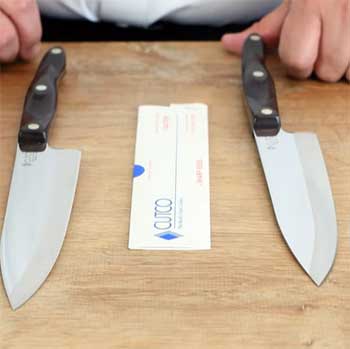
Cutco puts real thought into how their knives feel in the hand, and that kind of ergonomic engineering isn’t cheap.
The handle design goes through actual testing.
The shape, weight distribution, and grip texture are all intentional decisions made with the goal of reducing hand fatigue during extended use.
If you’ve ever used a cheap knife for a long cooking session, you know how much an uncomfortable handle can wear on you.
Cutco’s handles are designed to minimize that.
The bolster — the thick junction between the blade and handle — is designed to give the knife proper balance.
A well-balanced knife is less fatiguing to use and gives the user more control. Cutco pays attention to the weight distribution across the full length of each knife, and different models in the lineup have different balance points depending on their intended use.
This kind of ergonomic R&D isn’t free. Product engineers have to prototype, test, iterate, and finalize a design before it goes into production. That cost gets amortized across every unit sold, but it still shows up in the price.
Also Read: Differences Between Inkosi And Sebenza Knives.
Brand Heritage, Reputation, and Perceived Value
Cutco has been in business since 1949. That’s over 75 years of brand-building, customer loyalty, and reputational equity.
There’s something real about the perception of value that comes with a brand that old. When your parents had Cutco knives and loved them, and you grow up with those knives in the kitchen, you develop a reference point. The brand carries genuine generational trust in many households.
That heritage also means Cutco has spent decades investing in quality control and consistency. When customers know what to expect from a brand — and that expectation is consistently met — they’ll pay a premium for the certainty.
You’re not rolling the dice on whether this particular knife is going to be good. You already know it will be, because the brand has demonstrated that reliably for decades.
Brand equity is real economic value. It takes enormous sustained investment to build, and it’s reflected in pricing. This isn’t manipulation — it’s how premium goods markets work across every category, from automobiles to cookware.
The Cost of Quality Control and Consistency
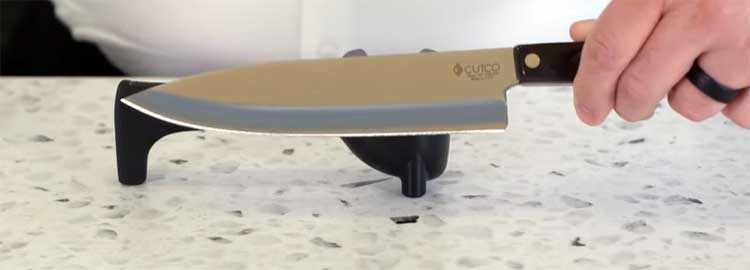
One thing that often separates a $30 knife from a $200 knife isn’t the average quality — it’s the consistency.
Cheap knives can occasionally be decent. But the failure rate is high. You might get three decent ones and one that’s warped, dull out of the box, or has a loose handle. When you’re buying into a premium brand, you’re paying for the assurance that every single unit meets a defined standard.
Cutco maintains strict quality control at every stage of production — from the raw steel coming in to the finished knife going out the door. That means inspection, testing, and rejection of units that don’t meet spec. Rejected units are a real cost. Labor spent on inspection is a real cost. The infrastructure for quality assurance is a real cost.
When a company makes a promise as bold as the Forever Guarantee, they can only afford to keep it if the product is consistently good. A knife that breaks or fails constantly would bankrupt the warranty program. So quality control isn’t just about pride — it’s operationally essential for Cutco’s business model to function.
And that cost lives in the price of the knife.
So, Are Cutco Knives Worth The Price?
That depends heavily on what you value and how you cook.
If you’re someone who uses knives daily, cooks seriously, and wants to buy once and never buy again, Cutco makes a strong case. The lifetime warranty, the free sharpening, the domestic manufacturing, and the proven durability are genuinely compelling when you think in terms of total lifetime cost.
If you’re a casual home cook who just needs something functional, you can find well-made knives at lower price points — particularly from German and Japanese brands — that deliver excellent performance without the premium price tag.
What I’d push back on is the framing that Cutco knives are expensive purely because of branding or the sales model. The reality is more nuanced. Yes, the direct sales model adds cost. But so does making knives in America, offering lifetime service, engineering proprietary blade geometry, and maintaining consistent quality over 75 years.
You may or may not choose to buy Cutco knives, and that’s a perfectly reasonable decision either way. But if you’re wondering why they cost what they cost, the answer isn’t a mystery — it’s the accumulation of real, documented, defensible costs stacked on top of each other. That’s the honest truth about the Cutco price tag, and I hope walking through it this way has given you a clearer lens for making your own decision.
Also Read: Differences Between Schmidt Brothers And Henckels Knives.
Frequently Asked Questions (FAQ)
Wüsthof, Shun, and Victorinox are commonly rated higher by professionals for edge sharpness and cutting performance.
Earnings vary widely. Most reps make roughly $15–$25 per appointment equivalent, with commissions on top — but income is inconsistent.
He’s publicly favored Wüsthof and Henckels, recommending a quality 8-inch chef’s knife as the essential starting point.
Wüsthof edges out Cutco for professional use and sharpness. Cutco wins on warranty and low-maintenance everyday durability.
Wrapping Up
Cutco knives are expensive because every element of the product — the materials, the manufacturing location, the blade engineering, the ergonomics, and the lifetime service commitment — carries a real, measurable cost.
You’re not paying for hype. You’re paying for a knife built in America, backed forever, and designed to last decades. Whether that trade-off makes sense for you depends on how seriously you cook and how you think about long-term value.
But now you have the full picture to make that call yourself