
I’ve always dreamed of turning those fallen trees on my property into usable lumber. If you’re like me, tired of paying for custom-cut wood and wanting total control over your projects, a Norwood sawmill is where your search should end.
It’s not just a tool; it’s a long-term investment in your craft, your independence, and your ability to build something truly unique from the ground up. This is for the person who wants to do it right, from tree to treasure, and build a legacy.
My Journey With Norwood Sawmill
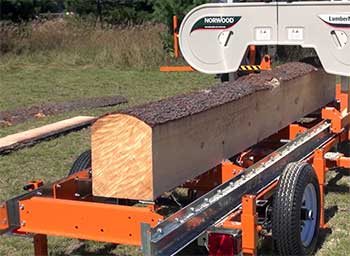
Let’s get this out of the way: I’m a serious woodworker and builder, but I’m not a professional sawyer.
I’m a guy with a piece of land that grows big, beautiful trees that sometimes fall.
For years, I’d either cut them up for firewood or, worse, pay someone to haul them away.
The idea of all that oak, maple, and cherry going to waste just killed me. I wanted to build my own workshop, custom garden beds, and maybe that live-edge dining table my wife has always wanted.
I researched portable sawmills for the better part of a year. I looked at everything. What drew me to Norwood, and specifically to the LumberMate LM29, was the modularity. I couldn’t afford a massive, all-hydraulic mill right out of the gate.
I needed something I could start with and build on. Norwood’s entire philosophy is “buy what you need now, add on later.” This was the hook.
When the mill arrived, it wasn’t a sawmill. It was a massive, heavy pallet with a lot of boxes and steel. This is the first reality check: you are building your sawmill, not just assembling it. I’m talking about a thick, phone-book-sized manual and bags and bags of hardware.
It took me and a friend two solid weekends. It’s not for the faint of heart. You need a good socket set, levels, and a lot of patience.
But here’s the magic. Because I bolted every single piece together, I know this machine inside and out. I know what every bracket does. I know how the carriage rides on the track. I know how to align the blade guides.
My first log was a 16-inch-diameter pine that had been down for about six months. I rolled it onto the bunks (which was a workout) and clamped it down. I double-checked my blade tension, fired up the Kohler engine, and engaged the blade.
I pushed that first cut, and the smell of fresh-cut pine filled the air. Seeing that first perfect, one-inch-thick board fall away from the cant was one of the most satisfying moments I’ve ever had as a builder. I’ve since built a 12×16 shed and I’m stacking slabs for that dining table. It’s a real tool, and it feels like my tool.
What I Absolutely Love About Norwood Sawmill?
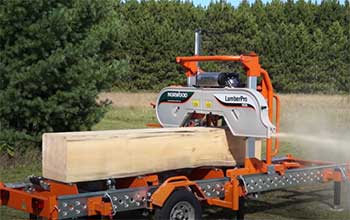
- The Modular Design is Genuinely Unbeatable This is, without a doubt, Norwood’s number one advantage. You aren’t locked into a single configuration. I started with a 16-foot bed. When I got a line on a massive 24-foot poplar, I just called them up and ordered an 8-foot extension. It bolted right on. The entire system is an ecosystem. You can add hydraulic or electric power feed, hydraulic log lifters, log turners, toe boards for tapering logs, and trailer packages. You can literally start with a $5,000 manual mill and, piece by piece, upgrade it into a $25,000 hydraulic beast that competes with the top-tier brands. This “grow-with-you” approach is fantastic for your budget and your skills.
- The Build Quality is Rock-Solid When you’re bolting this thing together, you get a real feel for the materials. This isn’t thin, stamped sheet metal. It’s heavy-gauge, laser-cut steel. The powder coating is thick and durable; mine has sat out in the rain (covered, of course) and I have zero rust issues. The carriage head is a four-post design, which I find incredibly rigid. When I’m cutting a wide, hard oak slab, I see zero flex or chatter in the head. This rigidity is what gives you those smooth, accurate, waiver-free cuts. It feels like a piece of industrial equipment, not a hobbyist’s toy.
- The Customer and Community Support is Top-Tier The one time I got stuck during the build (I couldn’t figure out the alignment on the blade-guide rollers), I called their support line. A real person who actually uses these mills picked up the phone. He didn’t read from a script; he talked to me like a fellow sawyer and solved my problem in five minutes. Beyond that, the online Norwood owners’ forums are a goldmine. You have thousands of people sharing tips, custom jigs they’ve built, and solutions to common problems. It feels like a club, and that’s a huge value when you’re taking on something this complex.
- You Get Phenomenal Cut Quality Once you learn to tune your mill, the lumber it produces is amazing. The blade tensioning system is simple and effective. The ceramic blade guides are fantastic and (in my opinion) much better than roller bearings, as they have no moving parts to clog with sawdust. I can confidently cut 1/16″ veneers if I want to. I can mill dimensional 2x4s that are more accurate than what I get from the big box store. The mill does its job, and it does it with precision.
My Few Frustrations With Norwood Sawmill
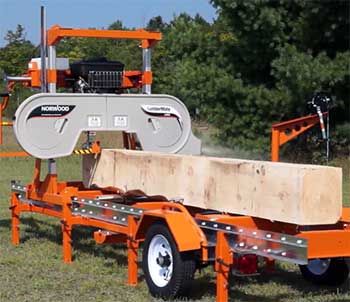
- The Assembly is a Serious Project I cannot stress this enough. This is not a “weekend-afternoon” assembly. This is a full-blown mechanical project. The manual is incredibly detailed, but it can be overwhelming. You are bolting together the entire frame, the entire carriage, and mounting the engine. If you’re the kind of person who gets frustrated building complex IKEA furniture, you should seriously consider another brand. You must be mechanically inclined and you must have patience. One bolt out of place, or one rail not perfectly level, will ruin all your cuts.
- “Upgrade-itis” Can Get Expensive The modularity is a double-edged sword. That tempting base price is just the entry ticket. You’ll quickly realize that you want the power feed after pushing the carriage 100 times. You’ll really want the log lifters after you try to muscle a 2,000-pound oak log onto the bed. These accessories are not cheap. They are built to the same high standard as the mill, and their prices reflect that. It’s easy for your $5,000 mill to turn into a $12,000 mill over a couple of years. You have to budget for the mill you will need, not just the one you can buy today.
- The Manual Models are a Serious Workout I run a manual mill. This means I am the log loader, the log turner, and the power feed. Turning a 20-inch log with a 5-foot cant hook to get the next face ready for cutting is hard, physical labor. Pushing the carriage through a 16-inch-wide oak cut takes real effort. I actually enjoy the workout, but many people underestimate it. If you have a bad back or aren’t physically fit, you must budget for the hydraulic log-handling options from the start.
Also read: Comparison of Timberking And Wood-Mizer.
Keeping Your Norwood Sawmill Purring
A sawmill is a dynamic tool. It vibrates, it gets covered in wet sawdust and pitch, and it has a high-strung engine. You have to stay on top of maintenance. Here’s my routine.
- Your Blades Are Everything Think of your blades as the most important part of the mill. I keep at least five blades in rotation. Don’t run a dull blade—ever. The second you have to push harder or the cut feels “off,” change it. Keep them clean. Pine pitch is the worst; it builds up on the blade and guides, creates heat, and causes cuts to wander. I keep a spray bottle of simple green or a 50/50 water-diesel mix and spray the blade down. Most importantly, get your tension right. Too loose, and you get wavy, rippled cuts. Too tight, and you’ll break blades and destroy your guide bearings.
- Alignment is a Daily Check Before I start a milling session, I do a 5-minute walk-around. The most critical check is the blade guides. Are they aligned? Are the ceramic guides still in good shape? I also check that the blade is perfectly parallel to the log bunks. I’ll take a small square and measure from the blade tooth to the bunk on both sides. If they’re not identical, your lumber will not be dimensional. This is the “tuning” part of sawing.
- Cleanliness and Lubrication Sawdust gets everywhere. It’s not just messy; it’s destructive. It clogs engine air filters (check yours daily!), it cakes up on the carriage wheels, and it packs into the drive belts. I use a leaf blower to clean the whole mill off after every day of sawing. I also keep a grease gun handy. The carriage wheels, the arbors, and any other Zerk fittings get grease regularly. A little bit of grease is the cheapest insurance you can buy.
- Vibration is the Enemy That engine shakes the whole machine. Go around with a wrench once a month and check for loose nuts and bolts. I’ve had bolts on the log clamps vibrate loose. It’s just a fact of life with this kind of equipment.
How Does Norwood Stack Up? (A Comparison)
I didn’t just stumble onto Norwood. My research boiled down to a few key competitors. Here’s how I see them stacking up against each other, based on what I’ve learned and what I’ve seen.
- Norwood Vs. MechMaxx Sawmills
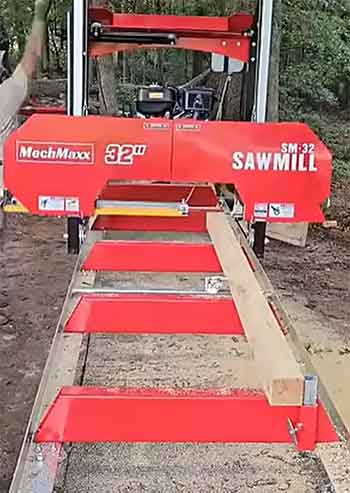
This is a comparison of two completely different philosophies.
When I looked at brands like MechMaxx, I saw a very tempting low price tag.
You can often get a mill with a larger engine and a wider cut capacity for significantly less money than a base-model Norwood.
They often come with an electric start as standard, which is a nice feature.
However, the trade-off, in my opinion, is in the build quality, the origin, and the long-term support.
These are typically imported mills made with lighter-gauge steel. You’re buying a machine that is built to a price point.
My big worry was, what happens in three years when a unique bearing fails or I need a specific part?
Norwood is the exact opposite. You are paying a premium for heavy-gauge, North American-made steel, a rock-solid 2-year warranty, and a support team based in the U.S. and Canada. You’re also buying into that modular ecosystem.
With MechMaxx, what you buy is pretty much what you get. With Norwood, the mill I bought on day one is just a starting point for the mill I can own in five years. I chose to pay more for the quality of the foundation and the lifetime upgrade path.
- Norwood Vs. the LX25 Portable Sawmill
This is a much more direct and tougher comparison.
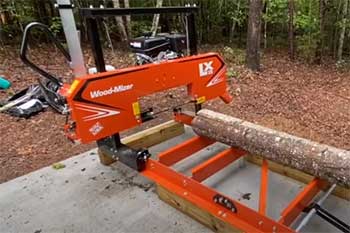
The Wood-Mizer LX25 is an entry-level, American-made mill from the biggest name in the business.
It’s built to compete directly with Norwood’s entry-level mills (like the LumberLite) on price, and it boasts fantastic build quality.
Like Norwood, it uses a four-post head on a twin-rail bed, so you get that same stability.
For me, the differences came down to the details. The LX25 uses roller guides for the blade, whereas I prefer the solid-state ceramic guides on my Norwood (no bearings to clog or fail). The real deciding factor, again, was the upgrade path.
The LX25 is a fantastic hobbyist mill, but it’s designed to be a hobbyist mill. The Norwood LumberMate series, while starting at a similar place, is designed from the ground up to have hydraulics, power feed, and log-handling attachments bolted on later. I wanted the system with the higher ceiling, and that was clearly Norwood.
- Norwood Vs. Wood-Mizer
This is the classic sawmill debate.
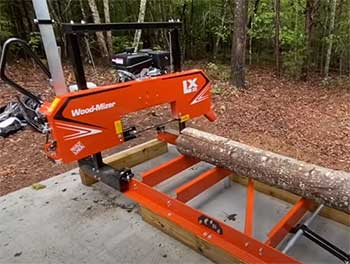
When you think of a Wood-Mizer, you’re probably thinking of their LT-series (like the LT15 or LT40) with its iconic single-post “cantilever” head.
This monorail design is brilliant.
It gives you a very open and easy-to-access log deck, which can make loading and turning logs with a cant hook a bit easier since there’s no second rail or post in your way.
The biggest difference is the “kit vs. turn-key” philosophy. Most Wood-Mizer mills ship largely assembled. You can be milling the same day they deliver it. A Norwood is a project before it’s a tool. You are building it from the ground up.
I saved thousands by doing that labor myself, and I gained an expert-level understanding of my machine. The Wood-Mizer is a fantastic, proven, and reliable machine, but you pay for that convenience. I’m the kind of person who wanted to build my mill, not just buy it.
Frequently Asked Questions (FAQ)
“Good” doesn’t cover it. They are fantastic, but they are for a specific type of person. If you are a hands-on builder, a mechanic, or a serious woodworker who likes to be in total control of your equipment, they are one of the best investments you can make. If you want a machine that shows up ready to go and you don’t like tinkering or getting your hands dirty, you might find them frustrating. The mill is as good as the person who builds and maintains it.
No, they are not. This is a huge point of pride for the company and a big reason for their build quality. All Norwood sawmills are manufactured in North America. Their primary factory and headquarters are in Ontario, Canada, and they also have facilities in the U.S. You are buying a North American-made piece of heavy-duty steel.
When I got mine, it came with a 2-year warranty on the sawmill itself. This covers any defects in manufacturing or materials. It’s important to know that this doesn’t cover the “consumable” parts. Things like blades, belts, and bearings are expected to wear out and are your responsibility. The engine is also covered by its own warranty, directly from the engine manufacturer (like Kohler or Briggs & Stratton), which is also typically two or three years.
As I mentioned above, they are proudly made in Canada and the USA. This is a major selling point. You can call them and talk to the people who are just a few yards away from where the mills are designed and built. This North American manufacturing is a key part of their quality control and their reputation.
My Final Verdict
So, should you buy a Norwood sawmill? If you’re a person who loves the process of building, who sees a pile of bolts and steel as a puzzle, not a problem, then 100% yes. If you want a tool that can grow with your skills and your ambition, there is no better choice.
You can start with a basic manual mill and build your way to a professional hydraulic operation without ever selling your first machine.
It’s an investment, not just in money, but in time and effort. You will learn to be a mechanic, a sawyer, and a millwright. But in return, you get the incredible power to turn a tree you cut down into a treasure you built.
For me, that’s what it’s all about.