
I’ve spent a lot of time standing in appliance aisles, reading spec sheets, watching YouTube teardowns, and talking to homeowners who’ve lived with both of these machines — and I want to give you the most honest, no-fluff breakdown of the Bosch and Whirlpool dishwasher debate you’ll find.
These two brands dominate the mid-range and premium dishwasher market for very different reasons. One leans into quiet performance and German engineering precision. The other bets on American durability, fast cycles, and family-sized practicality.
Both have strong cases. But depending on what you actually need in your kitchen, one is almost certainly the right choice — and the other might quietly disappoint you for years.
| Feature | Bosch | Whirlpool |
| Noise Level | 38–50 dB (industry-leading quiet) | 47–55 dB (moderate) |
| Drying Method | Condensation / CrystalDry | Heated dry / Fan-assisted |
| Wash Cycles | 5–7 cycles depending on model | 4–6 cycles depending on model |
| Third Rack | Yes (FlexSpace 3rd rack) | Yes (on select models) |
| Soil Sensor | Yes (on most models) | Yes (on select models) |
| Energy Star Certified | Yes | Yes |
| Average Water Usage | ~3.5 gallons per cycle | ~3.5–4.5 gallons per cycle |
| Price Range | $699–$1,599+ | $499–$1,099 |
| Reliability Rating | Excellent | Good to Very Good |
| Warranty | 1 year limited (limited lifetime on racks/door) | 1 year limited |
| Made In | Germany / USA (varies by model) | USA |
| Best For | Quiet performance, premium finish | Families, budget-conscious buyers |
Key Differences Between Bosch And Whirlpool Dishwashers
This is where the decision really gets made. Let’s be specific about what actually separates these two brands in meaningful ways.
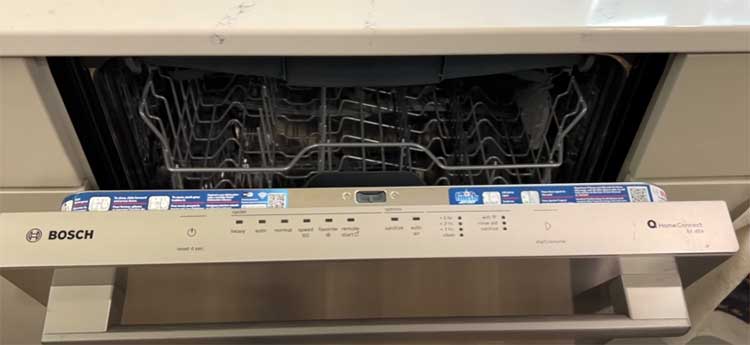
- Noise level is the single biggest differentiator — Bosch’s 38–44 dB on premium models versus Whirlpool’s 47–55 dB is a gap you will notice and live with every day, particularly if your kitchen is open to your living space or dining room
- Drying performance splits the other way — Whirlpool’s heated dry produces consistently dry dishes including plastics, while Bosch’s condensation drying (outside of CrystalDry models) regularly leaves moisture on plastic containers
- Interior quality differs significantly — Bosch uses stainless steel tubs across most of its lineup, while Whirlpool uses plastic interiors on base and mid-range models, which affects durability and long-term hygiene
- Cycle speed favors Whirlpool — the 1-Hour Wash option is fast and available across the lineup, whereas Bosch’s shortest cycles tend to run longer even at comparable settings
- Cleaning intelligence runs deeper on Bosch — PrecisionWash’s multi-sensor system is more sophisticated than Whirlpool’s soil sensor, particularly useful for mixed loads and varied soil levels
- Price-to-performance ratio differs depending on your priorities — Whirlpool delivers better value at the $500–$800 range, while Bosch’s advantages become more pronounced and worth the premium at $900 and above
- Long-term reliability data consistently gives Bosch a slight edge — independent studies and repair frequency data show Bosch requiring fewer service calls over a 5–10 year ownership period
- Third rack design quality is meaningfully better on Bosch — the FlexSpace rack provides genuinely more usable loading flexibility compared to Whirlpool’s narrower third rack offering
- Aesthetic integration options are broader on Bosch — panel-ready designs and multiple handle configurations allow for fully integrated kitchen looks that Whirlpool’s lineup doesn’t match
- Brand service network is stronger for Whirlpool in rural and suburban markets across the United States, making repairs faster and easier to arrange if something does go wrong
Also Read: Differences Between Cove And Bosch Dishwashers.
Bosch Dishwashers: Key Features
Bosch has spent decades building a reputation as the gold standard for dishwasher engineering, and they’ve earned it the hard way — by consistently delivering machines that outperform competitors in the areas that matter most to discerning buyers.
- Bosch dishwashers are among the quietest on the market, with their 500 and 800 Series models operating as low as 38–40 dB — that’s quieter than a normal conversation. You can run the dishwasher while your kids are sleeping, while you’re on a phone call, or while watching TV in an open-plan kitchen and you genuinely won’t notice it running.
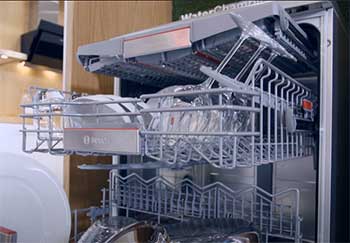
- The third rack on Bosch dishwashers is one of the most thoughtfully designed in the industry. Bosch calls it the FlexSpace 3rd rack, and it accommodates utensils, spatulas, ladles, and even flat items like measuring cups with far more flexibility than competing racks. It adds 30% more usable loading capacity without requiring you to reorganize the entire lower basket.
- Bosch uses a condensation drying system rather than a traditional heating element. On the 800 Series, this is upgraded to CrystalDry technology — a volcanic mineral called Zeolite absorbs moisture and converts it to heat, resulting in dramatically better drying performance, particularly on plastics. Anyone who’s ever opened a dishwasher to find wet Tupperware knows exactly why this matters.
- The PrecisionWash system uses intelligent soil sensors to detect how dirty your dishes actually are and adjusts water pressure, temperature, and cycle duration accordingly. You’re not just running a timed cycle — the machine is actively responding to what’s inside it.
- Bosch’s RackMatic adjustable upper rack system allows you to change the height in three positions with one hand, even when the rack is loaded. This sounds like a small detail but becomes invaluable when you’re trying to fit tall items in the lower basket alongside a fully loaded upper rack.
- The InfoLight feature, available on many Bosch models, projects a red dot on the floor when the cycle is running. Since the machine is so quiet, this visual cue lets anyone in the household know the dishwasher is active without opening the door mid-cycle.
- Bosch’s EcoSilence Motor is brushless, which means fewer moving parts, lower energy consumption, and a longer lifespan compared to conventional motors. It’s a meaningful engineering choice, not just a marketing label.
- Most Bosch dishwashers are Wi-Fi connected (Home Connect app) on the 500 Series and above, allowing you to start, monitor, and schedule cycles from your phone. You can also receive cycle completion notifications — useful if you want to unload quickly to keep a fresh kitchen.
Bosch Dishwasher Pros
- Exceptionally quiet operation that won’t disrupt open-plan living spaces, bedrooms, or home offices nearby
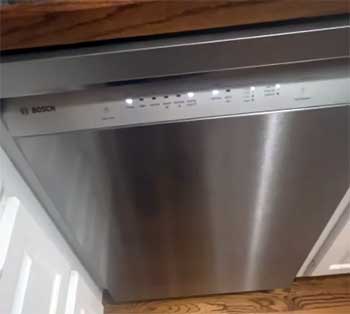
- Outstanding build quality with stainless steel tubs that resist staining, odor, and wear far better than plastic interiors
- Superior drying performance on the 800 Series thanks to CrystalDry, which handles plastics far better than most competitors
- The third rack design is genuinely useful and flexible — not just a marketing add-on
- Consistent cleaning performance across different load types, water hardness levels, and soil levels
- PrecisionWash soil sensing means you rarely need to pre-rinse dishes before loading, saving water and effort
- Energy efficiency is strong across the product line, with many models using under 3.5 gallons per cycle
- Long-term reliability data consistently places Bosch near the top among all dishwasher brands
- Resale value and brand perception remain high, which matters if you’re renovating to sell a home
- Available in multiple finishes including black stainless, panel-ready options for fully integrated kitchen designs, and classic stainless
Bosch Dishwasher Cons
- The entry price point is higher than Whirlpool — you’re paying a premium even on the base 300 Series models compared to equivalent Whirlpool tiers
- Condensation drying (on non-CrystalDry models) is noticeably slower and less effective than heated drying — plastics especially may need towel drying after the cycle
- Some users find the cycle times longer than expected, particularly on heavy-duty or sensor-adjusted cycles
- The controls are not as intuitive for first-time users — the hidden or top-panel controls on some models have a learning curve
- Bosch customer service and repair availability can be inconsistent depending on your region, particularly in rural areas
- The 300 Series lacks some of the premium features (like CrystalDry) that justify Bosch’s reputation, meaning you often need to spend more to get the experience Bosch is actually known for
- Not all models include a heated dry option, which can be a dealbreaker for households that want dishes bone-dry immediately after a cycle
- Wi-Fi connectivity, while available, isn’t as seamlessly integrated or feature-rich as some competing smart home ecosystems
Also Read: Differences Between KitchenAid 404 And 604 Dishwashers.
Whirlpool Dishwashers: Key Features
Whirlpool takes a different approach — one rooted in American practicality, family-oriented design, and value that doesn’t require you to take out a second mortgage. These machines are built to handle heavy real-world use without demanding premium-level attention in return.
- Whirlpool dishwashers run a 1-Hour Wash cycle across most of their lineup, which is genuinely useful for households that need clean dishes fast. When you’ve run out of plates before dinner, a 60-minute turnaround beats waiting two hours for a full cycle.
- The Sensor Cycle on mid-range and upper Whirlpool models uses soil sensing to automatically adjust water use and cycle duration. It’s not as refined as Bosch’s PrecisionWash, but it covers the core function well enough for most household loads.
- Whirlpool offers a third rack on their higher-tier models (like the WDT970SAKZ), and while it’s narrower and less flexible than Bosch’s FlexSpace, it still meaningfully extends loading capacity for a typical family’s needs.
- The heated dry option is available across most of Whirlpool’s lineup, which means dishes come out genuinely dry at the end of the cycle — including plastics. This is an area where Whirlpool has a clear practical edge over base-tier Bosch models.
- Whirlpool’s Total Coverage Spray Arm on select models provides 360-degree wash coverage, addressing the common issue of items in the corners and back of the rack not getting adequately cleaned.
- Many Whirlpool models feature a dedicated silverware spray jet that targets utensils directly in the third rack or silverware basket, improving cleaning consistency on forks and spoons that tend to nest together.
- The Adjustable Upper Rack on Whirlpool models is easy to use and provides good flexibility for accommodating oversized pots, baking sheets, and tall stemware.
- Whirlpool’s Load & Go Dispenser on some models allows you to pre-fill a detergent reservoir that automatically dispenses the right amount per cycle for up to a month of use — a clever feature for people who hate remembering to add detergent every time.
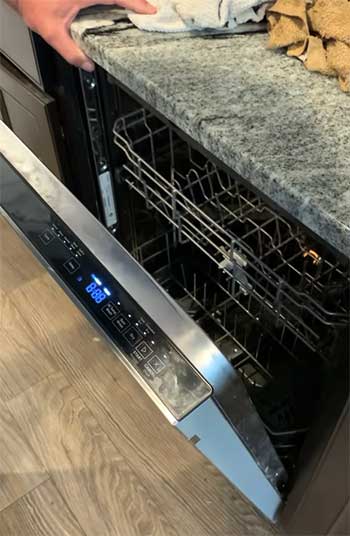
- Whirlpool’s fingerprint-resistant stainless finish is applied to most mid-range and above models, making maintenance noticeably easier for families with young children.
Whirlpool Dishwasher Pros
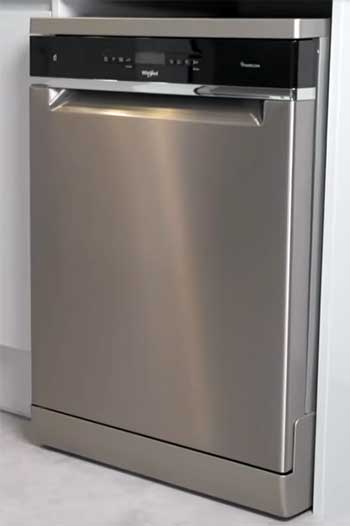
- More accessible price points make Whirlpool a strong choice for budget-conscious buyers who still want solid, reliable performance
- Heated drying produces consistently dry dishes including plastics — no towel-drying required at the end of a cycle
- The 1-Hour Wash cycle is a genuine convenience feature for fast turnarounds, not just a spec sheet checkmark
- Strong brand service network across the United States means repairs are easier to schedule and parts are more readily available
- Load & Go Dispenser on select models is a thoughtful convenience feature that reduces daily effort
- Whirlpool dishwashers are widely available at major retailers (Home Depot, Lowe’s, Best Buy), making purchasing, delivery, and installation straightforward
- Straightforward, intuitive controls with a low learning curve — good for households where multiple people operate the appliance
- Consistently good cleaning performance on standard loads, everyday dishes, and moderate soil levels
- Made in the USA (for many models), which matters to buyers who prioritize domestic manufacturing
- Solid reliability scores, particularly in the mid-range tier, with a large install base providing good long-term data
Whirlpool Dishwasher Cons
- Noticeably louder than Bosch at similar price points — typical noise levels run 47–55 dB, which is audible in open-plan spaces, especially during evening hours
- The interior tub on base models is plastic rather than stainless steel, which is less durable, more prone to staining, and can retain odors over time
- Cleaning performance on heavily soiled loads or baked-on food is less consistent compared to Bosch’s PrecisionWash system
- The third rack, when available, is narrower and less versatile than Bosch’s FlexSpace design
- Long-term reliability, while generally good, places slightly below Bosch in most independent repair frequency surveys
- Smart home connectivity and app integration lags behind Bosch and other premium brands in terms of features and responsiveness
- The soil sensor on base and mid-range models is less sophisticated, meaning cycles don’t always self-adjust as efficiently
- Finish options are more limited compared to Bosch — fewer panel-ready configurations for integrated kitchen designs
- Water usage per cycle tends to be slightly higher on equivalent models compared to Bosch
Also Read: Is Kirkland Ultra Shine Dishwasher Detergent Worth It?
Frequently Asked Questions (FAQ)
In terms of overall performance, noise level, and long-term reliability, Bosch holds an edge — but Whirlpool offers better value at lower price points and superior heated drying on base models. The “better” choice depends entirely on your priorities and budget.
Based on independent repair frequency data and consumer satisfaction surveys, Bosch consistently ranks among the most reliable dishwasher brands. Miele and LG also rank highly. Whirlpool is above the industry average but slightly below Bosch in most long-term reliability studies.
The Bosch 800 Series (model SHPM88Z75N) frequently tops independent ratings from Consumer Reports, The Wirecutter, and appliance review outlets for its combination of cleaning performance, drying capability via CrystalDry, noise level, and build quality.
Bosch is widely considered the best mainstream dishwasher brand for performance and reliability. Miele competes at the ultra-premium tier, but for the $700–$1,500 price range that most buyers are shopping in, Bosch is consistently the top-rated brand across independent review sources.
Wrapping Up
So where does this leave you? If you’ve been on the fence, here’s my honest take: for most households prioritizing quiet, long-term reliability, and premium cleaning performance — especially in open-plan homes or renovation projects — Bosch is the smarter investment.
But if you’re equipping a busy family kitchen on a practical budget, need fast cycle options, and want dishes that come out completely dry every time without spending upward of $900, Whirlpool delivers real-world value that’s hard to dismiss.
You now have everything you need to make this decision with confidence. Think about your daily routine, your kitchen layout, your noise sensitivity, and what you’re genuinely willing to spend.
Whether you choose the engineering precision of Bosch or the accessible reliability of Whirlpool, you’re choosing between two legitimate answers to the same question — and either can serve your kitchen well for years to come.