
I’ve stood in the aisle of the local hardware store countless times, staring at the colorful array of bottles and wondering if I am about to save my lawn or completely destroy it. It is a common dilemma for anyone trying to manage a yard.
My goal here is to cut through the marketing noise and analyze the chemical and practical differences between Ortho Weed B-gon and Roundup.
We will look at exactly which one belongs on your driveway and which one belongs on your turf, ensuring you pick the right tool for the job so you don’t accidentally turn your green grass brown.
Quick Comparison: At A Glance
| Feature | Ortho Weed B-gon | Roundup (Standard) |
| Primary Action | Selective Herbicide | Non-Selective Herbicide |
| Best Used For | Lawns, turf, grass with weeds | Driveways, patios, fence lines, renovations |
| Effect on Grass | Safe for most grasses (if used correctly) | Kills grass on contact |
| Active Ingredients | Typically 2,4-D, Mecoprop-p, Dicamba | Glyphosate (or similar non-selective agents) |
| Visible Results | Slower (days to weeks) | Faster (hours to days) |
| Root Kill | Yes, systemic | Yes, systemic |
| Rainproof | Usually 1 hour | Usually 30 minutes to 1 hour |
Ortho Weed B-gon: The Lawn Specialist
When I need to treat my front lawn, this is what I reach for. I have used it on everything from clover outbreaks to creeping charlie, and the appeal is obvious: I don’t have to worry about aiming perfectly.
Key Features of Weed B-gon
- Selective Chemistry: The formulation usually relies on a mix of 2,4-D, Quinclorac, and Dicamba. This “three-way” mix is the industry standard for homeowners because it covers a massive spectrum of common lawn weeds without burning the turf.
- Systemic Action: It doesn’t just burn the leaves. The chemical is absorbed by the foliage and moves down into the root system.2 This is crucial because if you don’t kill the root of a dandelion, it will just come back in two weeks.
- Variety of Applicators: I have bought this in the ready-to-use trigger spray, the battery-operated wand (which saves hand cramping), and the hose-end sprayer concentrate.
Also Read: Comparison of Ortho And Roundup.
Pros of Weed B-gon
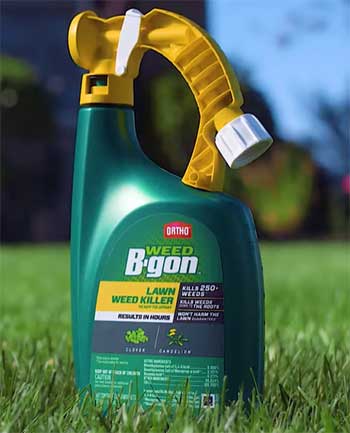
- Turf Safety and Selectivity The biggest selling point is simply that I can relax while spraying it. Unlike non-selective killers where a single wayward drop means a dead patch of grass, Weed B-gon is forgiving. I have blanket-sprayed entire sections of my front lawn where the clover was getting out of hand, and the fescue didn’t even yellow. It targets the hormonal systems of broadleaf plants specifically, leaving the monocots (grasses) physiologically untouched. This allows for “broadcast” application rather than just “spot” treatment.
- Deep Root Destruction I appreciate that this is a systemic killer. It does not just burn off the top leaves, which looks good for three days until the plant regenerates. The active ingredients (usually a blend of 2,4-D, Mecoprop-p, and Dicamba) are absorbed through the leaf surface and transported through the vascular system of the weed. It travels all the way down to the taproot. This is essential for perennial weeds like dandelions; if you don’t kill the root, you haven’t actually solved the problem.
- Rainfast Technology Weather forecasting is rarely perfect, and I have been caught by a surprise shower more than once after yard work. Most Weed B-gon formulations are “rainfast” in about one hour. This drying time is impressive. As long as I can get a sixty-minute window of dry weather, I know the chemical has bound to the leaf surface and started penetrating. I don’t have to stress if it rains later that afternoon; the job is already done.
- Flexible Application Methods I like having options based on the size of the job. If I just have three dandelions near the mailbox, I grab the ready-to-use trigger spray. If the entire backyard is overrun with chickweed, I buy the concentrate and load up my hose-end sprayer. The ability to dial in the concentration (or let the hose-end sprayer do it for me) makes it a versatile tool for both small skirmishes and full-scale wars.
Cons of Weed B-gon
- Temperature Sensitivity and “Burn” Risk This is the most common mistake I see people make. You cannot use this product when the thermometer creeps past 85°F or 90°F. When it gets that hot, the grass is under stress, and the selective chemicals can become volatile. I made the mistake once of spraying on a 95-degree July afternoon, and while the weeds died, the tips of my grass turned yellow and stunted for weeks. You are limited to spraying in the cool of the morning or on milder days.
- Slow Visual Feedback We live in a world of instant gratification, and Weed B-gon does not provide that. When I spray a dandelion, it looks perfectly healthy the next day. It can take 24 to 48 hours to see the first signs of curling (epinasty), and it might take two full weeks for the weed to turn brown and disappear. You have to trust the process and resist the urge to respray immediately, which would just overdose the area.
- Limited Spectrum on Grassy Weeds The standard red-bottle formula is practically useless against crabgrass, goosegrass, or nutsedge. Because those weeds are biologically similar to your lawn grass, the selective formula ignores them. To treat those, I have to buy the specific “Weed B-gon plus Crabgrass Control” (the orange cap), and even then, mature crabgrass is incredibly difficult to kill with it. It forces you to buy multiple products for different weed types.
- The “Chemical” Smell 2,4-D has a distinct, medicinal odor that lingers. When I spray the yard, my neighbors know. It isn’t necessarily toxic fumes in a cloud, but the scent is strong enough that I usually close the windows of the house if I am spraying near the foundation. If you are sensitive to chemical smells, this application can be unpleasant.
Also Read: Comparison of RM18 And Roundup.
Roundup: The Hardscape Master
Roundup is a different beast entirely. It was historically synonymous with Glyphosate, though in recent years, due to litigation and consumer demand, the formula has evolved. Some versions now use vinegar, soaps, or other chemicals, but the “classic” performance is what most people expect.
Key Features of Roundup
- Non-Selective Toxicity: This blocks an enzyme essential for plant growth (EPSP synthase).3 Since almost all plants need this enzyme, almost all plants die when touched by it.
- Rapid Absorption: Roundup is designed to penetrate the waxy cuticle of a leaf very quickly.4 This makes it highly effective against tough, woody weeds that other sprays bounce off of.
- Soil Inactivity (Mostly): One feature I appreciate is that glyphosate binds tightly to soil particles, making it inactive in the ground relatively quickly.5 This allows for replanting (re-sodding or seeding) sooner than with some other heavy chemicals.
Pros of Roundup
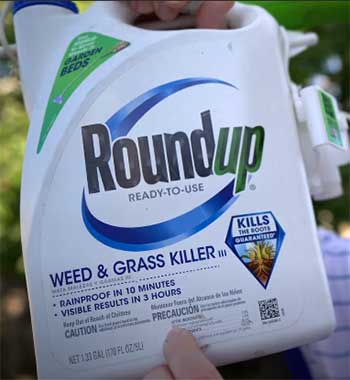
- Total Vegetation Control When I need a patch of ground stripped to bare earth, Roundup is unmatched. Whether I am prepping a bed for new mulch, clearing a fence line, or dealing with weeds popping up through the cracks in my asphalt driveway, Roundup kills it all. I don’t have to identify the weed. I don’t need to know if it is a broadleaf or a grass. If I spray it, it dies. That simplicity is efficient.
- Rapid Results Modern Roundup formulations have improved significantly in speed. Many include Diquat or Pelargonic acid alongside Glyphosate to provide a “burndown” effect. I can spray weeds in the driveway on a Saturday morning, and by Saturday evening, they are wilting. By Sunday, they are yellowing crisp. That visual confirmation is satisfying and lets me know immediately that the application was successful.
- Efficacy on Woody and Tough Plants Weed B-gon bounces right off plants with waxy coatings or woody stems, like Poison Ivy, wild blackberry, or tree saplings. Roundup penetrates these defenses. Because it moves systemically through the plant, it can take down a small sapling or a thick vine that would otherwise require me to dig it out with a shovel. For clearing brush, it is the only chemical option that makes sense.
- Soil Inactivation One of the fascinating chemical properties of Glyphosate is that it binds tightly to soil particles and becomes inert fairly quickly. This means I can use it to kill off a patch of bad turf, wait a relatively short period (usually 3 to 7 days depending on the label), and then seed new grass right over it. It doesn’t poison the ground for months like some heavy-duty industrial sterilizers do.
Cons of Roundup
- Risk of Drift: This is my biggest anxiety when using it. If a slight breeze catches the spray and carries it to my wife’s hydrangeas or my tomato plants, those plants are likely dead. You have to be incredibly precise.
- Health and Environmental Concerns: It is impossible to ignore the controversy surrounding Glyphosate. While regulatory bodies in the US generally deem it safe for consumer use when following the label, many users are uncomfortable with the potential health links, leading them to seek alternatives.
- Does Not Prevent Regrowth (Standard Version): Unless you buy the “Extended Control” version which adds a soil sterilizer, Roundup only kills what is currently growing. New seeds can sprout the next day.
Also Read: Comparison of RM43 And Roundup.
The Application Experience: A User Perspective
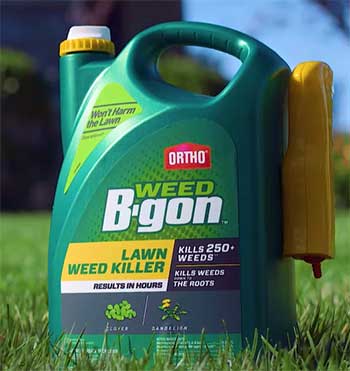
When I actually head out to the yard, the experience of using these two products feels distinct.
With Weed B-gon, I am usually in “maintenance mode.”
I might hook the concentrate up to my hose and spray the entire back lawn. It feels like a broad treatment.
I am walking the whole yard, smelling that distinct chemical scent (which is quite strong with 2,4-D), and trusting the chemistry to sort the good plants from the bad.
It is a volume game. I am treating thousands of square feet.
With Roundup, I am in “sniper mode.” I usually use the hand-trigger bottle or a pump sprayer with a cone shield. I am watching the wind. I am careful where I step so I don’t track the wet chemical onto the lawn. It is a surgical strike. I am treating inches, not acres.
Effectiveness On Different Weed Types
To understand which to buy, you have to look at what is actually growing in your yard.
Broadleaf Weeds (Dandelion, Clover, Chickweed)
- Weed B-gon: Excellent. This is its bread and butter. It will melt clover away and twist dandelions until they wither.
- Roundup: Effective, but overkill. Using Roundup on a dandelion in the middle of your lawn means you will have a dead dandelion surrounded by a 6-inch circle of dead grass.
Grassy Weeds (Crabgrass, Foxtail, Quackgrass)
- Weed B-gon: Weak to Moderate. The standard bottle won’t touch crabgrass. You must buy the specific formulation that includes Quinclorac. Even then, mature crabgrass is hard to kill selectively.
- Roundup: Highly Effective. It kills grassy weeds easily because they are biologically similar to lawn grass. This is why Roundup is the only option for a lawn renovation where you want to kill everything and start over.
Difficult/Woody Weeds (Creeping Charlie, Wild Violet, Poison Ivy)
- Weed B-gon: Struggles. It usually takes multiple applications to knock down Creeping Charlie or Violets because of their waxy leaves and resilient root systems.6
- Roundup: Superior. The systemic nature of Roundup is better suited for these hard-to-kill perennial weeds, provided you can apply it without hitting desirable plants.
Safety and Environmental Considerations
We cannot discuss herbicides without addressing safety. I treat both of these chemicals with immense respect.
- For Weed B-gon: The primary risk is to other plants via vapor drift. 2,4-D can vaporize in hot weather and drift to nearby sensitive crops like tomatoes or grapes.7 I never spray it when it is over 85°F. Regarding pets, the rule is simple: keep them off until the spray has dried completely.
- For Roundup: The concern is long-term exposure and skin contact. I always wear long pants, rubber boots, and gloves. I never spray in shorts. While the EPA maintains its stance on safety, the sheer volume of litigation makes me cautious. I use it sparingly, only when manual weeding isn’t an option.
Also Read: My Experience With Vigoro Weed & Feed.
Frequently Asked Questions (FAQ)
No. Weed B-gon is a selective herbicide that kills weeds but spares grass, whereas Roundup is a non-selective herbicide that kills almost all vegetation, including grass.
Yes, it is highly effective on common broadleaf weeds like dandelions and clover, provided it is applied according to the label instructions regarding temperature and mixing ratios.8
For consumer use, products containing high concentrations of Glyphosate mixed with Imazapyr (like RM43) or Triclopyr are considered the strongest, often sterilizing the soil for up to a year.
No, the brand is not being discontinued, but specific formulations change due to state regulations. For example, some states restrict 2,4-D, leading Ortho to release alternative formulas in those regions.
Making The Final Call
The choice between Weed B-gon and Roundup isn’t about which product is “better” in a vacuum; it is about where the weed is located.
If the weed is surrounded by grass you want to keep, Weed B-gon is your only logical choice. It allows you to maintain a pristine lawn without turning it into a patchwork of dead brown spots. It takes a bit longer to work, and you have to watch the temperature, but it preserves your turf.
If the weed is in a driveway crack, a mulch bed, or a patio where you want zero vegetation, Roundup is the superior tool. It acts faster, kills a broader range of plant species, and handles the tough, woody intruders that selective herbicides can’t scratch.
I keep both in my garage. Weed B-gon sits on the shelf for the spring and fall lawn maintenance, and Roundup sits in the corner for the summer battles against the weeds invading my driveway. Understanding the chemistry ensures that I control the weeds without letting the weeds—or the chemicals—control me.