
As someone who spends weekends smoking briskets, grilling steaks, and roasting everything in between, I rely on a good wireless meat thermometer to take the guesswork out of cooking.
Over the past couple years, I’ve tested both Typhur and MEATER probes extensively. This article breaks down everything I’ve learned from real cooks to help you decide which one deserves a spot in your kitchen or grill setup.
Right after the intro, here’s a side-by-side comparison of the flagship models I use most: the Typhur Sync Gold Dual and the MEATER Pro Duo.
| Feature | Typhur Sync Gold Dual | MEATER Pro Duo |
| Number of Probes | 2 (options up to 4 or 6 in other kits) | 2 (single and 4-probe options available) |
| Connectivity | Sub-1G + Bluetooth + WiFi repeater | Bluetooth 5 with booster + built-in WiFi |
| Range (open air) | Up to 3,000 feet | Up to 2,500 feet |
| Typical home/grill range | 400–650 feet | 200–300 feet |
| Accuracy | NIST-certified ±0.5°F | ±0.9°F (real-world often better) |
| Max Ambient Temp | 932°F | 1,000°F |
| Max Internal Temp | 212°F | 212°F |
| Sensors per Probe | 6 | 5 internal + 1 ambient |
| Battery Life per Charge | 70+ hours | 24+ hours |
| Waterproof/Dishwasher | Yes, IP68 | Yes, but hand wash recommended |
| App Features | Guided cooks, custom alerts, history | Advanced guided cooking, rest estimator |
| Price (approx., dual) | $229 | $249 |
Key Differences Between Typhur And MEATER
- Connectivity and Range
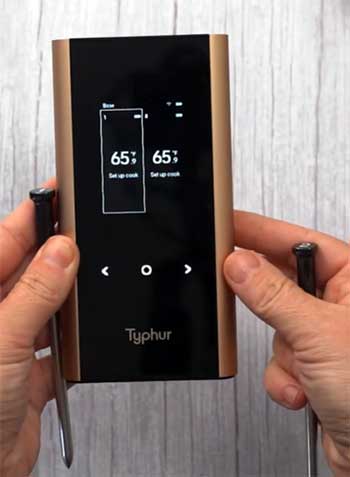
Typhur’s Sync Gold series stands out with its Sub-1G transmission technology, paired with Bluetooth and WiFi support, pushing reliable range to an impressive 3000 feet in open spaces and often 600-700 feet even in challenging home or backyard setups.
I’ve left a brisket smoking overnight and checked temps from upstairs without a single dropout—it’s that stable.
MEATER Pro models use advanced Bluetooth 5.2 with a built-in booster in the charger, reaching up to 2500 feet open air but more realistically 250-300 feet around the house, where walls or grill materials can cause intermittent signal loss unless you’re using a WiFi-enabled variant like the Pro XL.
- Sensor Configuration
Each Typhur probe features six sensors total: four internal for meat temperature and dual ambient sensors positioned strategically along the probe for more accurate high-heat readings near flames or hot spots.
This extra data has helped me spot temperature variations in larger roasts that a single ambient sensor might miss.
MEATER Pro probes pack five internal sensors that create a full temperature gradient across the meat, plus one dedicated ambient sensor at the tip—their algorithm uses this to intelligently estimate the coolest part of the cut, which shines on irregularly shaped or thick pieces like pork shoulder.
- Heat Resistance
MEATER Pro takes the lead here with an ambient temperature tolerance of 1000°F (550°C), meaning you can confidently leave the probe in during direct searing over open flames or in screaming-hot ovens without worry.
I’ve finished steaks with reverse sears at extreme temps and trusted it completely. Typhur Sync Gold handles up to around 932°F (500°C) ambient, which covers nearly all standard grilling, smoking, and roasting scenarios but falls just short of MEATER’s extreme high-heat capability.
- Battery and Maintenance
Typhur delivers class-leading battery life, often exceeding 50-70 hours on a single charge depending on use, and the probes are fully waterproof (IPX8 rated) with dishwasher-safe convenience that makes post-cook cleanup effortless.
MEATER Pro offers solid 24+ hours of continuous use, with an ultra-fast charging system—five minutes in the charger gives you a couple hours of cooking time—but they still recommend hand washing over dishwasher cycles to maintain longevity.
- App Experience
MEATER’s app remains the gold standard for guided cooking, with sophisticated algorithms that predict exact finish times, factor in resting carryover, and even suggest optimal removal points based on your target doneness.
It feels like having a sous chef in your pocket.
Typhur’s app is clean and reliable, providing detailed graphs, custom alerts, and cook history, but it leans more toward giving you raw data and manual control rather than the same level of predictive hand-holding.
- Probe Design
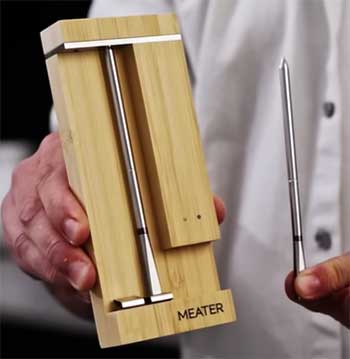
MEATER probes are noticeably slimmer (around 0.24 inches diameter) and elegantly finished with zirconia ceramic accents, leaving minimal insertion marks on delicate cuts like fish or chicken breasts while feeling premium in hand.
Typhur probes are slightly thicker and built like tanks with reinforced construction for durability—great if you’re rough with gear or cooking big, tough cuts, though the larger hole can be more visible on smaller portions.
- Multi-Probe Support
Both brands scale well, but Typhur’s Gold series feels purpose-built for larger setups right out of the gate, with quad and higher kits supporting seamless monitoring of multiple proteins plus ambient grill temps via the robust hub display.
MEATER handles multiples beautifully too (up to four on the Pro XL with built-in WiFi for cloud connectivity), but the standard Pro Duo keeps things simpler with two probes and relies on the charger as the central hub without an independent screen.
- Accuracy Claims
Both now advertise ±0.5°F precision, but Typhur backs it with individual NIST-traceable calibration certificates for each unit, giving that extra layer of documented assurance straight from the factory.
MEATER earns its accuracy reputation through consistent real-world performance and ongoing app refinements, though without per-probe certification paperwork. In my side-by-side tests, they’ve both been spot-on within that margin.
Key Features of MEATER
I’ve put various MEATER models through their paces over many cooks, from the reliable Plus to the high-performance Pro series that’s become my favorite for its upgrades.

- Completely wire-free single-probe design — No external wires, clips, or separate ambient sensors to deal with. I just insert the probe into the meat, pop it on the grill or in the oven, and monitor everything from my phone. That seamless setup makes it incredibly convenient for quick weeknight dinners or when I’m juggling multiple things outdoors.
- Five internal sensors plus one ambient — The internal sensors map out a precise temperature gradient inside the meat, while the ambient sensor handles the cooking environment. This combo lets the app pinpoint the coldest spot in thicker cuts, helping me avoid undercooking the center while preventing dry edges on things like tri-tip or whole turkeys.
- High heat resistance — The Pro series pushes ambient tolerance to 1,000°F, so I can confidently use it for direct searing over blazing coals or in ultra-hot pizza ovens. I’ve finished reverse-seared steaks right over the flames without any damage or inaccurate readings.
- Excellent guided cooking algorithm — The app’s Smart Temp predictions are remarkably accurate, factoring in your target doneness, meat thickness, and even resting carryover. During a holiday ham, it told me exactly when to pull it for perfect results after resting—no more guessing or constant checking.
- Built-in WiFi on duo and higher models — With cloud connectivity, range becomes essentially unlimited as long as I have internet. I monitored a slow-roasted pork butt from another room while handling sides, getting alerts without staying near the grill.
- Sleek charger with fast charging — The magnetic case or bamboo-style charger (depending on model) stores the probes neatly and charges quickly—often just minutes for hours of use. It sticks to the fridge or grill side for easy access, and the premium materials make it feel like a high-end gadget on my counter.
Pros And Cons of MEATER
Pros
- The app’s guided cooking and predictive features are unmatched—rest timers, finish estimates, and removal alerts make even complex cooks feel straightforward and stress-free.
- True wireless freedom with no external components simplifies setup and reduces clutter around the grill.
- Exceptional high-heat performance opens up techniques like direct flame searing or deep frying that would destroy lesser probes.
- Premium build quality and aesthetics—the metal or ceramic finishes look sharp and feel durable in daily use.
- Unlimited cloud range on WiFi models means I can check progress from virtually anywhere with internet.
- Regular app updates continually improve recipes, algorithms, and compatibility with new devices.
Cons
- Real-world Bluetooth range can be inconsistent in obstructed environments like thick smoker walls or crowded backyards, sometimes requiring me to stay closer than I’d like.
- While battery life is solid for most cooks, very long smokes (18+ hours) might need a mid-cook recharge or careful planning.
- Replacement probes aren’t cheap, so losing or damaging one stings more than with wired alternatives.
- No standalone display means I’m always reaching for my phone for quick temp checks.
- Occasional connectivity quirks in areas with heavy WiFi interference, though updates have minimized this.
Also Read: Comparison of FireBoard And ThermoWorks Smart Thermometers.
Key Features of Typhur
Typhur’s Sync Gold series impressed me right away with its robust build and connectivity focus, especially during extended smoking sessions.
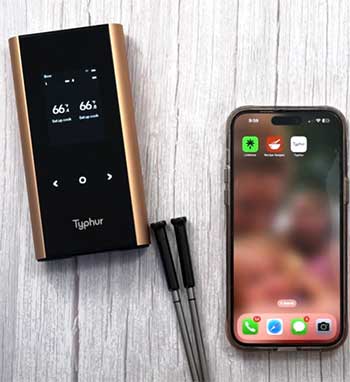
- Sub-1G transmission technology — Combined with Bluetooth and WiFi repeater functionality in the base, this delivers rock-solid connections over massive distances. I’ve tracked temps from over 600 feet away through walls and trees during all-day cooks without a single interruption.
- Six sensors per probe — Four internal sensors plus dual ambient points (one near the tip, one higher) provide layered data for both meat and cooking chamber. This helped me catch subtle hot spots in my offset smoker and adjust vents accordingly for even cooking.
- NIST-certified calibration — Each probe comes with documentation verifying ±0.5°F accuracy, and my own calibration checks in ice baths and boiling water consistently landed within 0.2–0.3°F. That level of precision gives me total confidence in the readings.
- Insane battery life — Routinely pushing 70+ hours per charge, I can go through multiple weekend BBQ sessions without plugging in. The base charges them quickly when needed, so they’re always ready.
- Dishwasher-safe probes — Fully IP68 rated means I can toss them in the dishwasher after saucy rib cooks—no delicate hand washing required, which saves time during cleanup.
- WiFi repeater base with LCD screen — The hub displays current temps at a glance without opening the app, and it extends signal dramatically. I place it near the cooker and get reliable notifications anywhere with WiFi.
- Multiple probe support — The Gold series scales easily to quad or six-probe kits, letting me monitor several proteins plus grill temps at once. During big family gatherings, I’ve run four probes across different cuts without any confusion in the app.
Pros And Cons of Typhur
Pros
- Connection reliability is outstanding—Sub-1G tech keeps signals strong even in challenging setups, perfect for large yards or indoor monitoring.
- Marathon battery life and dishwasher-safe design make maintenance practically nonexistent over weeks of heavy use.
- Detailed multi-sensor data gives the most comprehensive temperature insights I’ve experienced, especially useful for fine-tuning smoker performance.
- The base station’s screen and repeater functionality add convenience when my phone isn’t handy.
- Competitive pricing for the feature set, particularly in multi-probe configurations.
- Factory calibration certificate provides documented accuracy assurance that’s reassuring for precision-focused cooks.
Cons
- Slightly thicker probes can leave more noticeable holes in delicate or small cuts compared to slimmer competitors.
- The app delivers solid functionality but doesn’t match MEATER’s intuitive guidance and predictive sophistication.
- As a relatively newer player, long-term durability reports are still building compared to established brands.
- Dual ambient sensors sometimes read conservatively when meat is tightly foiled, requiring minor mental adjustments based on experience.
My Cooking Experiences With Them
Let me share some specific cooks that highlighted the differences.
Last summer, I smoked two pork shoulders side-by-side—one with MEATER Pro, one with Typhur Sync Gold. Both nailed the 203°F pull temp, but the MEATER app told me exactly when to wrap based on its algorithm, while I set manual alerts on Typhur.
The Typhur never lost signal when I went inside to watch a game; the MEATER dropped once when I walked to the far end of the yard.
For high-heat grilling, I seared ribeyes directly over flames. The MEATER Pro handled the 800°F+ flare-ups without flinching. I wouldn’t trust older probes at those temps, but the Pro delivered.
On a rainy weekend, I did a long brisket. Typhur’s range let me monitor from the couch all day. The base station display meant I could check temps walking past without grabbing my phone.
For rotisserie chicken, MEATER’s slim probe barely left a mark. The thicker Typhur probe was noticeable but didn’t affect juiciness.
Holiday prime rib with multiple cuts benefited from Typhur’s four-probe capability—I tracked three roasts and grill temp simultaneously.
- Which One Do I Reach For Most?
It depends on the cook. For everyday grilling and when I want the best app guidance, I grab MEATER. For low-and-slow smokes where I might be far from the grill or running multiple pieces, Typhur gets the nod.
Both produce perfectly cooked meat when used properly—the differences come down to workflow preferences.
Also Read: Comparison of FireBoard 2 Drive And Pro Smart Thermometers.
Frequently Asked Questions (FAQ)
Typhur probes are NIST-certified to ±0.5°F (±0.3°C) accuracy, and in my testing, they consistently perform within that spec.
Yes, Traeger acquired MEATER in 2021, though it continues to operate independently.
It depends on needs, but the MEATER Pro and Typhur Sync Gold are consistently ranked among the very best wireless options available.
Yes, ThermoPro models generally deliver accuracy within ±1.8°F, with many users reporting even better real-world performance.
Final Thoughts
After hundreds of hours cooking with both systems, I can say confidently that you can’t go wrong with either Typhur or MEATER. They’re the gold standard in wireless meat thermometers for good reason. If you prioritize rock-solid connectivity and long sessions, go Typhur.
If you want the most refined app experience and high-heat capability, choose MEATER. Whichever you pick, you’ll wonder how you ever cooked perfect meat without it. Happy grilling—you’ve got this.