
If you are anything like me, the aisle of weed killers at the hardware store induces a specific kind of anxiety. You see the skulls and crossbones, the warnings about “keeping pets off for 24 hours,” and the intense chemical names that sound like they belong in a laboratory, not your backyard.
That is exactly why I picked up Spruce Weed & Grass Killer. It promises a pet-safe, essential-oil-based solution backed by the giants at P&G. If you are looking for a way to banish weeds from your patio, driveway, or sidewalk without turning your yard into a toxic zone, this is likely the bottle you need.
You can typically find it at major retailers like Walmart, Home Depot, or directly from their website.
My Experience With Spruce Weed Killer
I remember the exact moment I decided I needed a change.
It was a crisp Saturday morning, and I was stepping out onto my paver patio with a cup of coffee.
Instead of enjoying the clean lines of the stone, my eyes were immediately drawn to the bright green intruders poking out from every crack.
Crabgrass, dandelions, and some mystery vine were staging a coup.
Usually, my routine would involve suiting up like I was handling nuclear waste—rubber gloves, long pants, and a mask—before spraying a glyphosate-based killer.
Then, I would have to play the role of a prison warden, guarding the patio for the next day to make sure my Golden Retriever, heavy-footed and curious, didn’t walk through the wet chemical and track it into the house. It was exhausting.
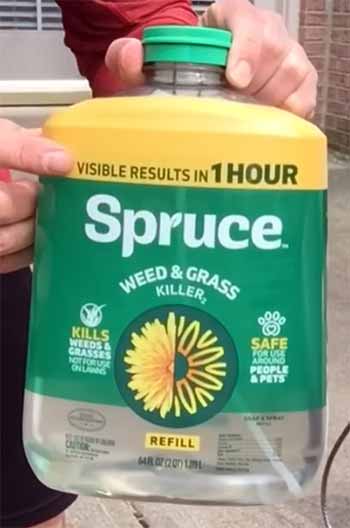
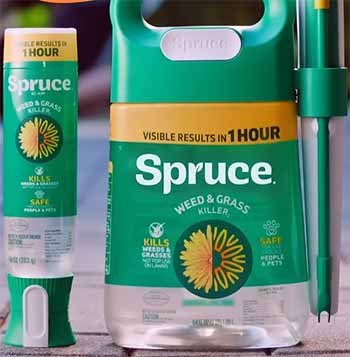
This time, I grabbed the Spruce Power Wand starter kit I had bought on a whim. The first thing I noticed was the lack of “prep.” I didn’t have to mix concentrate with water or fiddle with a measuring cup. I just snapped the wand into the cap, removed the battery tab, and I was live.
As I pulled the trigger, I braced myself for that harsh, stinging chemical odor that usually lingers in the nose for hours. It never came. Instead, the air filled with a scent that was surprisingly pleasant—like a mix of strong peppermint and citrus. It smelled more like a cleaning product or a candle than an herbicide.
I targeted the dandelions first. The wand provided a continuous spray, which was a massive upgrade from the hand-cramping pump sprayers I was used to. I drenched the leaves, making sure they were fully coated, as the instructions emphasized coverage.
Here is the crazy part: I went inside to refill my coffee, and when I came back out about an hour later, the weeds looked… sad. The bright green had already started to dull, and the leaves were curling inward. It wasn’t the slow, two-week death march you get with systemic killers; this was immediate, visible dehydration.
By the next afternoon, the weeds in the cracks were crispy, brown, and dead. Best of all, once the spray dried (which took about 15 minutes in the sun), I let the dog out without a second thought. That peace of mind alone was worth the price of admission.
Why I Am Sticking With Spruce (Pros)
There is a lot to love about this product, and honestly, it has changed how I approach yard work. It feels less like a chore and more like a quick maintenance task.
- The “Pet Parent” Peace of Mind
This is, without a doubt, the biggest selling point.
If you have dogs, cats, or young children, you know the panic of wondering if they touched the “bad grass.”
Spruce uses ingredients like cornmint oil and geraniol.
While you still shouldn’t spray it directly on your pet (obviously), the downtime is minimal.
Once it is dry, it is safe. This means I can spot-treat a weed in the morning and have the kids playing in that same spot by lunch.
You don’t have to plan your weeding around a 24-hour quarantine window.
- Immediate Visual Feedback
We live in a world of instant gratification, and weeding is usually the exception. With traditional killers, you spray and wait… and wait. You wonder, “Did I use enough? Is it working?” With Spruce, the gratification is almost instant.
Because it works by stripping the waxy coating off the weed and dehydrating it, you see the wilting happen in real-time. It is oddly satisfying to watch the weeds shrivel up within hours. It gives you the confidence that the job is done.
- The Aromatherapy Factor
I touched on this in my experience, but it bears repeating. Most herbicides smell aggressive. Spruce smells like a spa day gone wrong, but in a good way. The peppermint oil is dominant, and it actually makes the task of spraying pleasant.
You don’t feel like you need a shower immediately after using it.
- The Power Wand Ergonomics
If you have a large driveway or a lot of hardscaping, the manual trigger bottles are a nightmare for your grip strength. The battery-operated Power Wand included in the larger kits is fantastic. It delivers a consistent, steady stream or mist without you having to pump anything. It saves time and saves your hands.
Where Spruce Weed Killer Falls Short (Cons)
However, no product is perfect, and Spruce has limitations that you need to be honest about before buying.
- The Root of the Problem
Because Spruce is a “contact” herbicide, it kills what it touches. It burns down the plant tissue it lands on. It is not a systemic killer like glyphosate, which absorbs into the plant and travels down to kill the root.
For small annual weeds, Spruce is lethal. But for an established, monster dandelion with a taproot the size of a carrot? You might burn off the leaves, but that root is still alive underground. I found that some of the tougher weeds would send up new shoots a week later, requiring a second spray. You are trading the “kill it forever” power of harsh chemicals for the safety of essential oils.
- It Is a Grass Killer, Too
The name says “Weed & Grass Killer,” and they mean it. This is not a selective herbicide that you can spray all over your lawn to kill clover while leaving the Bermuda grass alone. If you spray this on your lawn, you will have dead spots of grass.
It is strictly for precision work: cracks in the driveway, mulch beds, gravel paths, and patios. Do not use this as a broadcast spray on your turf unless you want a brown lawn.
- The Cost Factor
Essential oils and fancy spray wands cost money. Spruce is generally more expensive per ounce than the generic gallon jugs of chemical weed killer. If you have acres of land to clear, this will get expensive fast.
It is designed for the suburban homeowner with a patio and a driveway, not a farmer clearing a field.
Application Tips For Spruce Weed Killer
To get the most out of Spruce, you have to treat it differently than the old-school poisons. You are using physics (dehydration), not just toxicity, to kill the plant.
- The Sun Is Your Best Friend: Since Spruce works by dehydrating the plant, it works best when the sun is helping. I have found that spraying on a hot, sunny day at noon yields devastating results for the weeds. If you spray on a cloudy, humid, or rainy day, the effectiveness drops significantly. The product needs that heat to evaporate the moisture from the weed’s cells once the oils have broken down the surface.
- Drench, Don’t Mist: With systemic killers, a light mist is often enough. With Spruce, you need coverage. You need to coat the leaves entirely because only the parts you touch will die. I like to set the nozzle to a slightly wider spray to ensure I am getting the stems and the undersides of the leaves if possible. If you miss half the leaf, half the leaf will survive.
- Shake It Up: Natural ingredients have a tendency to separate. The oils can float to the top or settle. Before you start spraying, give the container a vigorous shake. This ensures you are spraying the active mixture and not just the carrier fluid. If you feel like the product isn’t working, it is often because it wasn’t mixed well enough in the bottle.
- Battery Care: If you opt for the Power Wand, remember to flip the switch to “lock” or remove the batteries if you are storing it for the winter. I made the mistake of leaving the wand “on” in the shed, and the batteries were dead when spring rolled around. Also, if the spray seems weak, check the nozzle for dried oil residue; a quick wipe with a warm cloth usually clears it.
Spruce Weed Killer Vs. The Competition
Understanding where Spruce fits in the market helps you decide if it is the right tool for your shed.
- Spruce Vs. RM43 Weed Killer
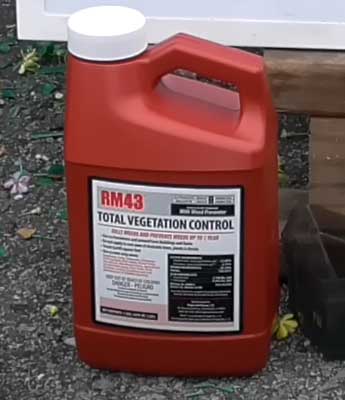
If Spruce is a scalpel, RM43 is a sledgehammer.
I have used RM43 on the back fence line of my property where I didn’t want anything to grow for a year, and it works terrifyingly well.
The primary difference here is longevity and toxicity. RM43 contains Glyphosate and Imazapyr.
The Imazapyr is a soil sterilizer, meaning it stays in the ground and prevents anything from growing for up to 12 months.
When I compare this to Spruce, the use cases are completely opposite. I would never spray RM43 on my patio or near my flower beds because the runoff could kill the roots of my prize roses or the oak tree nearby.
Spruce, with its essential oil base, has no soil activity. You spray it, it kills the foliage, and it degrades rapidly. If I decide next week that I want to plant a fern where a weed used to be, I can do that with Spruce. With RM43, that ground is poisoned for a year.
The safety profile is the other massive divider. When I use RM43, I am in full PPE—rubber boots, long sleeves, mask—because that stuff is potent. With Spruce, I feel comfortable spraying it in shorts (though I still wear shoes).
If you need to keep a gravel parking lot 100% bare for a year and don’t have pets roaming there, RM43 is the winner. But for a family backyard where kids and dogs play on the patio, RM43 is overkill and potentially hazardous, making Spruce the only logical choice for high-traffic zones.
- Spruce Vs. Vigoro Weed & Feed

The confusion between these two usually comes down to the word “Weed,” but they are enemies in the turf war.
Vigoro Weed & Feed is designed to save your grass while killing the intruders.
Spruce is an equal-opportunity killer; if you spray Spruce on your lawn to kill a dandelion, you will kill the dandelion and the circle of Bermuda grass surrounding it.
I look at this as a difference in mechanism and timing. Vigoro is a granular product that you have to apply with a spreader, usually in the morning when the grass is damp so the granules stick to the weed leaves. It is a slow burn.
You apply it, water it in later, and wait weeks for the weeds to curl up and die while the nitrogen boosts your grass. It is a broadcast solution for a whole lawn problem.
Spruce is for the areas Vigoro cannot touch. You can’t put Vigoro on a brick walkway or a driveway crack because there is no soil for the fertilizer to activate, and the granules will just wash away into the storm drain.
I use Vigoro to manage the health of my actual lawn turf, but I keep the Spruce Power Wand for the hardscapes and mulch beds where I need precision death, not feeding. Attempting to spot-treat a single weed with a handful of Vigoro is ineffective, just as trying to treat your whole lawn with Spruce would be a disaster.
- Spruce Vs. Menards Premium Weed & Feed

Comparing Spruce to the Menards house brand of Weed & Feed highlights a major difference in “application anxiety.”
The Menards product, much like Vigoro, relies on a precise schedule.
You need the right temperature (usually below 85 degrees), the right moisture (morning dew), and no rain in the forecast for 24 to 48 hours.
If you mess that up, you either burn your lawn with too much nitrogen or the weed killer doesn’t stick and fails to work.
Spruce frees you from that calendar watching. I found that Spruce actually thrives in the conditions that Menards Weed & Feed hates.
Spruce loves heat. The hotter and drier it is, the faster the essential oils strip the weed’s moisture.
I can go out at noon on a 90-degree Saturday—a time when applying Menards Weed & Feed would scorch my lawn—and attack the weeds on my patio with maximum effectiveness.
There is also the issue of “tracking.” With granular products like the Menards Weed & Feed, I am always paranoid about the little yellow or white pellets getting stuck in my shoe treads and tracking them onto the hardwood floors or into the garage.
It is messy. Spruce is a liquid that dries in minutes. Once it is dry, it is gone. There is no residue to track into the house. While the Menards bag is the economical choice for treating 5,000 square feet of turf in one go, it is clumsy and dirty compared to the surgical, clean convenience of the Spruce wand for day-to-day maintenance.
Frequently Asked Questions (FAQ)
Spruce is a contact herbicide using essential oils and soaps to dehydrate plants, making it safer for pets once dry. Roundup uses glyphosate, a systemic chemical that kills the root but carries higher toxicity risks.
The active ingredients are primarily essential oils, specifically Cornmint Oil, Geraniol, and Mentha Arvensis Oil, combined with Sodium Lauryl Sulfate (soap).
You will typically see visible results (wilting, browning) within 1 hour, with the weed fully drying out within 24 hours.
No, it is a contact killer. It kills the foliage it touches but does not travel down to kill deep taproots, so reapplication may be needed for established weeds.
Final Thoughts
Spruce Weed & Grass Killer represents a shift in how we maintain our outdoor spaces. It moves us away from the “kill at all costs” mentality toward a safer, more family-friendly approach.
While it may require a second pass on tough weeds and costs a bit more than the harsh chemicals, the trade-off is undeniable. You get a clean patio, a great smell, and the freedom to let your dog run outside minutes after you are done.
For the modern homeowner, that peace of mind is the ultimate luxury. You can buy it at Walmart, Home Depot, or spruceit.com.