
I remember standing in the aisle of my local hardware store, staring at a wall of red tools, completely paralyzed. On one side, the compact M12s looked like the perfect lightweight companions.
On the other, the M18s promised enough raw power to tear down a house. If you are stuck in that same “Red vs. Red” debate, you are not alone.
I’ve used both extensively on everything from weekend DIY cabinet installs to heavy structural repairs, and the answer isn’t just about voltage—it’s about how you work. In this article, I’ll break down exactly which system belongs in your garage based on real-world use, not just spec sheets.
| Feature | Milwaukee M12 System | Milwaukee M18 System |
| Voltage | 12 Volts | 18 Volts |
| Primary Focus | Portability, Precision, Tight Spaces | Raw Power, Runtime, Heavy Duty |
| Battery Style | Stick (in-handle) & Compact Flat Base | Slide-on Pack (Flat Base) |
| Tool Weight | Ultra-lightweight (typically 2-3 lbs) | Standard to Heavy (typically 4-8 lbs) |
| Best For | MEP trades, HVAC, Cabinetry, DIY | Framing, Demolition, Outdoor Power |
| Motor Tech | Brushed & Brushless (FUEL) | Brushed & Brushless (FUEL) |
| Price Point | Budget-friendly to Mid-range | Mid-range to Premium |
Key Differences Between Milwaukee M12 And M18
When you strip away the marketing, the battle between these two platforms comes down to a few fundamental philosophies. It is not just about one being “better” than the other; it is about physics and ergonomics.
- Size and Weight Factors
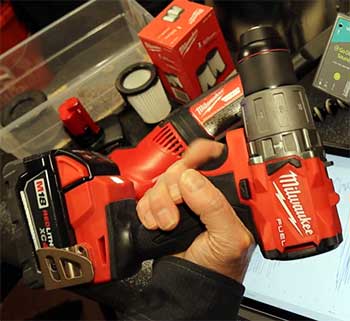
The most immediate difference you will feel is the physical footprint.
The M12 tools are designed to disappear into a tool bag.
The handle ergonomics are thicker because the “stick” battery slides inside the grip, but the overall head length is often tiny.
I can easily fit an M12 impact driver in between floor joists or inside a kitchen cabinet without needing a right-angle adapter.
In stark contrast, the M18 tools are your standard jobsite workhorses. They use a slide-pack battery that sits at the bottom of the tool, acting as a stable base. While this makes the tool stand up easily, it adds significant bulk and weight.
After holding an M18 drill overhead for an hour to hang drywall, your shoulder will let you know exactly how heavy it is.
- Power Output Capabilities
Voltage equates to potential power, and this is where the gap widens. Don’t underestimate 12 volts, though. The modern M12 FUEL (brushless) line produces more torque than my old 18V brushed tools from ten years ago.
For 80% of tasks—driving 3-inch deck screws, drilling pilot holes, or cutting PVC—the M12 has plenty of grunt.
However, the M18 is for when you need to replace a corded tool. If you are mixing buckets of concrete, drilling 1-inch holes through masonry, or ripping pressure-treated lumber all day, the M18 delivers sustained power without bogging down.
It maintains high RPMs under heavy load where the M12 might stall to protect itself.
- The Battery Ecosystem
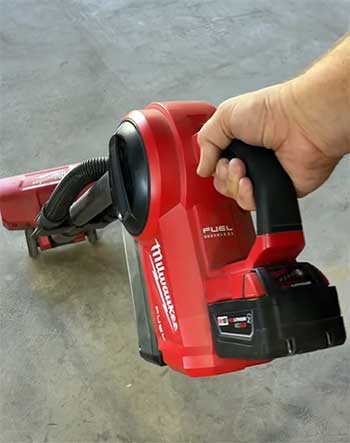
The M12 batteries range from compact 1.5Ah sticks to larger 6.0Ah “XC” packs that widen the base of the tool.
They are relatively cheap and charge very fast.
The M18 batteries, on the other hand, are an investment.
They range from slim 2.0Ah packs to massive 12.0Ah High Output bricks.
The beauty of the M18 system is that the same battery powering your drill can also power a lawnmower, a table saw, or a giant jobsite light.
Deep Dive: Milwaukee M12 System
The M12 system is arguably the most surprising tool line on the market. Years ago, 12-volt tools were seen as “toys” for homeowners. Milwaukee changed that narrative completely by making the M12 line professional-grade. I find myself reaching for these tools 90% of the time simply because they are easier to handle.
Key Features of the M12 Line
- Compact “Stick” Battery Design: The battery slides into the handle, keeping the tool profile slim.
- Dedicated “Stubby” Impact Wrenches: Famous for fitting into wheel wells and engine bays where air tools used to be king.
- Specialty Trade Tools: The M12 line includes incredibly niche tools like PEX expanders, copper tubing cutters, and thermal imagers that don’t exist on other 12V platforms.
- Hybrid Lighting: Many M12 lights are small enough to clamp onto a pipe or hang from a magnetic hook.
Pros of the M12 System
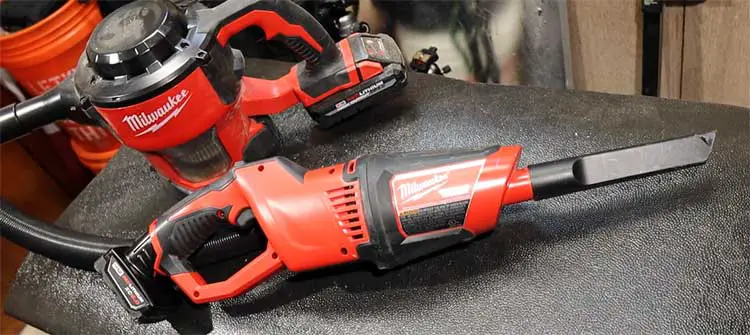
- Incredible Ergonomics: The weight savings cannot be overstated. If you are a plumber, electrician, or HVAC tech climbing ladders or crawling into attics, every ounce matters. You can hang an M12 drill on your belt and forget it’s there.
- Fits Anywhere: I have installed drawer slides in a 12-inch cabinet where my M18 impact driver simply physically would not fit. The M12 maneuverability saves you from stripping screws at weird angles.
- Cost-Effective: You can often buy a full M12 combo kit (Drill + Impact) for the price of a single M18 bare tool. For apprentices or homeowners, the barrier to entry is much lower.
- Surprisingly Capable Power: With the “FUEL” brushless models, you are getting performance that rivals many entry-level 18V tools from other brands. It handles lag bolts and hole saws better than you would expect.
Cons of the M12 System
- Thicker Grip Handle: Because the battery lives inside the handle, the grip circumference is wider. If you have smaller hands, this can actually be more fatiguing than the M18 grip over a long day.
- Limited Runtime on High Draw: If you try to use an M12 circular saw to rip sheet goods for four hours, you will be swapping batteries constantly. It just doesn’t have the fuel tank for sustained high-wattage work.
- Lack of Heavy Outdoor Equipment: You won’t find an M12 lawnmower or a full-size chainsaw. This system is strictly for handheld power tools and inspection gear.
- Stand-Up Issues: With the smaller batteries, M12 tools are top-heavy and don’t stand up on their own; you have to lay them on their side, which can scuff up the tool housing.
Deep Dive: Milwaukee M18 System
The M18 system is the industry standard for a reason. It is the “do-it-all” platform. If you are framing a house, building a deck, or doing automotive restoration, the M18 system ensures you never run into a situation where the tool “just can’t do it.”
Key Features of the M18 Line
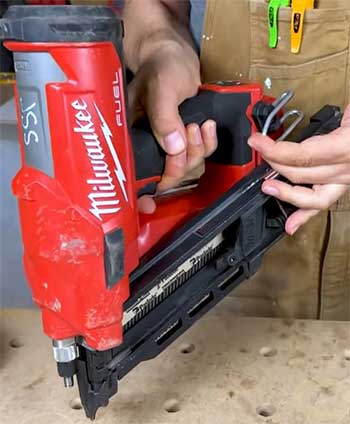
- High Output Battery Tech: The M18 platform utilizes advanced 21700 battery cells in their “High Output” packs, allowing tools to draw massive current without overheating.
- One-Key Technology: Many M18 tools come with Bluetooth tracking and customization, allowing you to dial in specific torque settings or track the tool’s location if it gets stolen.
- Desktop-Grade Power: The M18 Table Saw and Miter Saw run off the same batteries as your drill, effectively cutting the cord on the entire jobsite.
- Universal Slide Pack: The battery interface is robust and allows for huge capacity options, up to 12.0Ah, which is like carrying a generator in your hand.
Pros of the M18 System
- Unmatched Power: When you pull the trigger on an M18 FUEL Sawzall, it eats through cast iron, thick steel, and nail-embedded wood aggressively. There is no hesitation.
- Massive Tool Selection: The M18 ecosystem is vast. It includes everything from standard drills to obscure tools like knockout punches, threaders, and even backpack vacuums. You can run your entire professional life on this one battery.
- Outdoor Power Equipment: You can use the same M18 batteries for your leaf blower, string trimmer, and hedge trimmer. This dual-use capability is a huge money saver for homeowners who do their own yard work.
- Runtime King: With a 5.0Ah or 6.0Ah battery, you can often work a full half-day or more on a single charge. For production work, this efficiency is critical.
Cons of the M18 System
- Heavy and Bulky: There is no getting around it—these tools are bricks. Using an M18 impact driver for small tasks like installing light switch covers feels ridiculous and tires out your wrist.
- Expensive Batteries: The larger M18 batteries are significantly pricier than M12s. Replacing a dead 5.0Ah or 12.0Ah battery is a painful hit to the wallet.
- Overkill for Precision: The raw power can sometimes be a detriment. It is much easier to accidentally overdrive a screw or crack delicate trim with an M18 impact driver than with the more forgiving M12.
- Space Hog: M18 tools take up a lot of space in your truck or workshop. A kit of four M18 tools might require two large Packout boxes, whereas the M12 equivalent fits in one.
The Finish Nailer Face-off: M12 Vs. M18
This is one of the most specific and heated debates in the Milwaukee community. If you are a finish carpenter or a DIYer looking to install trim, which nailer do you buy?
The M18 Finish Nailers (18 gauge brad, 16 gauge, and 15 gauge) are widely considered some of the best battery nailers ever made. They fire instantly with zero ramp-up time (unlike the old flywheel styles).
They can sink 2-inch or 2.5-inch nails into solid oak without blinking. However, the M18 brad nailer is huge. It looks like a sci-fi weapon. If you are trying to nail crown molding inside a closet, the M18 is going to be a headache to maneuver.

The M12 Finish Nailers (specifically the 23 gauge pin nailer and the newer 18 gauge brad nailer) are compact marvels.
The M12 18-gauge brad nailer is significantly lighter and smaller than its M18 brother. It fits between studs easily.
However, there is a trade-off: the M12 brad nailer typically tops out at 1.5-inch nails (though some newer specs push this, the effective reliable range for the compact platform is shorter).
If you need to shoot 2-inch nails through thick baseboards into drywall and studs, the M12 might come up short on capacity or power depth compared to the M18.
My Verdict: If you are doing standard door casings and baseboards, get the M18 for the versatility of nail length. If you are a cabinet installer or doing light trim/paneling where you rarely need nails longer than 1.25 inches, the M12 will save your arm from falling off by 2 PM.
Also Read: My Thoughts On Eureka AirSpeed Vacuum.
Frequently Asked Questions (FAQ)
Yes, primarily in size and power. M18 is a larger, heavier 18-volt platform designed for heavy-duty construction and high runtime. M12 is a compact 12-volt platform designed for portability, lighter tasks, and working in tight spaces.
The M18 finish nailer is larger, heavier, and can drive longer nails (up to 2-1/8″ or 2-1/2″ depending on the model), making it better for thick trim. The M12 finish nailer is lighter and more compact but generally limited to shorter nails (often maxing out around 1.5″), making it better for cabinetry and light molding.
The M12 is excellent for electricians, plumbers, HVAC techs, and homeowners who need tools that fit in tight spaces (like under sinks or between joists). It is perfect for drilling pilot holes, driving standard screws, cutting PVC, and automotive work where portability beats raw power.
No. The battery interfaces are physically different. M12 batteries are “stick” style that insert into the tool handle, while M18 batteries are slide-packs that attach to the bottom of the tool. They are not interchangeable, though many chargers can charge both types.
Final Thoughts
Choosing between the Milwaukee M12 and M18 platforms usually isn’t about picking a “winner,” but rather picking the right teammate for your work. If you are a general contractor framing additions and building decks, you need the M18 system.
Its raw power and runtime are non-negotiable for heavy construction. However, if you are a DIY enthusiast, an electrician, or someone who mostly does repairs and installations, the M12 system is likely all you will ever need. It punches way above its weight class and is a joy to use because it doesn’t wear you out.
Personally, I started with M18 because I thought “more power is always better.” Over the years, I’ve slowly transitioned to using M12 for 90% of my daily tasks. I only drag the big M18 box out when I have to mix concrete or cut 4×4 posts.
My advice?
Start with the M12 FUEL drill and impact driver kit. You will be shocked at how much they can do. If you eventually hit a task they can’t handle, buy that specific tool in the M18 version. But for most of us, the little red tools are the real MVPs.