
If you are currently standing in the aisle of a hardware store or hovering over a “Buy Now” button wondering if this little red box is worth the cash, the short answer is yes.
You should buy the Milwaukee M12 Compact Vacuum if you are already invested in the M12 ecosystem or if you need a dedicated, ultra-portable solution for small, dry messes that does not require dragging out a shop vac.
It is not a whole-house replacement, but for quick tactical strikes against sawdust, drywall dust, and vehicle interiors, it is arguably the best in its class.
My Experience With The Milwaukee M12 Vacuum
I remember the exact moment I decided my massive, corded shop vacuum was overkill.
I had just finished installing a new dimmer switch in the hallway.
There was a small pile of drywall dust and wire strippings on the floor—maybe a cup’s worth of debris.
Dragging the 12-gallon beast up from the garage, uncoiling twenty feet of extension cord, and finding an outlet just to clean up a mess that would take ten seconds to vacuum felt ridiculous. That is when I finally pulled the trigger on the Milwaukee M12 Compact Vacuum.
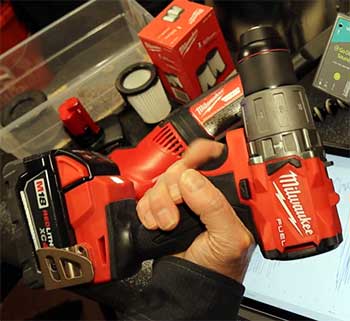
Taking it out of the box, the first thing that struck me was the form factor. It does not look like a traditional dustbuster, nor does it look like a miniaturized shop vac. It looks like a tool. It fits in your hand like a drill or a reciprocating saw.
It feels dense and well-constructed, with that familiar glass-filled nylon housing that Milwaukee users have come to expect.
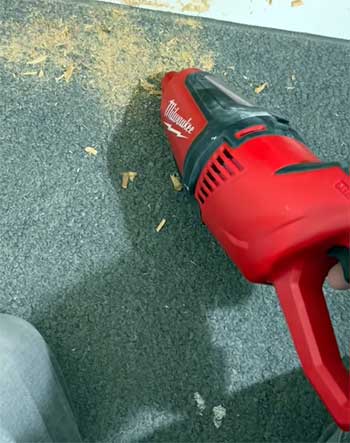
My first test was that hallway mess. I slapped in a 4.0 Ah XC battery, hit the trigger lock, and watched the drywall dust vanish. The suction was surprising for a 12-volt tool. It did not just politely ask the dust to move; it snapped it up.
The clear viewing window on the canister was immediately gratifying, letting me see exactly what I had captured.
Over the last few months, this thing has become my “daily driver” for cleanup. It lives in my truck door panel half the time and on my workbench the other half. I have used it to clean crushed cheerios out of car seats, sawdust off my miter saw fence, and even to suck a spider out of a corner of the ceiling (sorry, buddy).
One specific instance that sold me completely was detailing my truck. usually, this is a nightmare of extension cords and dragging a heavy canister around the driveway. With the M12, I just walked out, crawled into the back seat, and went to town.
The crevice tool clicked on securely, and I was able to get deep into the seat rails where fries go to die. The lack of a hose was actually a benefit here; the whole unit is the nozzle, so you have direct control over where the suction is applied. It changed my mindset from “cleaning is a chore” to “cleaning is a quick task I can do in two minutes.”
Pros of The Milwaukee M12 Vacuum
- Unmatched Portability and Ergonomics
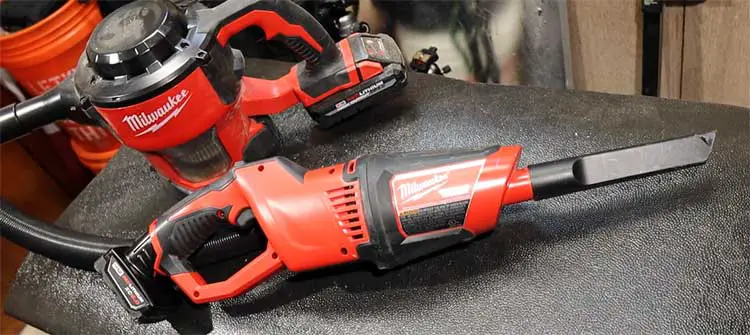
The single biggest advantage of this unit is how it feels to use. Most handheld vacuums are unbalanced. They are front-heavy or have awkward handles that strain your wrist after a few minutes. Milwaukee designed this with the grip of a power tool.
The weight sits comfortably in your hand, and the battery acts as a counterweight at the bottom. You can maneuver it overhead, sideways, or upside down without fighting gravity. Because it is so compact, it fits into tight spaces—like under a sink or inside a cabinet—where a larger vacuum hose might be clumsy to wrangle.
- Surprising Suction Power
We need to talk about the 12-volt motor. Generally, 12-volt tools are seen as the “lite” versions of their 18-volt cousins, but the airflow this unit generates is impressive. It is rated for roughly 33 CFM (cubic feet per minute).
While that sounds low compared to a corded unit, the seal pressure is high. This means it pulls hard against surfaces. When you put the flat utility nozzle against a floor mat, you can feel it grabbing the fabric. It has enough static lift to pull embedded sand and heavy debris like metal shavings or wood screws, which is something many weaker “dustbuster” style vacuums struggle with.
- The M12 Battery Ecosystem
If you are reading this, there is a good chance you already own a red tool or two. The beauty of this vacuum is that it breathes new life into your existing batteries. It runs on the same battery that powers your drill, your heated jacket, or your hackzall.
You do not need a proprietary charger or a built-in battery that dies after three years, turning the whole tool into e-waste. If the vacuum runs out of juice, you just swap the pack and keep going. This interoperability is a massive cost saver and convenience factor that cannot be overstated.
- Intelligent Attachment Design
Milwaukee included a crevice tool, a utility nozzle, and an extension wand. What makes this a “pro” is not just that they exist, but how they fit. They friction-fit tightly, but they also have a distinct “tool-like” quality.
The extension wand allows you to use the vacuum almost like a miniature upright for spot cleaning floors without bending over. The crevice tool is narrow enough for sliding door tracks and tight automotive gaps.
Furthermore, the vacuum has a lock-on switch. This sounds minor, but many handhelds require you to hold the trigger down constantly. Being able to lock it in the “on” position reduces fatigue significantly during longer cleanup sessions.
Cons of The Milwaukee M12 Vacuum
- Limited Bin Capacity
The trade-off for that sleek, compact design is a very small dust canister. It fills up fast. If you are planing a piece of wood and generating mountains of shavings, you will be emptying this thing every three minutes. It is strictly for small messes.
The canister is also a bit tricky to empty completely without getting your hands dirty, as dust tends to cling to the sides of the plastic housing. You often have to reach in and pull out clumps of hair or carpet fibers that get stuck between the filter and the casing.
- Filter Maintenance Requirements
The filter on the M12 is a pleated paper filter. While it is effective at trapping fine dust, it clogs very quickly. Once the pleats are packed with drywall dust or fine sawdust, suction drops off a cliff.
You cannot just shake it out; you really have to brush it off or bang it against a trash can aggressively to restore performance. If you are sucking up primarily fine particulates, you will find yourself cleaning the filter more often than you are cleaning the floor.
- Battery Runtime on High Demand
While the M12 system is great, this vacuum is a high-drain device. If you use a small 2.0 Ah battery (the compact ones), you might only get 8 to 10 minutes of runtime. The vacuum motor pulls a lot of amps to generate that suction.
To get a truly usable runtime for a car detail or a larger cleanup, you essentially need to use the XC 4.0 or XC 6.0 extended capacity batteries. If you only have the small batteries that came with a drill kit, you will likely find the runtime frustrating.
Maintenance Tips For Longevity of Milwaukee M12 Vacuum
- The Filter Cleaning Ritual
To keep this vacuum performing like new, you have to treat the filter as a consumable that needs constant care.
Do not just dump the canister.
After every few uses, take the filter out. If you have an air compressor, give it a gentle blast of air from the inside out.
This pushes the embedded dust out of the pores of the paper.
If you do not have a compressor, tap the hard plastic rim of the filter against the inside of your trash can.
Do not hit the paper pleats themselves, as they can crush or tear.
I also recommend buying a backup filter. Keep one washed and drying (yes, you can gently wash them, but they must be bone dry before use) while you use the other. This rotation ensures you never have downtime.
- Managing the Canister Latch
One weak point on this unit can be the canister latch mechanism. It is a plastic clip that holds the dust bin to the motor housing. If you let debris build up in the interface where the two parts meet, the latch won’t seat properly. Over time, forcing it can cause the plastic to stress and break.
Make sure to wipe the rim of the canister with a rag every time you empty it. A clean seal ensures the vacuum closes easily and also improves suction efficiency by preventing air leaks.
- Motor and Inlet Care
Occasionally, you should inspect the inlet—the hole where the debris enters the canister. Because of the 90-degree turn the air makes, long objects like toothpicks or nails can sometimes get lodged in the throat of the vacuum, creating a bridge for other debris to pile up against.
Shine a flashlight down the intake every once in a while to ensure it is clear. Also, keep the battery contacts clean. This vacuum draws high current, and dusty contacts can lead to voltage drops that make the motor sound weak or cut out intermittently.
A quick wipe with a dry cloth or a little contact cleaner on the battery terminals ensures full power delivery.
Comparing The M12 To The Competition
The Battle Against the Yellow Brand
When you look at the Dewalt 20V Max cordless hand vacuum, you are seeing a different philosophy. The Dewalt is a wet/dry unit, whereas the Milwaukee M12 is strictly dry. This gives Dewalt a distinct edge if you are a plumber or dealing with spills. However, the Dewalt unit is significantly bulkier.
It has a hose-style design that makes it feel more like a tool box than a handheld wand. The Milwaukee M12 is far more agile. You can holster the Milwaukee in a large tool belt loop or toss it in a small bag. The Dewalt demands its own space.
If your priority is raw power and water cleanup, the yellow team wins. If your priority is grab-and-go convenience and fitting into tight spaces, the Milwaukee M12 is the superior design.
- Comparing to the M18 Big Brother
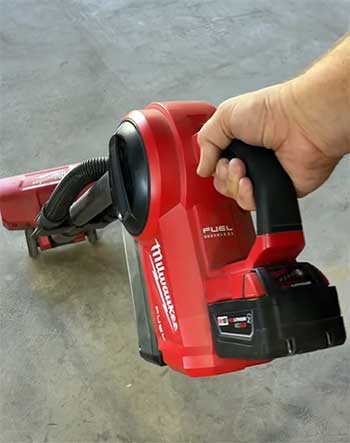
Milwaukee makes an M18 version of this vacuum, and the confusion between the two is common.
The M18 Compact Vacuum is essentially the M12 on steroids.
It has a larger canister, slightly more suction, and runs on the 18-volt platform.
However, bigger is not always better. The M18 unit is heavier and longer.
It loses that magical balance that the M12 possesses.
The M18 can feel unwieldy for quick tasks, like dusting off a workbench or cleaning a dashboard.
The M12 hits a sweet spot where the power-to-weight ratio is perfect. Unless you are exclusively on the M18 platform and refuse to buy M12 batteries, the M12 vacuum is actually the better “handheld” experience. The M18 tries to be a shop vac replacement and falls short, while the M12 knows exactly what it is—a spot cleaner—and excels at it.
- The Dyson Comparison
It might seem unfair to compare a tool brand to a luxury home appliance brand like Dyson, but for many homeowners, this is the real decision. A Dyson handheld trigger vacuum is a marvel of engineering. It has cyclonic action, superior filtration, and looks like a space weapon.
It also costs three to four times as much as the Milwaukee M12 (tool only). The Dyson is fragile. If you drop a Dyson on a concrete garage floor, you are likely out several hundred dollars. If you drop the Milwaukee M12, you pick it up and keep working. The Milwaukee is built to survive job sites. It handles screws, metal shavings, and rough treatment that would destroy a Dyson’s delicate bin mechanisms. For pristine home interiors, the Dyson wins.
For the garage, the workshop, the car, and the renovation zone, the Milwaukee is the only logical choice.
Also Read: Differences Between Fein And Festool Workshop Vacuums.
Frequently Asked Questions (FAQ)
There is no “FUEL” version of this specific compact vacuum yet, but on the standard brushed motor model, you can expect roughly 15-20 minutes of runtime with a 4.0 Ah battery, or about 8-10 minutes with a smaller 2.0 Ah compact battery.
It handles dry materials only: drywall dust, sawdust, metal shavings, screws, wood chips, dirt, sand, and general household debris like crumbs or pet hair. It is not rated for water or wet debris.
Ratings vary by category, but for heavy-duty job site handhelds, the Milwaukee M18 and M12 lines are consistently top-rated for durability, while Dyson V-series vacuums often top the charts for residential whole-home cleaning power.
For a handheld vacuum, the M12 is better due to its lighter weight and superior maneuverability. The M18 offers more power and runtime but is heavier and bulkier, making it less convenient for quick, small cleanup jobs.
Final Thoughts
The Milwaukee M12 Compact Vacuum is not designed to replace your rigid shop vac or your household upright. It is designed to fill the gap between “I can’t be bothered to clean that up” and “I need to get the heavy equipment.” It removes the friction from cleaning.
It turns a five-minute setup into a ten-second reaction. If you value efficiency, own M12 batteries, and want a tool that survives the rigors of real work, this vacuum is a mandatory addition to your kit.