
As a passionate home cook who spends weekends firing up the grill or smoker, I know how frustrating it can be to guess when meat is perfectly done. Over the years, I’ve tested countless thermometers, and two stand out: Meater and Thermoworks.
This article breaks down my real-world experience with both, comparing their wireless probe systems to help you pick the one that fits your cooking needs. I’ll share features, strengths, weaknesses, and key differences so you can cook with confidence.
| Feature | Meater (Pro/Pro Duo models) | Thermoworks RFX |
| Price (single probe setup) | $130 (Pro) to $200 (Duo) | $168 (starter kit with probe + gateway) |
| Accuracy | ±0.9°F internal, multiple sensors for gradient | ±0.5°F claimed, lab-grade precision |
| Range | Up to 165 ft Bluetooth, unlimited with WiFi repeater | Up to 1,500 ft via proprietary radio to gateway |
| Connectivity | Direct Bluetooth + WiFi repeater option | Proprietary RF to gateway, then app |
| App Features | Advanced guided cooks, time estimates, recipes | Basic temp graphs, alarms, no predictions |
| Battery Life | Up to 24+ hours per charge | Up to 60+ hours per charge |
| Ambient Temp Measurement | Built into probe end | Separate clip-on probe for accuracy |
| Max Temp Tolerance | Up to 1000°F (newer models) | Up to 700°F meat, 1000°F ambient |
| Probes Included | 1-4 depending on model | 1 in starter, expandable |
Key Differences Between Meater And Thermoworks RFX
These contrasts shape which one you’ll prefer.

- Design philosophy — Meater goes all-in on a single, completely wireless probe with no external parts, prioritizing simplicity and a clean look that’s perfect for casual cooks or anyone who hates dealing with cables. Thermoworks RFX, by contrast, uses a probe plus a separate gateway and clipped ambient sensor, embracing a more traditional pro-style setup that favors maximum accuracy over minimalism.
- Connectivity approach — Meater relies on Bluetooth directly from the probe, with an optional WiFi repeater in the charger for cloud access, which works well but can occasionally drop in challenging environments. RFX uses a dedicated proprietary radio frequency signal to its gateway, delivering rock-solid connection even through thick smoker walls or over long distances.
- Ambient temp method — Meater measures ambient temperature from the exposed end of the same probe, which is convenient but can be affected by proximity to cold meat or uneven heat distribution. RFX includes a separate, clip-on ambient probe that you position away from the food, giving far more reliable and independent pit temperature readings.
- App experience — Meater’s app acts like a cooking coach, offering step-by-step guided cooks, finish-time predictions, rest timers, and recipe suggestions that make it feel almost foolproof. The Thermoworks app sticks to clean graphs, customizable alarms, and raw data logging—straightforward and powerful, but you have to bring your own cooking knowledge.
- Range and reliability — RFX easily hits hundreds of feet with virtually no dropouts thanks to its dedicated radio system, making it ideal for large yards or walking away for hours. Meater’s Bluetooth range is shorter without the repeater, and even with it, I’ve seen occasional interruptions on very long or obstructed cooks.
- Battery and charging — Both are rechargeable and reliable, but RFX probes consistently deliver longer runtime—often 60+ hours—while Meater Pro probes top out around 24-48 hours depending on the model and usage.
- Cost structure — A single Meater Pro probe is more affordable upfront if you only need one, but expanding to multiple probes quickly raises the price. RFX requires the gateway from the start, making the initial kit pricier, though adding extra probes later is generally more budget-friendly.
- Use case fit — Meater shines in ovens, rotisseries, air fryers, or any setup where wires would be a hassle, and its guided features make it great for holidays or complex roasts. RFX is built for serious low-and-slow smoking and grilling, where stable long-range monitoring and precise ambient readings matter most.
- Accuracy focus — Thermoworks RFX edges out with lab-grade calibration and separate sensors, giving the kind of precision competition pitmasters demand. Meater is plenty accurate for home use (±0.9°F) and focuses more on usable estimates and gradient mapping than absolute lab perfection.
- Expansion — Both systems support multiple probes, but RFX makes scaling up more affordable and seamless since the gateway handles many probes at once. Meater’s multi-probe options (like the Block) work great but come at a premium price per probe.
Your style—smart assistance or unflinching accuracy—decides the winner.
I’ve used Meater for family holidays where its guidance prevents disasters, and RFX for low-and-slow smokes demanding exact control. Both elevate cooking, but they serve different needs.
Also Read: Differences Between FireBoard 2 Drive And Pro Smart Thermometers.
Key Features of Meater
I’ve relied on Meater for everything from quick weeknight steaks to all-day brisket smokes. Its design eliminates wires completely, which changes the game for rotisserie or oven cooks.
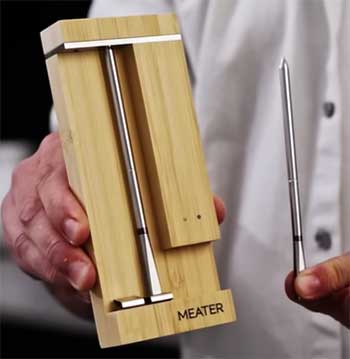
- Truly wireless single-probe design — The entire unit inserts into the meat—no external transmitters or clipped bases. I love spinning a whole chicken on the rotisserie without cables tangling.
- Multiple internal sensors — Five or more sensors along the probe create a temperature gradient. The app pinpoints the coldest part automatically, perfect for thick cuts like pork shoulder where hot spots develop easily.
- Built-in ambient sensor — One end measures pit or oven temperature while the other tracks internal meat temp. It gives a complete picture from one insertion.
- Smart app with guided cooking — The app walks you through setup, estimates finish time based on target temp and rest, and sends progress alerts. I’ve followed its turkey instructions and pulled out juicy birds every time.
- Rechargeable bamboo charger — The probe docks in a sleek wooden block that doubles as storage and a Bluetooth repeater for extended range. A quick charge delivers hours of use.
- High heat tolerance in newer models — Pro versions handle direct flames up to 1000°F, making them great for searing reverse-seared steaks or campfire cooking.
- Multi-probe options — Duo or Block models monitor several items at once. I’ve tracked steak and salmon simultaneously and adjusted timings perfectly.
These features make Meater feel like a cooking assistant rather than just a thermometer.
Pros of Meater
After dozens of cooks, here are the standout benefits that keep me reaching for it.
- Convenience and ease of use — Setup takes seconds: insert, pair, and go. No clips or gateways simplify cleanup, especially for oven roasts.
- Advanced predictive features — The app’s time-to-completion estimates reduce constant checking. On long smokes, it accounts for resting and carryover heat accurately.
- Sleek, all-in-one design — Nothing protrudes awkwardly. It looks clean in photos and works seamlessly on griddles or in sous-vide bags.
- Strong community and recipes — The app integrates user tips and preset cooks for cuts like prime rib or brisket. I’ve experimented with new rubs confidently.
- Versatility across cooking methods — It excels in ovens, air fryers, deep fryers, and grills. I used it for Thanksgiving turkey in the oven and got perfect results.
- Reliable battery for extended cooks — Charges last through overnight smokes. The low-battery warnings give plenty of notice.
- WiFi connectivity option — The repeater enables monitoring from anywhere, ideal for running errands during a pork butt cook.
Meater turns stressful cooks into relaxed experiences with its smart guidance.
Cons of Meater
It’s not flawless—I’ve hit some limitations that matter for serious sessions.
- Occasional connectivity drops — On very long cooks (12+ hours), thick grill lids or distance cause signal loss. I’ve missed alerts and rushed back to check.
- Ambient temperature accuracy issues — The sensor near the probe end gets influenced by meat proximity or cold spots. Readings sometimes lag behind dedicated clips.
- Higher cost for multiple probes — Adding probes gets pricey quickly. A four-probe Block costs more than some full grill setups.
- App can feel overwhelming — Guided cooks are helpful, but overriding settings requires extra steps. I sometimes just want raw temps.
- Probe length limitations — It’s great for average cuts but struggles with very thick roasts without careful placement.
- Charging dependency — Forgetting to charge means no cook. I’ve kept spares as backups.
- Less raw precision focus — It prioritizes user-friendly estimates over lab-grade readings, which pros might notice.
These issues appear more on marathon smokes than quick grills.
Also Read: Differences Between FireBoard And ThermoWorks.
Key Features of Thermoworks RFX

Thermoworks built its reputation on precision, and the RFX probe delivers pro-level performance for pitmasters.
- Separate ambient probe design → A dedicated clip-on sensor measures pit temp accurately without meat interference. It captures true smoker conditions better.
- Proprietary radio frequency transmission → The probe sends data to a gateway over long distances reliably. I’ve walked across the yard without drops.
- Exceptional accuracy and build quality → Lab-calibrated sensors deliver consistent readings. It matches my reference thermometers closely.
- Expandable system → The starter kit includes one probe and gateway; add more for multi-zone monitoring on large cooks.
- Long battery life → Charges endure days of use. I’ve run back-to-back sessions without recharging.
- Simple, no-frills app → It displays clear graphs, sets high/low alarms, and logs data—focused on essentials without distractions.
- Rugged, professional construction → The probe withstands drops and high heat. It feels indestructible.
- Gateway for extended range → The unit boosts signal massively, perfect for big properties or thick-walled smokers.
RFX prioritizes rock-solid data over bells and whistles.
Pros of Thermoworks RFX

Here’s what consistently impresses me when I need rock-solid performance on important cooks.
- Unmatched reliability — The proprietary radio signal almost never drops, even on overnight briskets or through heavy smoker walls. I’ve left it running for hours without a single hiccup.
- Superior accuracy — Readings match my calibrated reference thermometers within fractions of a degree, giving me the confidence needed for competition-level consistency.
- Impressive range — With the gateway, I can walk across the yard or into another room and still get real-time updates—no repeater tricks required.
- Dedicated ambient sensing — The separate clip-on probe gives true pit temperature without any interference from the meat, making it easier to maintain steady smoker conditions.
- Battery endurance — Probes regularly last 60+ hours on a charge, which is perfect for back-to-back cooks or multi-day events.
- Straightforward interface — The app shows clean graphs and lets me set precise alarms quickly—nothing flashy, just exactly what I need without distractions.
- Scalability — Adding extra probes is straightforward and relatively affordable once you have the gateway, ideal for monitoring multiple pieces of meat or zones.
- Durability — The build quality feels commercial-grade; it survives drops, splashes, and high heat without complaint.
RFX delivers pure, dependable data that serious cooks can trust completely.
Cons of Thermoworks RFX
It excels at precision, but there are trade-offs that make it less ideal for every situation.
- Requires a separate gateway — You have to carry and place an extra piece of hardware, which adds a small but noticeable step compared to truly wireless options.
- Basic app lacking predictions — There’s no finish-time estimation or guided cooking—you get great data, but all the timing calculations are on you.
- Higher starter price — The initial kit with probe and gateway costs more upfront than a single-probe wireless alternative.
- Less sleek design — The clipped ambient probe and gateway mean some wires and bulk, which can be awkward on rotisseries or in tight oven spaces.
- No direct WiFi in probe — Everything routes through the gateway first, so setup involves one more device to connect.
- Fewer smart integrations — No built-in recipes, community tips, or advanced algorithms—just raw temperature tracking.
- Steeper for casual users — The pro-level precision is fantastic, but for quick weeknight steaks, it can feel like overkill.
It suits dedicated pitmasters and data-driven cooks more than absolute beginners looking for hand-holding.
Also Read: Comparison of Pit Boss Sportsman 820 And Pro Series 850 Pellet Grills.
Frequently Asked Questions (FAQ)
It depends—MEATER offers more advanced app features and better build quality, while ThermoPro provides great value with dual probes at a lower price.
Yes, Traeger acquired MEATER in 2021, but it operates independently.
Subjective, but many consider Thermoworks RFX top for reliability and accuracy, with strong competition from newer models like Combustion Inc.
Pros often choose Thermoworks products, especially the Thermapen ONE for instant reads and Signals or RFX for monitoring.
Final Thoughts
In my years of cooking, I’ve learned no thermometer is perfect, but the right one transforms results. If you want smart help and ease, Meater will guide you to success. If you prioritize precision and reliability, Thermoworks RFX delivers pro-level confidence.
You deserve perfectly cooked meat every time—pick based on your setup, and you’ll wonder how you managed without it. Happy grilling!