
If you are tired of struggling with dull, mismatched blades in your kitchen, you simply must buy a McCook knife set. I found that for the price point, the value proposition is nearly unbeatable.
They offer a fantastic balance of aesthetic appeal, functional sharpness, and the incredible convenience of a built-in sharpener. Whether you are prepping a simple Tuesday night dinner or hosting a holiday feast, this set equips you with everything you need.
It is an investment that pays off every time you slice an onion without tears.
My Experience With The McCook MC29 Knife Set
I remember the day my old chef’s knife finally gave up on me. It wouldn’t hold an edge, and the handle was loose.
I went online looking for a replacement and stumbled upon McCook.
I wasn’t looking to spend a fortune on a Wüsthof or Shun, but I wanted something that looked good on the counter and actually cut food.
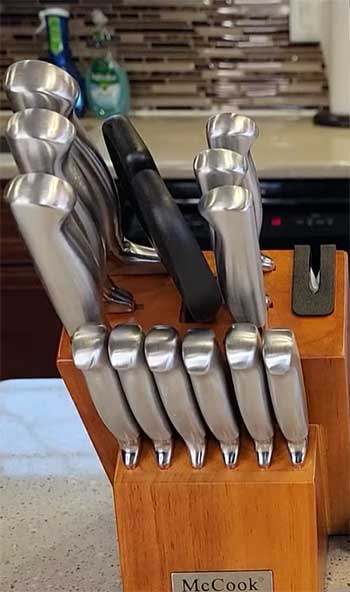
I settled on the McCook MC29 set, mostly intrigued by the graphite finish and the built-in sharpener in the block.
When the box arrived, I was immediately struck by the weight. It didn’t feel cheap.
Unboxing it, the wooden block had a nice heft and a rich color that matched my kitchen cabinets perfectly.
I pulled out the 8-inch chef’s knife first.
It felt balanced—not too heavy, but substantial enough to let gravity do some of the work.
My first test was the tomato test. My old knives would just squish tomatoes, but the McCook slid through the skin with zero resistance. It was genuinely satisfying. Over the next few weeks, I put them through the wringer.
I broke down a whole chicken with the shears and the chef’s knife, sliced crusty sourdough with the serrated bread knife, and used the paring knife for endless apple slices for my kids.
The feature I used most, surprisingly, was the sharpener. I had assumed it was a gimmick. But having the ability to give the blade a quick hone before starting prep made a massive difference in my workflow. I didn’t have to hunt for a honing steel in the back of a drawer.
However, it wasn’t all perfect. I noticed after a month that if I didn’t dry the steak knives immediately after washing, tiny spots would appear. I learned the hard way that “dishwasher safe” is a marketing term you should ignore if you want these to last.
But overall, moving from a hodgepodge of thrift-store knives to this cohesive set changed how I felt about cooking. It made me want to be in the kitchen more, and for the price I paid, that is a massive win.
The Upsides: Analyzing What Makes McCook Shine
When we look at what makes this brand successful on platforms like Amazon, it really comes down to a few key engineering and design choices that favor the home cook.
- High-Carbon Stainless Steel Composition
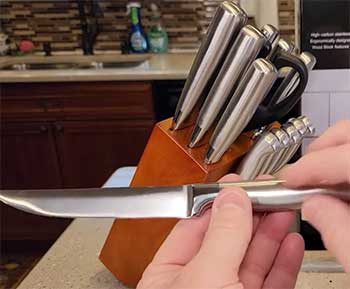
The primary selling point here is the steel. McCook uses high-carbon stainless steel.
From a metallurgical standpoint, adding carbon to the iron makes the steel harder.
Harder steel can take a sharper edge and hold it longer than softer, cheaper stainless steel variants.
When I use the chef’s knife, I can feel that rigidity.
It doesn’t flex uncomfortably when cutting through dense vegetables like butternut squash or sweet potatoes. You get a precise cut because the edge doesn’t roll over immediately upon impact with the cutting board.
- The Genius of the Built-In Sharpener
This is the feature that disrupts the budget knife market. Most home cooks do not know how to use a whetstone, and many are intimidated by a honing steel. By integrating the sharpener directly into the storage block slots, McCook ensures that edge maintenance is passive and habitual.
Every time you pull the knife out or put it back, you have the option to refresh the edge. This keeps the knife performing at 90% capacity for much longer than a standard set that slowly dulls over six months until it becomes dangerous.
- Ergonomics and Handle Design
The handle construction is full-tang on many of their sets, meaning the metal of the blade extends all the way through the handle to the end. This is crucial for balance. When you hold the knife at the bolster (the point where the blade meets the handle), the weight is distributed evenly. You don’t feel like the blade is dragging your wrist down.
The handles are often triple-riveted, which is a classic, durable method of securing the handle scales to the metal. It feels secure in the hand, even when my hands are a bit greasy or wet from washing vegetables.
- Aesthetic Uniformity
Let’s be honest, we eat with our eyes, and we cook in kitchens we want to be proud of. The McCook sets are designed to be displayed. They don’t look like industrial tools; they look like furniture.
The wood blocks are finished well, and the knives often have a cohesive look—whether that is the graphite non-stick coating or the classic stainless shine. It clears clutter from drawers and adds a touch of professionalism to the countertop.
Where The McCook Knife Set Falls Short?
No product is perfect, especially not one that costs a fraction of professional gear. You need to know the limitations before you buy.
- Susceptibility to Rust Spots
This is the most common complaint, and it is valid. Because the steel has high carbon content, it is not “stain-proof,” it is “stain-less.” There is a difference. If you leave these knives in a pool of water in the sink, or if you run them through a high-heat dishwasher cycle with harsh detergents, you will see rust spots. This is a chemical reality of the steel used.
It requires you to change your cleaning habits. If you are someone who strictly uses the dishwasher for everything, this set will frustrate you.
- The Coating Can Wear Off
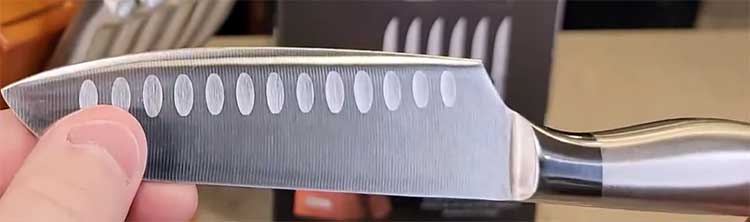
Many McCook sets come with a black or graphite coating on the blades. While this looks sleek and helps with food release (preventing potatoes from sticking to the blade), it is a coating.
Over years of sharpening and scrubbing with the rough side of a sponge, this coating can scratch and wear away. Once the coating is compromised, the aesthetics of the knife take a hit, even if the cutting performance remains the same.
- The Shears Are Average
While the knives are surprisingly good, the kitchen shears included in the block often feel like an afterthought. They are functional for opening packages or snipping herbs, but they lack the heavy-duty leverage needed to cut through sturdy poultry bones easily.
They are often the lightest item in the block and don’t match the premium feel of the chef’s knife.
Care Tips For McCook Knife Set
To get the most out of your McCook set, you have to treat it with a specific protocol. If you treat these like cheap utensils, they will degrade. If you treat them like tools, they will last for years.
- The Golden Rule of Washing
You must hand wash these knives. I cannot stress this enough. The dishwasher is a hostile environment for knives. The high heat expands the metal and the handle material at different rates, which can cause the handle to loosen or crack over time.
The detergent is abrasive and dulls the edge. The water jets bang the knife against other cutlery, chipping the blade. Immediately after using the knife, wash it with warm water and a mild dish soap. Do not let it sit in the sink with food acids (like lemon or tomato juice) on it, as acid can etch the steel.
- Drying is Just as Important
After washing, do not put it in a drying rack to air dry. Take a soft towel and dry the blade completely. Pay special attention to the bolster and the rivets on the handle, as water loves to hide there.
Putting a damp knife back into a wooden block is a recipe for mold in the block and rust on the knife. Ensure it is bone dry before it goes back into its slot.
- Utilizing the Built-In Sharpener Correctly
While the built-in sharpener is great, you shouldn’t just jam the knife in and out. Be deliberate. When you withdraw the knife, pull it out slowly and smoothly, allowing the ceramic sharpeners to run along the entire length of the blade.
Do this every time you take the knife out to cook. This process is called “honing”—it realigns the microscopic teeth of the blade. However, once or twice a year, the knife will need a true sharpening (removing metal to create a new edge).
The built-in sharpener is mostly for maintenance. If the blade becomes truly dull, you may still need a professional sharpening or a dedicated whetstone session to reset the geometry.
- Conditioning the Wooden Block
The wooden block is often ignored, but it is a natural material. In a hot kitchen, wood can dry out and crack. Once a year, take a clean cloth with a little bit of mineral oil (food safe) and rub it onto the wood block.
This keeps the wood supple, prevents cracking, and keeps it looking rich and new. It also helps repel water if you accidentally splash the block near the sink.
Comparison: McCook Vs. The Competition
When you are shopping in this price bracket, you are likely cross-shopping with a few other specific brands. Here is how McCook holds up against them analytically.
- McCook Vs. Imarku Knife Set

Imarku has made a massive name for itself, particularly with its standalone chef’s knife.
If you look at them side-by-side, Imarku often positions itself as the more “premium” option, and the price tag reflects that.
In my experience, Imarku’s blade finish and handle materials—often Pakkawood—feel slightly more refined out of the box than McCook.
They lean heavily into the Japanese aesthetic.
However, the value proposition is where McCook steals the show. To get a full 15-piece block set from Imarku, you are often paying double what you would pay for the McCook equivalent.
While the edge retention on an Imarku blade might be marginally better due to slightly different heat treatment protocols, I don’t think it justifies the massive price hike for a casual home cook.
McCook provides a comparable cutting experience and includes the built-in sharpener, a feature Imarku sets often lack. If you are on a strict budget but want a comprehensive set, McCook is the smarter financial move.
- McCook Vs. Chicago Cutlery Knife Set
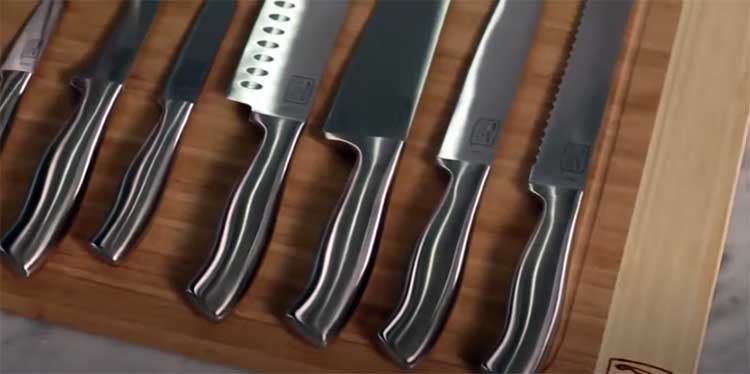
Chicago Cutlery is the legacy brand in this fight. Many of us grew up in kitchens that had these knives; they are famous for their classic walnut handles and traditional brass rivets. Comparing them to McCook feels like comparing a vintage sedan to a modern commuter car.
Chicago Cutlery sets have a warm, nostalgic aesthetic, but functionally, they can feel a bit dated. I have found that the wooden handles on Chicago Cutlery sets require significantly more maintenance; they dry out and get rough if you don’t oil them religiously.
McCook, with its more modern, often polymer or treated handles and graphite-finished blades, feels sleeker and easier to grip when things get messy. Furthermore, the steel in entry-level Chicago Cutlery sets can sometimes feel a bit soft, rolling the edge quickly.
McCook’s high-carbon stainless steel feels harder and more rigid on the cutting board. If you want a modern, hassle-free tool, I would grab the McCook over the old-school Chicago Cutlery.
- McCook Vs. Astercook Knife Set

These two brands are often fighting for the exact same spot in your shopping cart, usually hovering around similar price points.
The biggest difference I spot immediately is in the styling and “honesty” of the design.
Astercook sets often feature blades with a laser-etched pattern designed to mimic Damascus steel.
While this looks cool in photos, up close, it can look a bit gimmicky and artificial. McCook generally avoids this, opting for clean, solid colors or straightforward stainless steel.
It feels like a more honest product. In terms of performance, both brands offer similar sharpness out of the box, but I found the McCook handles to be substantially more ergonomic. Astercook handles can sometimes feel a bit blocky or slippery.
Additionally, the built-in sharpening mechanism in the McCook block tends to operate smoother than the Astercook counterparts, which can sometimes feel grindy or misaligned. If you want a knife set that isn’t trying to pretend to be a $500 Japanese set and just focuses on cutting well, McCook is the superior choice.
Frequently Asked Questions (FAQ)
They are excellent for the price, offering a great balance of sharpness and durability for home cooks, though they lag behind professional-grade brands like Wüsthof in edge retention.
McCook knife sets are primarily manufactured in China, which allows them to keep the price point competitive while maintaining decent quality control.
Gordon Ramsay typically recommends Wüsthof and Henckels knives for their professional pedigree; he does not specifically endorse McCook.
Yes, they can rust if not cared for properly. The high-carbon stainless steel requires hand washing and immediate drying to prevent oxidation spots.
Final Thoughts
If you want a kitchen upgrade that balances performance, style, and budget, you should buy the McCook knife set. It bridges the gap between flimsy starter knives and intimidating professional tools.
The built-in sharpener alone solves the biggest headache of knife ownership, ensuring your blades are ready whenever you are. While they require a bit of care regarding washing and drying, the payoff is a cooking experience that feels fluid and enjoyable.
Don’t overthink it—this set is a winner for the everyday home chef.