
If you are staring at ugly, outdated tiles and dreading the dust, cost, and chaos of a full renovation, you need to buy Epodex 2K tile paint immediately. It is, without a doubt, the most robust solution I have found for transforming a bathroom or kitchen without ripping a single thing out.
While other paints peel or chip within months, the epoxy-based formula from Epodex actually bonds to the surface, creating a finish that feels less like “painted tile” and more like a brand-new factory glaze.
If you want a permanent fix that looks professional, stop looking at the cheap tins at the hardware store and order this.
My Personal Experience With Epodex
I was standing in my guest bathroom, glaring at the beige-and-brown floral tiles that had likely been there since 1982.
I had two options: spend thousands hiring a contractor to smash them out, or find a way to cover them up.
I had tried standard tile paints before in a rental, and the results were disastrous—peeling around the shower head within weeks.
But the reviews for Epodex, specifically their 2-component (2K) system, suggested it was different.
It wasn’t just paint; it was a resin coating.
Ordering was straightforward, though I was nervous about the “mixing” aspect. I ordered the “Concrete Grey” in the 2K version because I wanted to paint the floor tiles as well as the walls.
When the package arrived, I was relieved to see the instructions were clear. You get a tin of resin (Component A) and a bottle of hardener (Component B).
The preparation took longer than the painting. I scrubbed every inch of those tiles with a sugar soap solution, then sanded them down with the sandpaper provided in the kit. I cannot stress this enough: if you skip the cleaning, you are wasting your money.
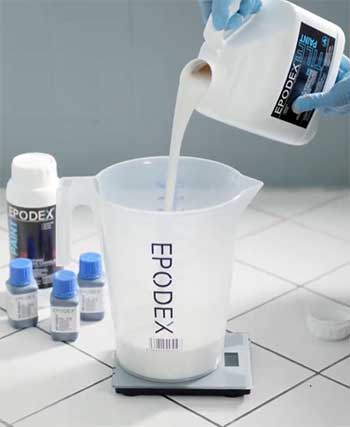
Mixing the paint felt like a science experiment. I poured the hardener into the resin at the 5:1 ratio. I was terrified of getting it wrong, but I used a kitchen scale to be precise. The mixture was thick, creamy, and surprisingly odorless. I was expecting a chemical headache, but I could barely smell a thing.
Applying it was satisfying. I used a foam roller, and the coverage was shocking. That hideous brown floral pattern disappeared under a single coat of grey. I did a second coat the next day just to be safe.
The “pot life” (the time you have to work with the paint before it hardens) was about 90 minutes, which was plenty of time for my small bathroom.
The result? Three days later, I walked on it. It didn’t feel like paint. It felt hard, like plastic or enamel. It has been six months, and despite daily showers and foot traffic, there isn’t a single chip. It looks like I installed modern grey ceramic tiles.
The Upsides: Why Epodex Stood Out
The market is flooded with “quick fix” tile paints, but Epodex occupies a different tier entirely. It bridges the gap between a cosmetic cover-up and a structural resurfacing.
- The 2K Durability Factor
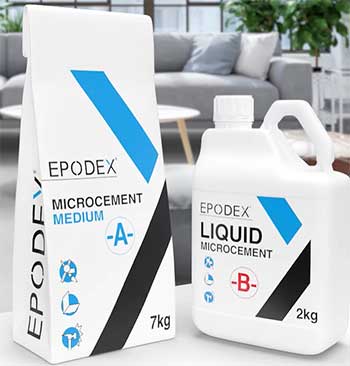
The most significant advantage of Epodex is the 2-component system (2K).
Most hardware store tile paints are 1-component (1K) acrylics.
They dry by evaporation, which means they essentially form a skin on top of the tile.
In a high-humidity environment like a shower, or a high-friction area like a floor, that skin eventually lifts.
Epodex 2K works by a chemical reaction.
When you mix the resin and hardener, the liquid transforms into a solid plastic-like polymer.
It doesn’t just sit on the tile; it cross-links to form a rigid shell. In my testing, I dropped a metal hairbrush handle-first onto the floor tiles about a month after painting. I winced, expecting a chip. There was nothing. This impact resistance is something you simply do not get with standard latex or oil-based tile paints.
- Odorless Application
If you have ever used epoxy products or oil-based primers, you know the smell can be overpowering. I was prepared to wear a respirator, but I didn’t need it. Epodex is water-based, meaning it has low VOCs (Volatile Organic Compounds).
You can paint a bathroom with the door open and not feel like you are poisoning the rest of the house. This is a massive “pro” for anyone with children or pets, or for those renovating in winter when you can’t leave all the windows open for days.
- Extreme Coverage and Opacity
One of the biggest fears with painting tiles is that the old pattern will bleed through, or you will see the “brush strokes” of the original design. The viscosity of the Epodex mixture is high. It is thick. When you roll it on, it has excellent self-leveling properties.
It fills in micro-scratches on the old glaze. I was covering a dark brown pattern with a medium grey, and the first coat achieved about 95% opacity. The second coat was purely for finish uniformity. You aren’t fighting the paint to get it to cover; it wants to cover.
- Color Customization
Unlike brands that offer you “White,” “Grey,” and “Cream,” Epodex operates more like a professional paint mixing service. You can buy the base and the pigments separately, or buy pre-mixed RAL colors. This allows for a level of design precision that is rare in the DIY tile paint market. If you want “Traffic Black” or a specific pastel green, you can get it.
Also Read: Comparison of Glidden Diamond And Glidden Premium.
The Downsides of Epodex Tile Paint: Where It Fell Short
No product is perfect, and while I love the result, the journey had some bumps that you need to be aware of before you click “buy.”
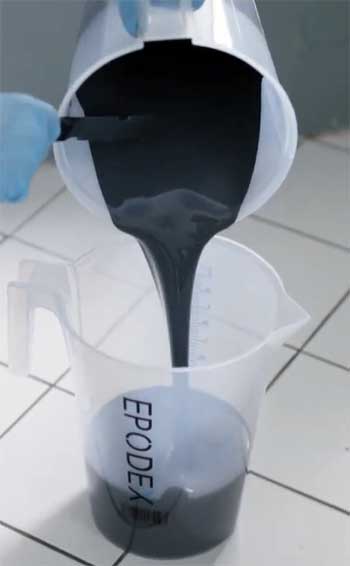
- The “Ticking Clock” Anxiety: The 2K system is a double-edged sword. Once you mix Component A and Component B, the clock starts. You have roughly 90 minutes (at standard room temperature) to apply that paint. You cannot save it for later. You cannot put a lid on it and finish tomorrow. If you mix too much, you waste it. If you mix it and then get a phone call, you might come back to a solid block of plastic in your tray. This requires a level of planning and speed that 1K paints do not. You need to be ready to go the second that stirrer stops moving.
- The Price Point: Epodex is not cheap. A full kit for a small bathroom can cost three to four times what you would pay for a tin of generic tile paint. You are paying for the resin technology. If you are painting a low-traffic guest toilet backsplash, the cost might feel unjustified. It is an investment product, not a budget flip product. You also have to factor in the cost of accessories—foam rollers, mixing cups, and stir sticks are essential, and while Epodex sells them, they add to the bill.
- Batch Consistency: I have read reports, and seen minor evidence myself, of slight color variations between batches if you are mixing the pigments yourself. Because the system often involves adding a small bottle of pigment to a large tub of resin, if you don’t squeeze out every single drop of pigment, your shade might be a fraction lighter than intended. It requires precise measurement. If you buy two different kits for the same room, you absolutely must mix them together or ensure your ratios are identical to avoid a two-tone floor.
Maintaining That Fresh Coat With Epodex Tile Paint
Once you have applied Epodex, the way you treat your tiles must change. You are no longer cleaning ceramic; you are cleaning a high-grade epoxy coating.
- The Vinegar Warning
This is the most critical maintenance tip I can give you: throw away your vinegar-based cleaners. Acid is the enemy of epoxy. While the coating is chemically resistant to water and soap, acidic compounds can soften the resin over time, leading to cloudiness or a loss of gloss.
If you are used to scrubbing limescale with straight vinegar, you need to stop. Use pH-neutral cleaners or the specific cleaner recommended by Epodex.
- Curing Time is Sacred
The instructions will tell you the paint is “dust dry” in a few hours and “touch dry” in a day. Do not be fooled. The chemical curing process takes a full 7 days to reach maximum hardness. Do not drag a washing machine across the floor on day three.
Do not scrub the shower walls with a stiff brush on day four. If you treat the paint gently for that first week, it will harden into a rock-solid surface. If you rush it, you risk creating indentations or scratches that will never heal.
- Grout Line Management
Epodex will cover your grout lines, making everything one uniform color. This looks modern, but some people hate losing the grid look. You have two choices: The “Dip” Method: The paint is thick enough that you will still see the indentation of the grout lines, just painted over.
This is usually fine for most people. The Grout Pen: If you want the contrast back, do not try to tape off the grout lines before painting—it is impossible.
Paint everything, let it cure, and then use a grout pen (Epodex sells one, or you can use other brands) to draw the lines back in. It takes a steady hand, but it restores the traditional tiled look.
- Dealing with Silicon
Paint will not stick to silicone sealant. Period. Before you start painting, you must cut out all the old silicone around your bathtub, sink, or floor edges. Do not try to paint over it; the paint will bead up and flake off immediately.
Paint the tiles, let them cure, and then apply fresh silicone on top of the new paint. This ensures a watertight seal and a professional finish.
- Sandbox Effect for Floors
If you are using Epodex on a floor, be aware that the high-gloss or satin finish can be slippery when wet, much like standard glazed tiles. Epodex sells “anti-slip micro beads” that you can mix into the final coat.
I highly recommend this for shower floors or bathroom floors. It adds a slight texture—almost invisible to the eye—that provides grip for your feet. Without it, a wet epoxy floor is a skating rink.
Also Read: Comparison of Farrow & Ball And Benjamin Moore.
Epodex Vs. The Competition
To understand why I recommend Epodex, we have to look at what else is on the shelf. The differences aren’t just branding; they are chemical.
- Epodex Vs. Rust-Oleum
Rust-Oleum is the brand everyone knows. It is accessible, affordable, and likely the first can you pick up at the hardware store. However, the fundamental difference here is the chemistry. Rust-Oleum typically relies on a one-part (1K) acrylic or oil-based formula.
This means it dries through evaporation. Epodex uses a two-part (2K) system that cures through a chemical reaction.
When you use Rust-Oleum, you are essentially applying a cosmetic skin over your tiles. It looks great for a while, but it lacks the structural integrity of an epoxy. If you drop a shampoo bottle in the shower, Rust-Oleum is far more likely to chip or peel because the bond is superficial.
Epodex, on the other hand, creates a hard, plastic-like shell that fuses to the surface. If you are flipping a house or need a quick cosmetic fix for a guest bathroom that rarely gets used, Rust-Oleum is a wallet-friendly choice that gets the job done.
But if you are painting a shower enclosure or a floor that sees daily foot traffic, relying on Rust-Oleum is a gamble that often results in peeling sheets of paint within a year.
- Epodex Vs. DWIL Tub and Tile Paint
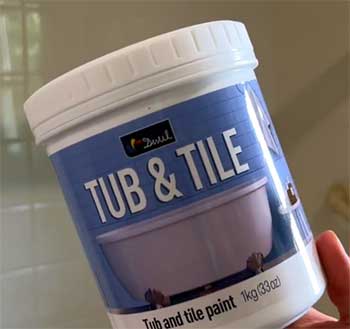
DWIL has exploded in popularity recently, largely due to its comprehensive Amazon kits that include rollers, tape, and drop cloths.
Like Epodex, DWIL often uses a 2K system, making it a more direct competitor than Rust-Oleum.
The battle here is about finish quality and ease of application.
DWIL tends to be incredibly thick.
While this sounds good for coverage, it can be a nightmare for novice painters because it is prone to leaving heavy roller marks if you don’t work fast enough. Epodex has a slightly better self-leveling consistency in my experience.
It flows out smoother, meaning you are less likely to see the texture of your roller once it dries. Furthermore, while DWIL offers a great “all-in-one” box, the quality of the included tools is often mediocre.
You are paying for the convenience of having a plastic tray and a cheap roller thrown in. With Epodex, you are buying a premium resin, and while you have to buy your tools separately, the final finish feels more like professional ceramic and less like a heavy plastic coating. If you want a glass-smooth finish and don’t mind sourcing your own high-quality roller, Epodex wins.
- Epodex Vs. V33
V33 is a massive player in the European market and is famous for its “Renovation” line. It sits comfortably in the middle ground between the basic 1K paints and the industrial strength of Epodex.
V33 is technically a 1-component paint that uses an “additive” system or advanced polymers to increase adhesion without the strict mixing ratios of a true epoxy.
The user experience with V33 is admittedly friendlier. You don’t have the intense “pot life” anxiety where the paint hardens in the tray within 90 minutes. You can take your time. However, that ease comes at a cost. V33 is softer.
It is excellent for wall tiles, kitchen backsplashes, and cabinetry, but it struggles on floors. I have seen V33 scratch when furniture is dragged across it, whereas Epodex resists that kind of mechanical stress much better. If you are painting a kitchen backsplash where the biggest threat is a splash of tomato sauce, V33 is easier to use and looks fantastic.
But for a bathroom floor or a wet room where water pools and people walk with shoes on, Epodex offers a level of waterproofing and abrasion resistance that V33 simply cannot match.
Also Read: Comparison of Farrell-Calhoun Paint And Sherwin-Williams.
Frequently Asked Questions (FAQ)
Generally, no. The epoxy is designed to be self-priming on ceramic. However, thorough sanding and degreasing are non-negotiable for adhesion.
Yes, but only if you use a 2-component (2K) resin-based paint. Standard latex paints will peel, but epoxy paints bond permanently to the surface.
Absolutely. It provides a hard, waterproof, industrial-grade coating that resists scratching and hot water better than any 1-part paint.
For high-traffic areas or showers, a 2-part epoxy paint (like Epodex 2K) is the best. For dry walls, a reinforced acrylic (like V33) is sufficient.
Wrapping Up
Epodex tile paint is not a magic wand; it is an industrial coating packaged for the homeowner. It demands respect during the preparation and application phases—you cannot cut corners with cleaning or mixing ratios.
However, if you follow the rules, the payoff is immense. You get a bathroom or kitchen that looks brand new for a fraction of the cost of retiling. It is durable, waterproof, and aesthetically pleasing. If you are on the fence, buy the sample kit.
Once you feel how hard that resin cures, you won’t want to use anything else.