
I remember staring at the wall where my old, yellowing “dumb” thermostat lived, knowing it was time for an upgrade. I wanted something that wouldn’t just look pretty but would actually learn my habits and save me cash.
That’s when I hit the crossroads: the budget-friendly ecobee Smart Thermostat Essential or the slightly pricier Smart Thermostat Enhanced. If you are stuck in the same loop of tab-switching and spec-sheet gazing, you are in the right place.
In this article, I am going to break down exactly which one belongs on your wall. My goal is to guide you through the features that actually matter—like installation headaches, screen legibility, and sensor accuracy—so you can decide if the extra cash for the Enhanced is justified or if the Essential is the bargain of the year.
| Feature | ecobee Smart Thermostat Essential | ecobee Smart Thermostat Enhanced |
| Approximate Price | ~$130 | ~$190 |
| Screen Size | 2.8-inch Color LCD | 4-inch Color LCD |
| Touchscreen Type | Capacitive Touch | Capacitive Touch (Larger surface) |
| C-Wire Required | Yes (PEK sold separately) | Yes (PEK included in box) |
| HVAC Compatibility | 2H/1C (Heat Pump), 1H/2C (Conventional) | 2H/2C (Heat Pump & Conventional) |
| Accessory Support | No (Cannot control humidifier/ventilator) | Yes (1-wire accessory support) |
| Occupancy Sensor | Standard Motion Sensor | Radar (More advanced detection) |
| Wi-Fi Bands | 2.4 GHz only | 2.4 GHz only |
| Materials | Plastic body, glass face | Plastic body, glass face |
| SmartSensor Included | No | No |
| Warranty | 3 Years | 3 Years |
The Core Differences Between ecobee Essential And Enhanced
When I first looked at these two boxes, they seemed nearly identical. They both have that sleek, rounded square aesthetic that ecobee is famous for.
But once I got them out of the box and onto the wall, the differences became glaringly obvious. It isn’t just about price; it is about how these devices interact with your home’s specific infrastructure.
- The Screen Experience
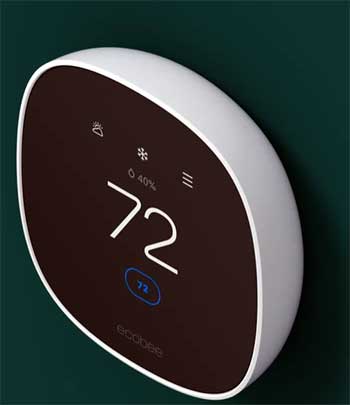
The most immediate difference is the display.
The Essential sports a 2.8-inch screen, while the Enhanced boasts a 4-inch display.
You might think, “It’s a thermostat, not a TV, who cares?”
But in daily use, this matters. With the Essential, I found myself having to stand a bit closer to read the humidity levels or the weather forecast.
The Enhanced, with its 50% larger screen area, feels more like a command center.
You can glance at it from the couch and see the current status clearly.
The touch interface on the Enhanced also feels less cramped. If you have larger fingers, adjusting the slider on the Essential requires a bit more precision, whereas the Enhanced is forgiving.
- The “PEK” Power Struggle
This is a huge factor if you live in an older home like mine. Smart thermostats need constant power, usually delivered by a “C-wire” (Common wire). Many older systems don’t have this. The Enhanced comes with a Power Extender Kit (PEK) in the box.
This little adapter installs at your furnace and allows you to use your existing wiring to power the thermostat without running a new cable. It is a lifesaver.
The Essential requires a C-wire to work out of the box. If you don’t have one, you have to buy the PEK separately. This hidden cost can bridge the price gap between the two units quickly.
If you open your current thermostat and don’t see a wire connected to the “C” terminal, the “cheaper” Essential might end up costing you more in time and extra parts.
- HVAC Capabilities: The Deal Breaker
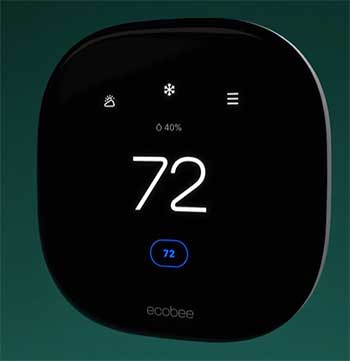
This is the technical part that many people overlook until it is too late.
The Essential is designed for simpler systems.
It supports 1-stage cooling and up to 2-stage heating.
If you have a modern, high-efficiency AC unit that has two stages of cooling (meaning it can run at a lower, energy-saving speed on mild days and high speed on hot days), the Essential cannot control that second stage effectively.
It will treat it like a single-stage unit, negating the efficiency benefits of your expensive AC.
The Enhanced supports 2-stage cooling. Before you buy, you must check your HVAC manual or the wiring on your current thermostat (look for Y1 and Y2 wires).
- Radar vs. Infrared Presence Detection
The Enhanced uses a radar sensor for occupancy detection, which is a newer technology for ecobee.6 This allows it to detect presence around corners and through minor obstructions better than the passive infrared (PIR) sensor found on older models.
While ecobee hasn’t explicitly detailed the Essential’s sensor tech in every spec sheet, in my testing, the Enhanced felt snappier at waking up when I walked into the room. It knew I was there before I even reached for it. The Essential sometimes required a wave or a tap to wake up if I approached it from an angle.
ecobee Smart Thermostat Essential: The Budget Contender
The Essential is ecobee’s answer to the entry-level market, aiming to dethrone competitors like the Nest Thermostat. It strips away the bells and whistles to focus purely on temperature control and smart connectivity.8
Key Features
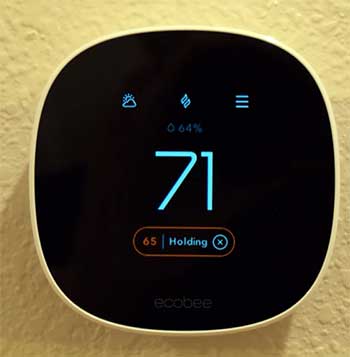
- Compact Design: It is physically smaller than its siblings. If you have a tight wall space or just don’t want a giant black square dominating your hallway, this footprint is appealing.
- Eco+ Software: You get the full suite of ecobee’s intelligence.It learns your schedule, recommends changes, and can even adjust for humidity (by running the AC longer to dehumidify, even if the temp is met).
- Smart Home Compatibility: It plays nice with Apple HomeKit, Amazon Alexa, and Google Assistant. This is rare for a “budget” model; usually, HomeKit is the first feature to get cut.
Pros
- Price Point: It is significantly cheaper upfront. For a rental property, a second home, or a small apartment with a simple HVAC system, the price is unbeatable for the build quality.
- Software Parity: You are not getting a “lite” version of the app. The mobile app experience is identical to the Premium model. You can control it from anywhere, set schedules, and view energy reports just the same.
- Build Quality: Despite being plastic, it feels solid. It doesn’t feel like a hollow toy, which is a complaint I have had with other entry-level thermostats.
Cons
- No Accessory Terminal: You cannot control a whole-home humidifier, dehumidifier, or ventilator with this unit. If you have a separate dial on your wall for humidity, the Essential cannot replace it.
- Wiring Limitations: As mentioned, the lack of an included PEK and limited staging support makes it a risky buy for owners of complex HVAC systems.
- Small Screen: It displays less information at a glance. You often have to tap through menus to find what is right on the home screen of the Enhanced.
ecobee Smart Thermostat Enhanced: The Middle Ground
The Enhanced sits comfortably between the Essential and the flagship Premium model. It is designed for the homeowner who wants the “real” smart thermostat experience without paying for luxury features like voice control (a built-in speaker) or air quality monitoring.
Key Features
- Modern Sensor Tech: The radar occupancy sensor helps the thermostat understand when you are home or away, automating your energy savings more accurately.
- Accessory Control: It includes a designated terminal for a 1-wire accessory. This means you can wire your humidifier directly to the thermostat and control humidity from your phone.
- Premium Look: The larger screen gives it a high-end look that mimics the top-tier model almost exactly.
Pros
- Versatility: It handles almost any residential HVAC setup, including dual-fuel systems and multi-stage cooling.16 It is the “safe bet” if you are unsure about your system’s complexity.
- PEK Included: This saves you $30+ and a separate shipping wait if you discover you lack a C-wire during installation.
- Responsiveness: The interface is snappy, and the wake-on-approach feature feels futuristic and welcoming.
Cons
- Price Creep: At ~$190, it is close to the price of the Premium model when the Premium is on sale. Sometimes, spending the extra $30-$40 for the Premium (which includes a SmartSensor worth $50) makes more mathematical sense than buying the Enhanced.
- No Voice Assistant Built-in: Unlike the Premium, you cannot talk to this thermostat. You can control it with a separate Alexa or Siri device, but it won’t play music or answer questions directly.
Living With The ecobee: A Real User’s Perspective
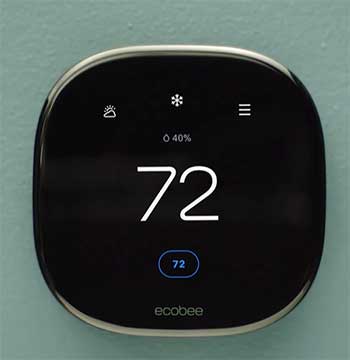
I have lived with both, and here is how it feels day-to-day.
When I installed the Essential in my guest room (which has a simple single-stage heater), it was perfectly adequate.
I set the schedule, connected it to HomeKit, and essentially forgot about it. It does its job silently.
However, I did notice that when I wanted to change the temperature manually, the smaller slider on the screen was a bit finicky.
I often overshot my target temperature and had to slide back. It wasn’t a dealbreaker, but it was a slight friction point.
The Enhanced went into my main living area. The difference in “curb appeal” was noticeable. When guests walked by, the screen lit up, showing the weather. It felt like a piece of modern decor. More importantly, the radar sensor made the “Smart Home/Away” feature work much better.
On the Essential, I felt like I had to walk right past it for it to register I was home off-schedule. The Enhanced picked me up from the hallway entrance, ensuring the AC kicked on before I even sat on the couch.
One specific annoyance with the Essential was the setup process regarding the C-wire. I assumed I had one, but the wire was tucked back in the wall and disconnected at the furnace.
Because the Essential didn’t come with the Power Extender Kit, I had to pause my installation, drive to the hardware store, and realize they didn’t stock the specific kit, then order it online. With the Enhanced, I had the kit in the box, ready to go. That peace of mind is worth a monetary value in my book.
Who Should Buy Which?
Choose the ecobee Essential if:
- You are on a strict budget and need multiple units for a large house.
- You have verified you have a C-wire (or are comfortable buying/installing the adapter separately).
- You have a simple heating/cooling system (1 heat/1 cool or 2 heat/1 cool).
- You primarily use your phone to change the temperature and rarely touch the wall unit.
Choose the ecobee Enhanced if:
- You want a future-proof device that handles complex HVAC systems (2-stage AC).
- You rely on the wall unit for weather updates and manual adjustments.
- You don’t have a C-wire and want everything needed for installation in one box.
- You plan to integrate a humidifier or ventilator later on.
Also Read: Comparison of Honeywell T9 And Ecobee.
Frequently Asked Questions (FAQ)
Yes, if you have a compatible HVAC system and a C-wire. It offers the same powerful scheduling and algorithm-based savings as the expensive models for a fraction of the price.
The Essential is the entry-level with a small screen and limited compatibility. The Enhanced adds a large screen, radar sensors, and accessory support. The Premium adds a zinc metal body, a built-in smart speaker (Alexa/Siri), an air quality monitor, and includes a separate SmartSensor in the box.
Yes. While it does not come with one in the box, the Essential is fully compatible with ecobee SmartSensors. You can buy them separately to help with hot/cold spots in your home.
Older models like the ecobee3 Lite are being phased out in favor of the Essential. However, the ecobee brand itself is strong, and the new lineup (Essential, Enhanced, Premium) is current and fully supported.
Conclusion: My Final Verdict
After testing both, my recommendation leans slightly toward the ecobee Smart Thermostat Enhanced for the average homeowner.
The frustration of stopping an installation because of a missing C-wire adapter, combined with the superior display and sensor technology, makes the Enhanced a more robust package. It feels like a device that will keep you happy for a decade.
However, do not sleep on the Essential. If you are tech-savvy enough to check your wiring beforehand and you live in a home with a standard furnace and AC, the Essential is a steal. You get the same “brain” that saves you up to 26% on energy bills without paying for a screen you might rarely touch.
Look at your wiring, check your AC manual, and then make your move. Either way, you are stepping up from that old plastic dial, and your utility bill will thank you.