
When you are staring at a wall of cordless vacuums in a home goods store, the paradox of choice is real. I’ve spent years navigating the evolving world of home floor care, and if there is one brand that consistently sparks a “this or that” debate, it is Dyson.
Today, I am looking at two of their most popular heavy hitters to help you decide which one deserves a spot in your utility closet. In this guide, I will break down the Dyson V11 vs. V12 to see if the newer, smarter tech of the V12 actually beats the raw, rugged power of the V11.
| Feature | Dyson V11 | Dyson V12 Detect Slim |
| Weight | 6.68 lbs | 5.2 lbs |
| Max Suction Power | 185 Air Watts | 150 Air Watts |
| Dust Bin Capacity | 0.76 Liters (0.2 Gallons) | 0.35 Liters (0.1 Gallons) |
| Power Control | Trigger (Must hold down) | Power Button (Single press) |
| Cleaning Head | Motorbar (standard) | Fluffy Optic (Laser) + Motorbar |
| Dust Detection | None | Laser & Piezo Sensor |
| Battery Life | Up to 60 Minutes | Up to 60 Minutes |
| Charge Time | 4.5 Hours | 3.5 to 4 Hours |
Key Differences Between Dyson V11 And V12
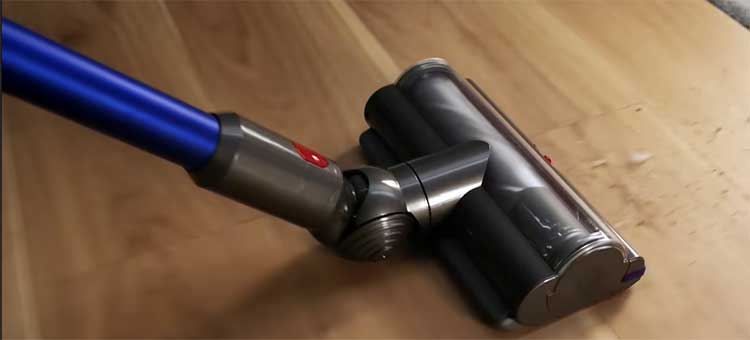
- The Ergonomic Shift: Power Button Vs. The Trigger
This is often the ultimate dealbreaker for many of us. The V11 utilizes the classic Dyson “dead-man” trigger. To keep the vacuum running, you have to maintain constant pressure with your index finger. While this is fantastic for battery conservation—stopping the motor the millisecond you stop vacuuming—it can be incredibly fatiguing during long sessions.
If you have any issues with grip strength or arthritis, the V11 can feel like a chore. The V12, conversely, introduced a bright red power button on the body. You press it once to start and once to stop. This might seem minor, but it completely changes how you hold the machine, allowing you to switch hands mid-clean or reach into awkward corners without maintaining a tight grip.
- Seeing the Unseen: Laser Dust Detection
The V12 comes equipped with the Fluffy Optic cleaner head, which features a precisely angled green laser. This isn’t just a flashy light; it’s designed to illuminate microscopic dust particles on hard floors that are invisible to the naked eye.
In a bright room, your floor might look spotless, but the V12 will show you a “dust forest” that you’ve missed. The V11 relies on high-quality brush bars but lacks any dedicated lighting or detection system, meaning you are essentially vacuuming by feel rather than by sight.
- Bin Capacity and Emptying Frequency
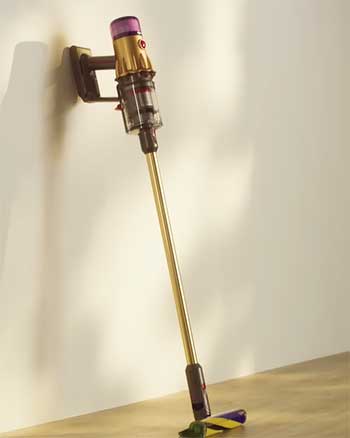
There is no sugarcoating it: the V12 bin is tiny.
At 0.35 liters, it is less than half the volume of the V11’s 0.76-liter bin.
If you live in a large house or have pets that shed heavily, the V12 will require multiple trips to the trash can during a single cleaning session.
The V11 is built for the “long haul,” allowing you to clean multiple rooms or even an entire floor without stopping.
This makes the V11 much better for deep-cleaning days, while the V12 excels at quick, daily maintenance in smaller environments.
- Acoustic Engineering and Noise Levels
Interestingly, while both are powerful, the V12 is generally quieter than the V11. Dyson re-engineered the airflow paths in the V12 to reduce turbulence.
While the V11 has a powerful, high-pitched “jet engine” whine that can be quite loud in confined spaces, the V12 has a more muffled, refined sound profile. If you have sensitive ears or want to vacuum without waking the whole house, the V12 offers a more polite cleaning experience.
- The Intelligence Factor: Piezo Sensors
The V12 is essentially a tiny computer. It uses a Piezo sensor to “hear” the vibrations of dust particles hitting the intake. This information is processed 15,000 times a second to adjust suction power automatically.
If you hit a patch of sugar or sand, the motor ramps up instantly; when the floor is clean, it drops back to Eco mode to save battery. The V11 has a “DLS” (Dynamic Load Sensor) system that adjusts based on floor resistance (like moving from wood to carpet), but it doesn’t actually know how much dirt it’s picking up.
Also Read: Comparison of Sebo E3 And Miele C3 Vacuums.
Key Features of The Dyson V11
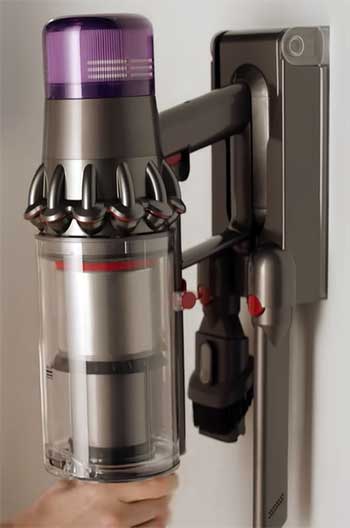
- Dynamic Load Sensing (DLS): The V11’s High Torque cleaner head is a marvel of mechanical engineering. It monitors brush bar resistance 360 times a second. This allows the vacuum to sense the difference between a flat hardwood surface and a dense rug. It’s a “set it and forget it” system that ensures you always have the right amount of suction without having to fiddle with buttons.
- High-Torque Suction (185 Air Watts): The V11 is a brute when it comes to power. With 185 AW, it creates a massive amount of lift, which is exactly what you need for deep-pile carpets. If you’ve ever felt like your vacuum is just “skimming” the surface, the V11 will change your mind by pulling out the deep-seated grit and allergens hidden at the base of the carpet fibers.
- LCD Screen Interface: The V11 was the first to bring a high-resolution LCD to the handle. It gives you a real-time countdown of your battery life down to the second. It also provides clear, animated instructions for maintenance—showing you exactly where a blockage might be or how to clean the filter—removing all the guesswork from ownership.
- Radial Cyclone Technology: With 14 cyclones generating over 79,000g of force, the V11 is incredibly efficient at separating dust from the air. This keeps the filter cleaner for longer and ensures that the suction doesn’t drop as the bin fills up. It’s a hallmark of Dyson’s commitment to “fade-free” power.
Pros And Cons of The Dyson V11
- Pros
- Superior Bin Volume: You can clean for ages without stopping to empty the bin, which is a massive time-saver in large homes.
- Heavy-Duty Carpet Performance: The 185 AW suction combined with the High Torque head makes it one of the best cordless vacuums ever made for thick rugs.
- Solid Build Quality: It feels incredibly durable and well-weighted for floor cleaning, providing a stable “planted” feel as you move.
- Value for Money: As a slightly older flagship, it is frequently on sale, making it the most powerful Dyson you can get for the price.
- Intuitive Auto Mode: The floor-sensing technology is very reliable and helps maximize battery life without user input.
- Cons
- Hand and Wrist Fatigue: The combination of the heavy motor and the constant trigger-squeeze can be very taxing on your hand.
- Lack of Illumination: Cleaning under beds or in dark corners is difficult because there are no lights on the standard cleaner head.
- Charging Time: It takes nearly 5 hours to go from dead to a full charge, which can be frustrating if you run out of juice mid-clean.
- Size Constraints: The bulkier bin and motor housing make it harder to reach deep under low-clearance furniture like sofas or dressers.
- No Particle Counting: You get no visual feedback on the actual cleanliness of the floor beyond what you can see.
Also Read: Comparison of SEBO E3 And K3 Vacuum Cleaners.
Key Features of The Dyson V12 Detect Slim
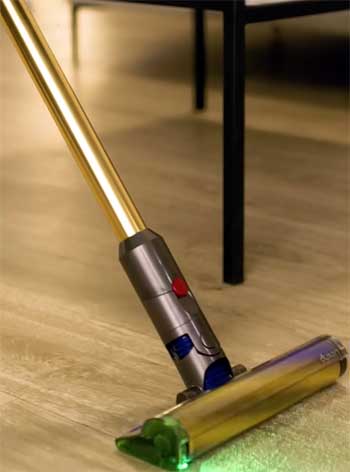
- The Hair Screw Tool: If you have long hair or pets, this tool is worth the price of admission. It uses a conical brush bar that spirals hair off and into the bin in seconds. Unlike traditional brush rolls where hair gets tangled and requires scissors to remove, the Hair Screw Tool is virtually tangle-free. It’s perfect for upholstery, pet beds, and car interiors.
- Hyperdymium™ Motor: The V12’s motor is smaller and lighter than the V11’s but spins at the same 125,000 RPM. This allows the machine to be much more maneuverable without sacrificing the high-speed air movement required to capture fine dust and allergens.
- Scientific Proof of a Deep Clean: The V12’s screen doesn’t just show battery life; it shows a color-coded bar graph of the particles you are picking up. It categorizes them by size: >10 microns (allergens), >60 microns (microscopic dust), >180 microns (dust mites), and >500 microns (sugar/sand). It turns cleaning into a bit of a game, giving you visual confirmation that your home is actually sanitized.
- Click-in Battery Design: The V12 was built from the ground up to support swappable batteries. While some later V11 models have this, it is standard on the V12. This means you can keep a second battery on the charger and swap it in for an instant 60-minute boost, effectively giving you unlimited runtime if you own enough batteries.
Pros And Cons of The Dyson V12 Detect Slim
- Pros
- Incredible Maneuverability: At just 5.2 lbs, you can whip this around furniture and carry it up stairs with virtually no effort.
- The Power Button: The single-press button is a massive ergonomic upgrade that makes the vacuum feel much more modern and user-friendly.
- Laser Visibility: The Fluffy Optic head is a game-changer for hard floors; you will be shocked (and maybe a little grossed out) at what you see.
- Smarter Suction: The Piezo sensor ensures you aren’t wasting battery on clean floors but have all the power you need when it matters.
- Advanced Filtration: Rated to capture even smaller particles than the V11, making it the superior choice for those with severe asthma or allergies.
- Cons
- Frequent Bin Emptying: The tiny bin fills up remarkably fast, especially if you have pets. It can be a “stop-and-go” experience.
- Narrower Cleaning Path: The cleaner heads are smaller than the V11’s, meaning it takes more passes to cover the same amount of floor space.
- Lower Peak Suction: While smart, it doesn’t have the same raw “pull” on thick carpets as the V11, which can be noticeable on high-pile rugs.
- Higher Price Point: You are paying a premium for the laser and the sensor tech, which might not be necessary if you mostly have carpets.
- Delicate Feel: Because it is “Slim,” it feels a bit more fragile than the robust V11, requiring a bit more care during use.
Understanding The Core Philosophy: Power Vs. Portability
To start, you have to understand that these two machines were built with different goals in mind. The Dyson V11 is what I like to call the “workhorse.”
It was designed to be a primary vacuum for a medium-to-large American home, where you might have a mix of thick carpets and hardwood floors. It’s beefy, it’s got a large bin, and it feels substantial in your hand.
On the other hand, the Dyson V12 Detect Slim is the “precision instrument.” It represents a shift in Dyson’s engineering toward making cleaning less of a chore and more of a light, tech-driven experience. It’s significantly lighter, but it achieves that by shrinking the bin and slightly lowering the raw suction numbers.
When you use the V12, you feel like you’re wielding a lightsaber; when you use the V11, you feel like you’re operating a high-performance SUV.
Also Read: Comparison of SEBO E3 And D4 Vacuum Cleaners.
Frequently Asked Questions (FAQ)
The V11 is better for large homes with lots of carpet due to its power and bin size. The V12 is better for smaller homes or those with mostly hard floors because of its laser and light weight.
Yes, primarily for the ergonomics. The combination of the lightweight body and the on/off power button makes it much easier to use than previous models.
The V12 is the best “all-rounder” for modern homes, but if you want the absolute most power for the least money, the V11 is the smarter financial choice.
The Dyson V12 Detect Slim was officially released in the United States in June 2022.
Final Thoughts: Which One Should You Choose?
Choosing between these two machines really comes down to your home’s layout and your physical comfort. If you live in a sprawling house with wall-to-wall carpeting and a couple of shedding dogs, you are going to appreciate the V11’s stamina and high-capacity bin.
You won’t have to stop every ten minutes to empty it, and the extra suction will dig deep into those carpets. It’s the classic choice for a reason.
However, if you find yourself constantly reaching for the vacuum for quick cleanups, or if you live in an apartment with beautiful hardwood floors, the V12 is almost certainly the better fit for you.
The laser will help you see every speck of dust, and the lightweight design means you won’t dread pulling it out of the closet. I personally love the V12 for its “smart” features, but I’ll always have a soft spot for the V11’s raw strength.