
I have spent countless mornings dialing in shots, wrestling with retention, and chasing that perfect extraction, and if you are reading this, you are probably in the same boat.
My intent here is simple: to break down the DF54 versus the DF64 to help you decide if saving cash with the smaller sibling is genius or a compromise you will regret.
I have put both through their paces to see which one actually delivers the best value for your home espresso setup.
| Feature | DF54 | DF64 Gen 2 |
| Burr Size | 54mm Flat Burrs | 64mm Flat Burrs |
| Motor Power | 150W | 250W |
| Plasma Generator | Yes (Built-in) | Yes (Built-in) |
| Grind Speed | Slower (~1g/sec for espresso) | Faster (~2-3g/sec for espresso) |
| Noise Level | Very Quiet | Moderate / Loud |
| Burr Upgradability | Limited (Custom 54mm) | Extensive (SSP, Gorilla Gear, etc.) |
| Footprint | Compact | Standard |
| Price Category | Budget Entry (<$250) | Mid-Range (<$400) |
| Best For | Beginners, Small Kitchens | Enthusiasts, Tinkers |
The Rise of The “DF” Grinders
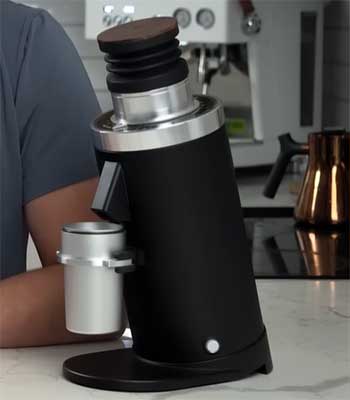
If you have been lurking on espresso forums or watching YouTube coffee reviews lately, you know the “DF” series has completely disrupted the market.
For years, we were stuck choosing between affordable conical burr grinders that lacked clarity or spending a fortune on commercial flat burr titans.
I remember when the original DF64 dropped; it was rough around the edges, messy, and loud, but it brought 64mm flat burrs to the masses.
Now, with the DF64 Gen 2 and the shiny new DF54, the landscape has changed.
The DF54 promises the same flat burr profile in a tiny, quiet package, while the DF64 Gen 2 fixes the flaws of its predecessor. I am looking at these not just as machines, but as daily drivers. How do they feel at 6:00 AM when I haven’t had caffeine yet? That is the real test.
Key Differences Between DF54 And DF64
When I place these two side-by-side on my workbench, the physical differences are obvious, but the functional differences are where the decision gets tricky. It is not just about size; it is about the ceiling of potential for your coffee.
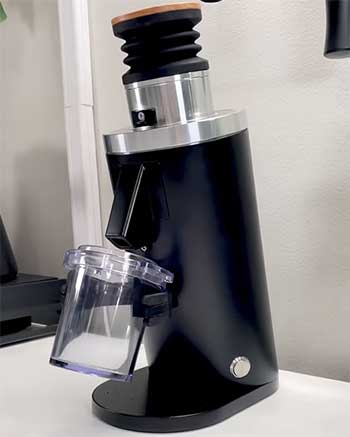
- Burr Size and Geometry: The most glaring difference is the diameter. The DF64 uses widely available 64mm burrs, which is the “magic number” in home espresso.1 This size allows for aggressive cutting geometries that can highlight fruitiness and acidity. The DF54 uses 54mm burrs.2 While they are still flat burrs and offer good clarity, the surface area is smaller. In my testing, this means the DF54 has to work harder and spin longer to grind the same dose.
- Aftermarket Potential: This is a huge factor for me. If I buy the DF64, I am buying a chassis that I can upgrade later. I can swap the stock burrs for SSP High-Uniformity or Multi-Purpose burrs to completely change the flavor profile. With the DF54, what you see is largely what you get. There are very few aftermarket 54mm flat burrs. You are locked into the stock flavor profile, which is excellent for the price, but lacks the “endgame” potential of the 64.
- Acoustics and Sound Signature: I was genuinely shocked by the DF54. It is whisper-quiet compared to almost anything else in this price bracket. It has a low hum that won’t wake up the house. The DF64, while improved in its second generation, still has that powerful, industrial roar. It screams “commercial equipment,” whereas the DF54 feels like a modern home appliance.
- Grind Time and Workflow: Speed matters when you are rushing. The DF64 rips through 18 grams of beans in seconds. The DF54 takes its time. It is significantly slower. While slow feeding beans can actually improve grind uniformity, the DF54 is slow by design due to the smaller motor and burrs. If you are making back-to-back drinks for guests, the DF54 might feel like a bottleneck.
Deep Dive: The DF54
The DF54 is the newcomer that has everyone talking. It effectively takes the “blueprint” of the successful DF64 Gen 2—including the anti-static tech—and shrinks it down.
Key Features of The DF54
- Integrated Ionizer (Plasma Generator): This is the star of the show. One of the biggest complaints with early single-dose grinders was static. Coffee chaff would stick to the chute, the cup, and the grinder body. The DF54 includes a plasma generator that neutralizes static charge.3 When I grind into the catch cup, it is fluffy and clean. I barely have to use RDT (Ross Droplet Technique) with this machine.
- 54mm Custom Flat Burrs: These burrs are designed specifically for this unit. They are punchy and provide a nice balance between the traditional body of a conical burr and the flavor separation of a flat burr. They are not generic; they actually taste quite impressive for a stock setup.
- Stepless Adjustment Dial: The chrome dial on top is smooth. It allows for infinite adjustments, meaning you are not limited to “clicks.” This is crucial for espresso, where a microscopic movement can change your shot time by five seconds.
Pros of The DF54
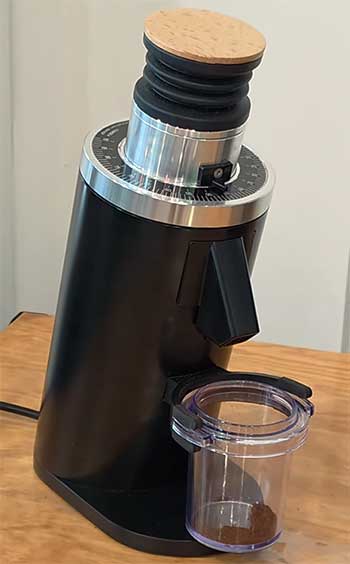
- Incredible Value for Money: I cannot stress this enough: getting a flat burr grinder with an ionizer for under $250 is unheard of. It democratizes good espresso. It makes the barrier to entry so much lower for someone wanting to move away from appliance-grade grinders.
- Compact and Heavy: It is small, but it is not a toy. I was surprised by the heft when I unboxed it. It stays planted on the counter. The small footprint is perfect if you live in an apartment or have limited counter space.
- Silence: As I mentioned earlier, the noise level is a massive pro. If you have thin walls or early mornings, the DF54 is the polite choice.
- Low Retention: Out of the box, with the bellows used at the end, I am getting out exactly what I put in (within 0.1g). The path from burr to chute is short and direct.
Cons of The DF54
- Slow Grinding Speed: You need patience. For a standard 18g dose, you are waiting upwards of 15-20 seconds depending on the roast level and fineness. It feels sluggish if you are used to commercial speeds.
- Limited Upgrade Path: If you catch the “upgradeitis” bug, you have nowhere to go with this grinder. You cannot slap in a set of SSP Lab Sweets. You are married to the stock performance.
- Power Limitations: The 150W motor is sufficient for the stock burrs, but I have heard it struggle slightly with very light, dense roasts at fine settings. It hasn’t stalled on me, but you can hear the RPMs dip.
Deep Dive: The DF64 Gen 2
The DF64 Gen 2 is the maturation of the platform. It fixes the messy declumper and static issues of the original and adds a premium feel. This is the grinder for the person who views coffee as a hobby, not just a drink.
Key Features of The DF64 Gen 2
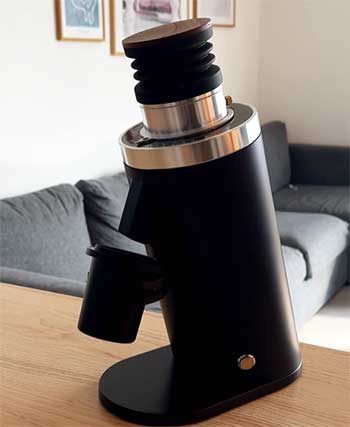
- Standard 64mm Platform: This uses the same mounting standard as the Mazzer Super Jolly and many other pro grinders. This opens up a world of burr geometries.
- Anti-Popcorn Disk: It comes with a disk that sits on top of the moving burr to prevent beans from jumping around. This helps feed the beans into the cutting teeth more consistently, which improves particle distribution.
- Metal Catch Cup and Collar: The build quality feels substantial. The catch cup is metal and fits perfectly near the chute (thanks to a repositioned holder) to minimize mess.
Pros of The DF64 Gen 2
- Flavor Versatility: With the stock burrs, the coffee is great. But the ability to swap to SSP Cast Lab Sweet or MP burrs means this grinder can evolve with your palate. I can tune this machine to highlight acidity in light roasts or body in medium roasts.
- High Torque Motor: The motor here feels robust. I have thrown rock-hard Nordic light roasts at it, and it chews through them without a hiccup. It feels powerful.
- Fast Workflow: It grinds fast. It clears the chamber fast. If you are making three lattes in a row, the speed difference between this and the DF54 becomes very apparent.
Cons of The DF64 Gen 2
- The Sound: It is loud. It has a high-pitched whine that can be grating. It is not as bad as a vacuum cleaner, but it certainly announces its presence in the kitchen.
- Mess (Without Cup Riser): While the ionizer works wonders, the distance from the chute to the cup can sometimes still allow for a stray ground or two if the cup isn’t positioned perfectly close.
- Price Jump: It is nearly double the price of the DF54. You have to ask yourself if the 10mm difference in burr size and the speed is worth an extra $150-$200.
Performance Analysis: Espresso Vs. Filter
When I pull shots with the DF54, I get a lovely, syrupy texture. The stock burrs seem tuned for traditional espresso. They blend flavors well, creating a cohesive, chocolatey shot with medium roasts.
However, when I tried a very light Ethiopian floral roast, I felt like some of the distinct notes were slightly muddied compared to the bigger burrs. It was still good—better than any conical burr in this range—but it lacked that “sparkle.”
The DF64 Gen 2 offers more clarity, even with stock burrs. The separation of flavors is more distinct. If I am drinking a complex anaerobic process coffee, I want the DF64. For pour-over and filter coffee, the DF64 also wins.
The particle distribution at coarser settings seems more uniform, leading to a cleaner cup with fewer fines clogging the filter. The DF54 produces a bit more fines at coarse settings, which can lead to a slightly muddy finish in a V60.
Construction And Aesthetics
Aesthetics are subjective, but I appreciate the industrial minimalism of both. The DF64 looks like a tool. It is cylindrical, slanted, and aggressive. The painted finish on the Gen 2 is a massive improvement over the vinyl wraps of the past.
It feels premium to the touch.
The DF54 is cute. It looks like a scale model of the 64. However, because it is lighter, I sometimes find myself holding the top of the grinder while using the bellows, just to ensure it doesn’t tip, though the base is weighted well enough for normal operation.
The power button on the DF54 is conveniently located on the front, similar to the updated DF64, which is a huge ergonomic win over the old side-button designs.
Which One Should You Buy?
This is where I have to look at you and ask: What kind of coffee drinker are you?
If you are just getting into “real” espresso, maybe upgrading from a pressurized basket machine or a built-in grinder on a Breville, the DF54 is a no-brainer. I honestly don’t see why anyone would buy a generic appliance grinder when this exists.
It gives you 90% of the performance of the big boys for a fraction of the price. It is quiet, tidy, and makes delicious coffee.
However, if you are the type of person who weighs their beans down to 0.01g, who frequents coffee forums, and who dreams of trying High-Uniformity burrs one day, buy the DF64 Gen 2. If you buy the 54, you will eventually wonder “what if?” and end up upgrading anyway. The DF64 is a platform you can live with for a decade.
Also Read: Differences Between Ratio Six And Moccamaster Coffee Makers.
Frequently Asked Questions (FAQ)
Technically, yes. The DF64 offers larger burrs, a stronger motor, faster grinding, and the ability to upgrade burrs, providing a higher potential ceiling for flavor clarity.
The “DF” series is manufactured by a Chinese company called Ningbo Frigga Home Appliances (often referred to as FL).4 They are sold under various names like Turin, G-Iota, and Solo depending on the distributor.5
64mm burrs have a larger surface area and cutting path than 54mm burrs. This generally allows for faster grinding, cooler operation, and more aggressive cutting geometries that can produce better flavor separation and clarity.
Yes, if you value flavor clarity and future-proofing. For enthusiasts who drink light roasts or want to upgrade burrs later, the performance gap justifies the price difference over the DF54.
Wrapping Up
I have realized that we are currently living in the golden age of home coffee equipment. A few years ago, a flat burr grinder under $500 was a fantasy. Now we have two incredible options.
The DF54 has won my respect as the ultimate entry-level king. It does everything a home barista needs without the fuss or the noise. It is the grinder I recommend to my friends who want good coffee without turning their kitchen into a laboratory.
But the DF64 stays on my counter. Why? Because I love the chase. I love knowing that I can tweak, upgrade, and push my extraction further.
If you want a set-it-and-forget-it appliance that punches way above its weight, grab the DF54. But if you want a hobby-grade machine that will grow with your skills, the DF64 is the investment you should make.
Choose the one that fits your morning routine, and enjoy the coffee.