
If you have ever stood in the middle of a sporting goods store staring at a blue half-ball and a wooden disc, wondering which one will actually fix your weak ankles or torch your core, you are in the right place.
I have spent years testing stability trainers to determine which tool delivers real athletic results and which one just gathers dust in the corner. My goal is to break down the mechanics, usability, and value of the BOSU ball versus the wobble board so you can decide which one deserves your money and your floor space.
| Feature | BOSU Ball | Wobble Board |
| Primary Material | Inflatable rubber dome, rigid plastic base | Wood or heavy-duty plastic |
| Stability Type | Dynamic, compressive instability (squishy) | Kinetic, angular instability (tipping) |
| Versatility | High (Cardio, Strength, Flexibility, Rehab) | Moderate (Balance, Rehab, Active Sitting) |
| Price Point | Premium ($100 – $180 range) | Budget to Mid ($20 – $80 range) |
| Storage | Bulky, requires dedicated floor space | Compact, slides under furniture |
| Learning Curve | Low (Beginner friendly) | High (Steep learning curve) |
| Impact Level | Low impact (High shock absorption) | Zero absorption (High joint load) |
Key Differences Between BOSU Ball And Wobble Board
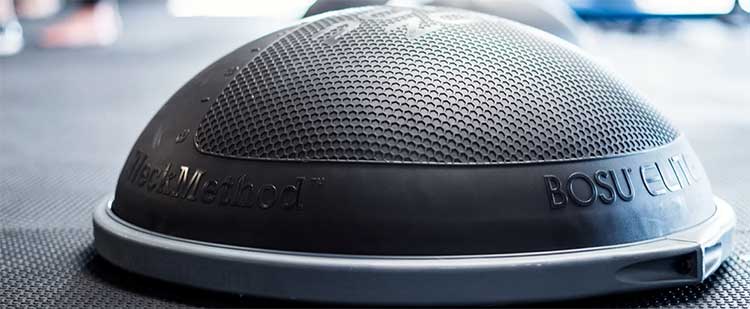
When I analyze these tools side-by-side, the distinctions in how they function are massive. These are not just two versions of the same thing; they are different tools for different jobs.
- Surface Texture and Feedback: The most immediate difference I notice is the feedback loop. On the BOSU, the feedback is muffled. The air bladder absorbs some of my energy. If I stomp on it, the BOSU takes the hit. On the wobble board, the feedback is instant and sharp. The energy travels straight through the wood into my skeletal system. This makes the wobble board superior for training nerve response, while the BOSU is better for endurance and muscle fatigue.
- Directional Freedom: A standard wobble board usually sits on a semi-spherical fulcrum. This allows for 360 degrees of rotation, but the “limit” is the floor. Once the edge hits the floor, the movement stops abruptly. The BOSU ball, due to its dome shape, offers a progressive slope. As I step further out toward the rim, the angle increases, but there is no hard “stop” until I fall off. This makes the BOSU feel more fluid, whereas the wobble board feels more binary—you are either balanced, or you have failed.
- Weight and Portability: This is a practical difference that cannot be ignored. My BOSU ball weighs nearly 19 pounds. It is awkward to carry. I have to use two hands or lug it by the rim. It dominates the room it is in. The wobble board weighs maybe 3 to 5 pounds. I can toss it in the trunk of my car, take it to the park, or slide it behind a dresser. If you live in a small apartment, the BOSU is a roommate; the wobble board is a guest.
Key Features of The BOSU Ball
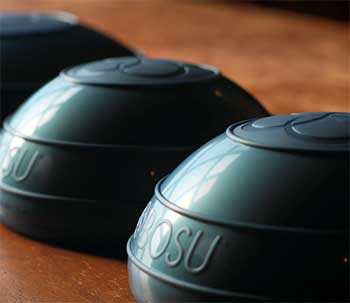
- The Pressurized Dome: The core feature is the inflated rubber hemisphere. It allows for variable resistance. If I want a harder workout where my feet sink more (making balance harder), I let a little air out. If I want a bouncy, reactive surface for cardio, I pump it up fully. This adjustability is something the wobble board completely lacks.
- The Rigid Platform Base: The bottom of the BOSU is a flat, molded plastic platform with non-skid rubber feet. This is crucial because it allows the unit to be used “dome side down.” In this position, the BOSU becomes a giant, heavy wobble board. This duality is its biggest selling point. You essentially get two products in one.
- Reinforced Rim: The rim of the platform is designed to be gripped. This is a subtle but vital feature. When doing pushups or mountain climbers with the dome side down, I grab the rim. It is ergonomically shaped to prevent wrist strain, acting like a set of pushup handles.
Pros of The BOSU Ball
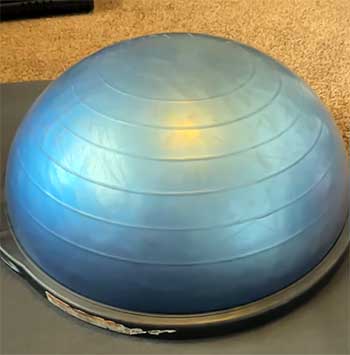
- Unmatched Exercise Versatility: I cannot stress this enough—the BOSU is a total gym. I use it for cardio by doing toe-taps and jump squats. I use it for strength by doing overhead presses while standing on the dome. I use it for flexibility by using the curve of the dome to stretch my back and abs. It integrates into almost every style of training, from HIIT to Yoga.
- Scalability for All Levels: The BOSU is welcoming. If you are a beginner, you can just stand on it. If you lose your balance, you just step off. The height is low, and the surface is soft. There is very little fear factor. For advanced athletes, doing single-leg pistol squats on the dome is one of the hardest exercises imaginable. It grows with you.
- Joint Protection: I have bad knees from years of running on pavement. The BOSU acts as a shock absorber. When I do plyometric drills like jump lunges, landing on the air-cushioned dome takes the sting out of the impact. It allows me to train explosively without the joint pain that usually follows.
- Core Engagement is Automatic: You simply cannot use the BOSU without engaging your core. Even just sitting on it to watch TV forces you to maintain posture. During active workouts, like squats, your abs have to fire constantly to keep you from falling over, turning every leg day into an ab day.
Cons of The BOSU Ball
- Storage is a Nightmare: There is no sugarcoating this. The BOSU ball is huge. It does not deflate easily for daily storage because inflating it takes time and effort. It essentially requires its own 3×3 foot area of floor space. If you try to stack things on top of it, they roll off. It is an aesthetic eyesore in a living room.
- Maintenance Requirements: Unlike a wooden board, the BOSU requires care. It can puncture. I have to keep it away from my cat’s claws and sharp objects on the floor. Over time, the air seeps out, so I have to locate the pump and reinflate it every few months to keep the tension right.
- The Cost Factor: It is expensive. You are paying for a large amount of material and manufacturing. For the price of one BOSU ball, you could buy a wobble board, a set of resistance bands, and a jump rope. You have to be sure you will use it to justify the price tag.
- Limited Proprioceptive Extremes: While it is great for balance, the “squish” can actually be a crutch. It masks some of your instability by absorbing it. A wobble board forces you to correct your own instability. If you are strictly looking to rehab a sprained ankle, the BOSU might be too forgiving in the early stages compared to the distinct movement of a board.
Key Features of The Wobble Board
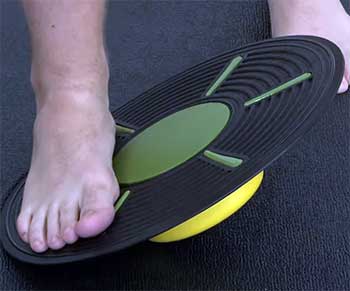
- The Single Fulcrum Point: The magic lies in the pivot point underneath the board. This is usually a hard plastic or wooden hemisphere. The height of this pivot determines the difficulty. Higher pivots mean a steeper angle of tilt. Some high-end boards allow you to adjust this height, but most standard ones are fixed.
- High-Traction Deck: Because the board is made of hard material, the top surface must have grip. Most quality boards use a sandpaper-like grip tape, identical to what you see on skateboards. This ensures that your foot stays planted even when the board is tilted at a precarious 20-degree angle.
- Rigid Construction: There is no give. The board is usually made of 7-ply wood or heavy-duty plastic. This rigidity ensures that 100% of the movement comes from your ankles and hips, not from the material flexing.
Pros of The Wobble Board
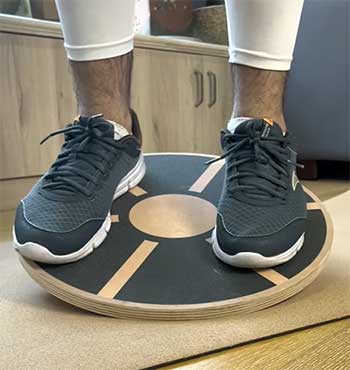
- Superior Ankle Rehabilitation: If you have ever rolled your ankle, a physical therapist has likely put you on a wobble board. The reason is the range of motion. The board forces your ankle to move through its full range of inversion and eversion under load. It strengthens the peroneal muscles on the side of the leg more effectively than the BOSU because there is no cushioning to help you.
- Perfect for Standing Desks: This is where the wobble board shines in a modern context. I keep one under my desk. Standing on a flat floor for 8 hours is exhausting and bad for circulation. Standing on a wobble board keeps my calves pumping and my hips shifting. It makes standing active rather than static, which keeps my energy levels up throughout the work day.
- Durability and Lifespan: A wooden wobble board is virtually indestructible. There is no air to leak. There is no rubber to degrade or crack over time. Unless you take a sledgehammer to it, a good wobble board will last a lifetime. It is a “buy it for life” item.
- Neuro-Muscular Connection: The feedback is so fast on a wobble board that it trains your brain to react quicker. This is vital for trail runners or older adults trying to prevent falls. It sharpens the reflex loop between the foot sensors and the brain.
Cons of The Wobble Board
- The Safety Risk: The wobble board can be dangerous. If you shift your weight too far, the board snaps down to the floor. If you are not expecting it, this can jar your back or actually cause an ankle sprain if your foot slips. It requires a level of caution that the BOSU does not. I always recommend using it near a wall or a sturdy chair when starting out.
- One-Trick Pony: It balances. That is it. You cannot comfortably do crunches on it because the wood digs into your back. You cannot do plyometric jumps on it because it is unstable and hard. It is a specialized tool. If you are not working on balance or active standing, it has no other use.
- Noise Factor: When the edge of a wooden board hits a hardwood floor, it makes a loud “clack.” If you live in an upstairs apartment, your downstairs neighbors will hate you. You almost certainly need to use it on a carpet or a yoga mat to dampen the sound and protect your floors from scratches.
- Discomfort for Upper Body Work: While you can do pushups on a wobble board to challenge your shoulders, it is uncomfortable. The grip tape is rough on the hands, and the hard edge presses into your palms. The BOSU is infinitely more comfortable for any exercise that requires your hands or knees to be on the device.
Practical Applications: How I Use Them
It is easy to list features, but context is everything. Here is how these two items fit into my weekly routine.
My BOSU Routine
I view the BOSU as a strength and conditioning tool. I pull it out on Tuesday and Thursday mornings.
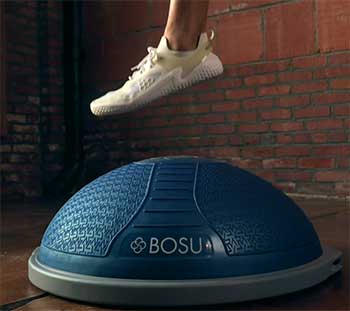
- The Warm-Up: I start by jogging in place on top of the dome. The instability wakes up my nervous system and gets my heart rate up faster than jogging on the floor.
- The Compound Set: I perform weighted squats standing on the dome. This limits the amount of weight I can use, but it skyrockets the intensity. My legs shake uncontrollably by the eighth rep.
- The Finisher: I flip the BOSU over (platform side up) and do “mountain climbers.” Holding the rim, I drive my knees to my chest. The board wobbles beneath my hands, forcing my shoulders and chest to stabilize the movement.
My Wobble Board Routine
I view the wobble board as a daily wellness tool, not necessarily a “workout” tool.
- The Daily Grind: It lives under my standing desk. I stand on it for about 20 minutes of every hour. I gently rock side-to-side while typing. It prevents that stiff lower back feeling I get from standing still.
- The Pre-Run Activation: Before I go for a run, I spend 3 minutes on the board. I do single-leg balances, trying to keep the board perfectly flat. This “wakes up” my ankles and prepares them for the uneven terrain of the road.
- Active Recovery: On rest days, while watching a movie, I will stand on the board and work on circular rotations—rolling the edge of the board in a circle without letting it touch the floor. It is a fantastic mobility drill that feels more like a game than exercise.
Determining The Winner For Your Needs
There is no universal winner here, but there is definitely a winner for you. It comes down to your space, your budget, and your goals.
You should buy a BOSU Ball if:
- You want a single piece of equipment that can handle cardio, strength, and core workouts.
- You enjoy high-intensity interval training (HIIT) and want to add a challenge to it.
- You have sensitive knees or joints and need a surface that absorbs impact.
- You have a dedicated workout space where the large footprint won’t be an annoyance.
- You want something that is fun and approachable for other family members, including kids.
You should buy a Wobble Board if:
- You are specifically rehabilitating an ankle or knee injury and need precise range-of-motion training.
- You work at a standing desk and want to increase your daily calorie burn and focus.
- You are on a budget and want a highly effective tool without spending over $100.
- You live in a small space and need equipment that can disappear when not in use.
- You are an athlete (like a surfer, skater, or trail runner) who needs to train reaction time and quick reflexes.
Also Read: Differences Between BOSU Original And NexGen Balance Trainers.
Frequently Asked Questions (FAQ)
The primary disadvantages are the risk of injury from sudden falls, the inability to use it for comfortable floor exercises like crunches, and the loud noise it makes when the edge hits hard flooring.
For pure strength gains, a stable bench is better because it allows for heavier loading. For pure balance rehabilitation, a wobble board is often better because it provides sharper sensory feedback. The BOSU is a jack-of-all-trades, but master of none.
Yes. Clinical studies have shown that wobble boards effectively improve proprioception (body awareness) and significantly reduce the risk of recurrent ankle sprains by strengthening the stabilizing muscles and ligaments.
Yes. Balancing on a BOSU ball forces the recruitment of deep core muscles and secondary stabilizer muscles in the hips and legs that are often neglected during standard stable-surface exercises.
Wrapping Up
After years of sweating over the blue dome and wobbling on the wooden disc, my verdict is clear: these tools serve different masters. The BOSU ball is the extrovert of the fitness world. It is big, bouncy, loud, and wants to be the center of your workout.
It invites you to jump, step, and sweat. If you want a tool that transforms your living room into a mini-gym and makes exercise feel like play, the BOSU is the undisputed king. It justifies its price tag through sheer versatility.
On the other hand, the wobble board is the introvert. It is quiet, focused, and intense. It does not want you to jump on it; it wants you to concentrate. If you are looking to bulletproof your ankles, improve your posture at your desk, or recover from an injury with surgical precision, the wobble board is the superior choice.
It proves that you do not need complex engineering to get a great result—sometimes, you just need a board, a fulcrum, and a little bit of gravity.