
If you have ever stood in the middle of a gym floor, staring at a blue half-sphere and a wooden plank on a roller, wondering which one will actually fix your bad posture or strengthen those weak ankles, you are in the right place.
My goal here is to strip away the marketing fluff and give you a raw, analytical comparison of the Bosu ball versus the balance board based on my time using both.
We are going to break down the mechanics, the muscular activation, and the practicality of each to help you decide which instability tool deserves your money and your floor space.
| Feature | Bosu Ball | Balance Board (Wobble/Rocker) |
| Primary Mechanism | Air-filled dome & rigid platform | Rigid deck on a fulcrum/roller |
| Stability Type | Squishy/Dynamic Surface | Hard Surface/Mechanical Tilt |
| Versatility | High (Cardio, Strength, Rehab) | Moderate (Balance, Core, Desk) |
| Skill Floor | Low (Beginner Friendly) | Medium to High (Steep Curve) |
| Space Required | High (Bulky footprint) | Low (Easily storable) |
| Durability | Vulnerable to puncture/deflation | High (Wood/Plastic rarely breaks) |
| Price Point | $100 – $180+ | $20 – $150+ |
| Best For | Total body fitness & Rehab | Proprioception & Skill sports |
Key Differences Between Bosu Ball And Balance Board
When I look at these two tools side-by-side, the differences go beyond just shape. They represent two different philosophies of training: Instability through deformation (Bosu) versus instability through mechanics (Balance Board).
- Muscular Engagement Patterns
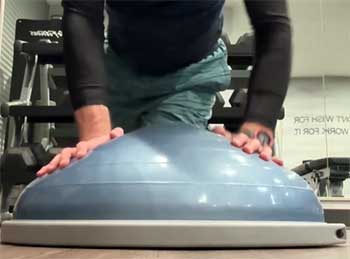
Bosu Ball: When I stand on the dome, my feet pronate and supinate rapidly to find purchase on the shifting rubber.
This lights up the intrinsic foot muscles and the lower calf.
However, because the surface is stable on the floor (the base doesn’t move), my upper kinetic chain (hips and core) can remain relatively static if I choose.
Balance Board: On a rocker or roller board, the entire system is in motion.
My hips must be fluid to counterbalance the movement of the board underneath me. I feel significantly more engagement in my adductors (inner thigh) and obliques on a balance board because I am fighting lateral forces that simply don’t exist on a Bosu.
- The “Fear Factor” and Nervous System
Bosu Ball: Psychologically, the Bosu is safe. It is close to the ground, wide, and grippy. I am never afraid of falling off a Bosu, only of losing my balance. This allows me to push harder on weights or reps.
Balance Board: The balance board demands respect. That low-level anxiety of falling heightens focus. This is great for mental training and focus (“flow state”), but it makes it terrible for high-repetition exhaustions sets. You cannot train to failure on a balance board safely.
- Cost Efficiency Over Time
Bosu Ball: You are paying for complexity and brand. The cost-per-use is high if you only use it for balance. However, if you replace your weight bench and stepper with it, the value skyrockets.
Balance Board: You can make a DIY balance board with a piece of plywood and a PVC pipe for $10. Even high-end ones are cheaper than a Bosu. If you are on a strict budget, the balance board offers a better “instability per dollar” ratio.
Key Features of The Bosu Ball
- Pressurized Dome Structure
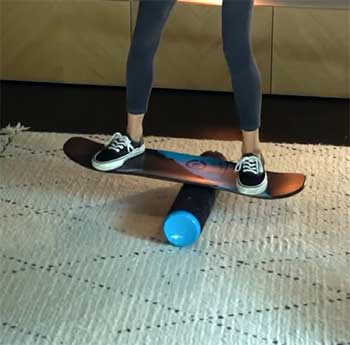
The most obvious feature is the inflated rubber hemisphere.
From a biomechanical standpoint, this creates a dynamic, unstable surface that deforms under your weight.
When I step on it, my foot doesn’t just tilt; the surface actually moves with me, forcing the small intrinsic muscles of my feet to grip and adjust constantly.
This creates a different neural feedback loop compared to a hard surface. It mimics walking on sand or soft earth.
- Rigid Platform Base
Flipping the unit over reveals a hard, flat plastic platform. This is where the “Both Sides” concept comes into play. By placing the dome side down, the device becomes a massive wobble board.
However, unlike a standard balance board, the fulcrum is the entire dome. This means the tipping point is less aggressive, but the amplitude of movement is huge.
- Recessed Handles
Most models come with cutouts on the bottom rim. I find these essential when using the Bosu for upper body work like push-ups or mountain climbers. Without them, trying to grip the slippery plastic edge while sweating is a recipe for a wrist injury.
The Advantages of The Bosu Ball
- Unmatched Versatility for General Fitness
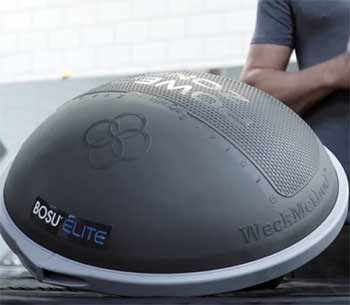
I can use this thing for literally everything.
I use it for cardio by doing toe-taps or box jumps onto the dome.
I use it for strength by doing squats or lunges to increase stabilizer recruitment. I use it for core work by sitting on the dome for V-ups.
If you have a small home gym and only want one piece of equipment, the Bosu covers more ground than almost any other accessory.
- Progressive Rehabilitation
There is a reason physios love these. The dome offers a forgiving instability. If I am coming back from an ankle sprain, a wooden balance board might be too aggressive and risky. The Bosu allows me to control the range of motion.
The squishiness of the dome dampens impact, making it friendlier on the joints for plyometric movements than a hard floor.
- Variable Difficulty via Inflation
You can actually hack the difficulty level by changing the air pressure. A fully inflated Bosu is bouncy and reactive. A slightly deflated Bosu is mushier, which strangely makes standing on it harder because your foot sinks in, requiring more ankle mobility to maintain an upright posture.
The Disadvantages of The Bosu Ball
- Storage Nightmare: I cannot sugarcoat this: the Bosu ball is a pain to store. It is large, round, and awkward. You cannot slide it under a bed effectively because of the dome height, and you cannot stack things on top of it. It effectively claims a 2×2 foot square of your living space permanently.
- The Price Tag: Genuine Bosu brand units are expensive. You are looking at a significant investment for a piece of molded rubber and plastic. While knock-offs exist, I have found their valves often leak or the dome separates from the base after a few months of heavy use.
- Material Fatigue: Over time, the dome stretches. After about three years of heavy use, I noticed mine lost some of its “snap.” It became permanently softer, even when fully inflated. Furthermore, because it is an air-filled bladder, it is susceptible to punctures. If you have a cat with claws or you train with shoes that have sharp debris in the tread, you risk popping your investment.
Key Features of The Balance Board
- The Fulcrum Mechanism
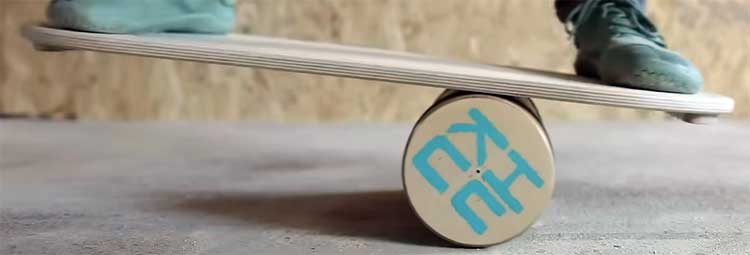
This is the heart of the device. On a wobble board, the fulcrum is usually a fixed semi-sphere attached to the center bottom. On a roller board (like an Indo Board), the fulcrum is a separate cylinder that the deck rides on.
This separation creates a “floating” sensation that is incredibly demanding. The fulcrum determines the “tipping angle”—a higher fulcrum means the board can tilt steeper before the edge hits the ground, increasing difficulty.
- The Rigid Deck
Unlike the Bosu’s squishy dome, the deck is unforgiving. Usually made of wood or high-density plastic, it transfers force instantly.
When I shift my weight on a balance board, the reaction is immediate. There is no lag time, which forces my central nervous system to fire faster. This improves reaction time in a way soft surfaces cannot.
- Grip Surface Technology
Because the deck is hard, traction is paramount. Most high-quality boards use skateboard grip tape or a textured rubberized finish. I prefer the grip tape for barefoot training as it provides tactile feedback, letting me know exactly where my foot pressure is distributed without slipping.
The Advantages of The Balance Board
- Superior Proprioception Training: If your goal is to wire your brain to your feet, the balance board wins. The rigid surface forces you to rely entirely on skeletal alignment and muscular tension. I find that using a roller board significantly improves my surfing and snowboarding skills because it mimics the fluid, frictionless movement of board sports.
- Compact and Portable: I can slide my balance board under the couch, lean it against the wall, or toss it in the trunk of my car. It takes up virtually zero space. For people living in apartments or those who want to train at a standing desk, this footprint advantage is massive.
- Durability: A wooden deck and a hard plastic roller are essentially immortal. Unless I take a sledgehammer to it, my balance board is going to outlive me. There are no valves to leak, no rubber to rot, and no glue to separate. It is a buy-it-for-life item.
The Disadvantages of The Balance Board
- High Skill Floor and Safety Risk: The first time I stepped on a roller board, I nearly shot the board through my drywall. These things can be dangerous. If your balance fails, the board can fly out from under you, leading to falls. Unlike the Bosu, which just sits there, a roller board is a dynamic projectile. It requires a spotter or a wall for beginners.
- Limited Exercise Variety: While you can do push-ups or squats on a balance board, it is generally a one-trick pony. You are mostly just… balancing. You cannot effectively use it for cardio (jumping onto a balance board is a death wish), and it doesn’t offer the same utility for rehab unless you are in the late stages of recovery.
- Hard on the Joints (Impact): Because there is no “give,” prolonged use can be fatiguing on the knees and hips if your mechanics aren’t dialed in. The shock absorption is zero; your cartilage has to do all the dampening.
Which One Fits Your Routine?
I have integrated both into my routine at different times, and here is how I categorize their utility based on specific user personas.
- The Home Gym Warrior
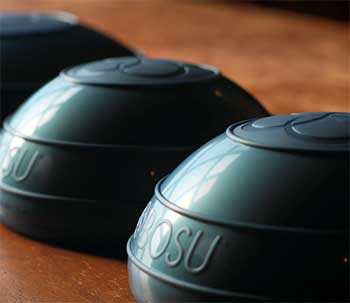
If you are building a general fitness space in your garage and want to do HIIT, ab circuits, and some stability work, get the Bosu Ball.
Its ability to act as a bench for chest presses or a support for back extensions makes it invaluable.
I often use it as a “pre-exhaust” tool—doing squats on the Bosu before hitting the heavy barbell squats to prime my nervous system.
- The Board Sport Athlete or Desk Worker
If you surf, skate, ski, or just stand at a desk all day, get a Balance Board. The specific lateral motion of a rocker board counteracts the static nature of standing still. I keep a wobble board under my standing desk.
Shifting my weight while typing keeps my lower back loose and prevents that stiff “tin man” feeling at the end of the day.
- The Rehab Patient
If you are recovering from an ankle sprain or ACL surgery, the Bosu Ball is the safer, smarter choice initially. The static base allows you to work on range of motion without the risk of the device shooting out from under you.
You can progress from sitting to standing to single-leg holds. The balance board is too binary—you are either balanced or you are falling—which is often too advanced for early rehab.
Frequently Asked Questions (FAQ)
What are the disadvantages of the bosu ball?
The main disadvantages are its large footprint, making it hard to store, and its susceptibility to punctures or deflation over time. It is also significantly more expensive than most simple balance boards and can result in “cheating” where users rely on the edge of the dome for stability rather than their muscles.
Is a bosu ball worth the money?
Yes, if you utilize it for its full versatility—strength training, cardio, and core work—it is worth the investment. However, if you strictly want to improve balance and nothing else, a cheaper balance board provides a better return on investment.
Which is better, a balance board or a wobble board?
It depends on your goal. A “rocker” style balance board (moves left-right) is better for board sport athletes (skaters/surfers). A “wobble” board (circular 360-degree pivot) is better for general ankle rehabilitation and all-around joint stability because it moves in every direction.1
Are planks harder on a bosu ball?
Yes, planks are significantly harder on a Bosu ball. Placing your hands or forearms on the unstable dome forces your shoulder stabilizers and core to micro-adjust constantly to prevent falling, recruiting more muscle fibers than a plank on the stable floor.
Final Thoughts
I have spent years wobbling, tilting, and occasionally falling off both of these devices, and my verdict is that they serve two distinct masters. The Bosu ball is a generalist. It is the Swiss Army Knife of the gym floor—bulky, slightly expensive, but incredibly useful for a hundred different things.
If you want to sweat, jump, and build a resilient body from the ground up, the Bosu is the tool I would recommend you reach for first.
On the other hand, the balance board is a specialist. It is sharper, harder, and less forgiving. It will not help you do cardio, and it makes a terrible bench press platform. But if you want to cultivate a ninja-like sense of balance, improve your reaction times for sports, or just keep your legs active while typing at a desk, the balance board is superior.
Ultimately, your choice comes down to space and intent. If you have the floor space and want a total-body tool, go Bosu. If you are tight on space and crave that intense, focused neuromuscular challenge, grab a board.
Just remember, whichever you choose, the magic isn’t in the plastic or the wood; it’s in the consistency of getting on it and embracing the shake.