
When you spend as much time in the kitchen as I do, you eventually realize that your knife is only as good as the surface it’s hitting. I used to think a board was just a board, but after years of prep work, I found myself choosing between the two biggest titans in the world of wood: Boardsmith and John Boos.
In this article, I want to help you decide which of these heavyweights belongs on your counter by comparing their craftsmanship, durability, and how they actually feel under a blade.
By the end, you’ll know exactly which investment will serve you best for the next twenty years.
| Feature | The Boardsmith | John Boos (Boos Block) |
| Construction | Premium End-Grain only | Edge-Grain and End-Grain options |
| Wood Quality | Hand-selected, premium hardwoods | High-quality Northern Hard Rock Maple |
| Finish | Smooth, artisan-sanded “buttery” feel | Standard factory finish (can be rough) |
| Feet | High-quality non-marking rubber feet | Optional (many are reversible without feet) |
| Customization | High (made to order available) | Low (mass-produced standard sizes) |
| Price Point | High-end investment | Entry-level to Professional |
| Availability | Artisanal/Small batch | Widely available (Amazon, Sur La Table) |
Key Differences Between Boardsmith And Boos Cutting Boards

- Grain Orientation and Edge-to-Edge Quality The most significant technical difference is the “grain.” Boardsmith specializes almost exclusively in end-grain construction. Think of wood as a bundle of straws; end-grain means you are cutting into the tips of those straws. This allows your knife to slide between the fibers. Boos, while they offer end-grain, is most famous for their edge-grain boards. In edge-grain, you are cutting across the length of those “straws,” which is much harder on your knife edge over time. Furthermore, Boardsmith hand-selects every piece of wood to ensure there are no knots or sapwood, whereas, in a mass-produced Boos, you might see more color variation and the occasional minor imperfection.
- The Finish and “Hand” of the Wood If you rub your hand across a Boardsmith, it feels like polished marble or silk. This is because they sand their boards through multiple grits of sandpaper, finishing with a process that raises the grain and knocks it back down. When a Boos comes out of the box, it often has a “factory” feel—it’s smooth, but it doesn’t have that deep, buttery luster. Often, you’ll find that a new Boos board requires you to do a little bit of your own fine-sanding and heavy oiling before it feels truly “premium.”
- Stability and Airflow Engineering I cannot stress enough how much I prefer the “feet” situation on a Boardsmith. Every Boardsmith comes with high-quality, non-marking rubber feet secured with stainless steel screws. This isn’t just about grip; it’s about hygiene. It allows air to circulate under the board, ensuring it dries evenly. Many John Boos boards are reversible and flat. While being reversible sounds like a “pro,” it actually means the board sits directly on your counter. If a little water gets trapped under there, the board can warp or, worse, develop mold.
- Artisanal vs. Industrial Scale When you buy a Boardsmith, you are often buying a board made by a small team of craftsmen who take pride in the “brick” pattern layout. The aesthetics are intentional. John Boos is a massive operation. While their quality control is generally high, they are an industrial manufacturer. Their focus is on efficiency and meeting the massive demand of restaurant supply stores. You are a customer to Boos, but you feel more like a patron of the arts when you buy a Boardsmith.
The Boardsmith: Key Features And Nuances
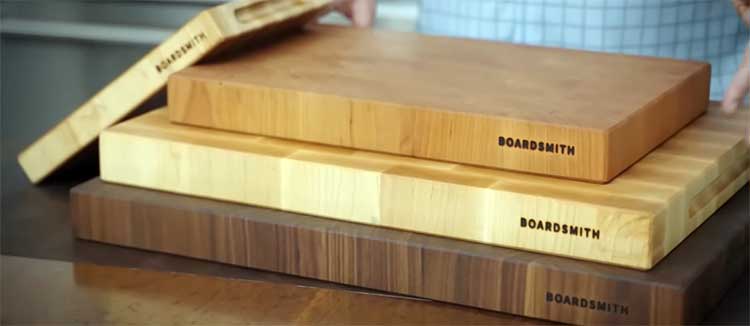
- The “Carolina Slab” Brick Pattern The first thing you’ll notice about a Boardsmith is that it doesn’t look like a standard checkerboard. They use a unique staggered brick layout. By using wider sections of hardwood and staggering the glue lines, they minimize the number of joints. This isn’t just for looks; fewer seams mean fewer points where the board could potentially fail or crack under pressure.
- Pharmacy-Grade Pre-Seasoning When your Boardsmith arrives, it’s not just “oiled.” They actually soak their boards in a tank of pharmacy-grade mineral oil for over 30 minutes before buffing them with a custom beeswax and oil blend. This deep saturation ensures that the wood is protected from the inside out the moment it hits your counter.
- Integrated Non-Slip Feet Unlike many competitors who leave feet as an afterthought, Boardsmith views them as essential. These high-quality rubber feet are attached with stainless steel screws. This raises the board about 3/4 of an inch, allowing air to circulate completely around it. This prevents the “swelling” and “cupping” that happens when moisture gets trapped between a board and a granite countertop.
- The Two-Inch Standard While many brands offer thin 1-inch or 1.5-inch boards to save on shipping, Boardsmith sticks to a beefy 2-inch thickness for their main blocks. This heft is intentional; it provides the mass needed to absorb the shock of heavy chopping, which saves your wrist from fatigue during long prep sessions.
The Boardsmith: Pros And Cons
Pros
- Ultimate Knife Longevity: Since you are cutting into the end-grain, your expensive knives won’t dull nearly as fast. I’ve noticed I have to hone my blades far less frequently when using my Boardsmith compared to any other surface.
- Heirloom Construction: These boards are thick—usually two inches or more. This thickness, combined with the premium wood selection, means the board is unlikely to crack or warp if you give it even basic care. It is a legacy item you pass down to your kids.
- Superior Stability: The combination of the board’s massive weight and the industrial-grade rubber feet means this thing is a tank. You can chop through a heavy butternut squash or a rack of ribs without the board sliding an inch.
- Customization Options: If you have a specific “dream size” for your kitchen island, Boardsmith is much more likely to accommodate a custom request than a major corporation like Boos.
- Pre-Seasoned Excellence: They arrive heavily saturated with high-quality mineral oil and beeswax. You can literally start chopping the second it comes out of the box without worrying about the wood being “thirsty.”
Cons
- Significant Financial Investment: You have to be serious about cooking to justify the cost. It is often double or triple the price of a standard cutting board you’d find at a big-box store.
- Heavy and Bulky: This is not a board you pull out of a cabinet, use for a minute, and put back. It’s heavy. Most people who own one treat it as a permanent counter fixture.
- High Porosity: Because end-grain acts like a sponge, you have to be very diligent about oiling it. If you let it dry out, the fibers can start to “check” or develop tiny cracks.
- Availability Issues: Because they are small-batch, popular sizes often go out of stock. You can’t always get one with “two-day shipping.”
John Boos: Key Features and Nuances

- The Legend of Northern Hard Rock Maple Boos built their empire on this specific wood. It’s incredibly dense and features a tight grain structure that is naturally antimicrobial. While they also offer Walnut and Cherry, the “Boos Block” experience is defined by the resilience of that iconic blonde Maple.
- NSF Certification for Professionals One of the biggest selling points for Boos is that many of their boards are NSF (National Sanitation Foundation) certified. This means they meet rigorous public health standards for use in commercial kitchens. If it’s safe enough for a high-volume steakhouse, it’s more than safe enough for your home.
- Reversible Versatility Many of the most popular Boos models, like the R-Board series, are reversible. One side often features a deep juice groove for carving meats, while the other is perfectly flat for vegetable prep. This “two-in-one” design is perfect for cooks who want to maximize their utility without buying multiple boards.
- The Massive “Butcher Block” Heritage While Boardsmith focuses on countertop slabs, Boos is the king of the “furniture-grade” block. They offer massive 3-inch, 4-inch, and even 6-inch thick blocks that stand on their own legs. These are designed to be the centerpiece of a kitchen, capable of handling a lifetime of heavy-duty butchery.
John Boos: Pros And Cons

Pros
- Unmatched Variety: Boos has hundreds of SKUs. Whether you want a thin board for a small apartment, a round board for cheese, or a massive table-sized block, they have it.
- Professional Pedigree: There is a reason you see these in every professional kitchen. They are tough, NSF-certified, and designed to handle the high-volume abuse of a line cook.
- Easily Replaceable: If you run a catering business or a busy restaurant and a board finally wears out after five years of heavy abuse, you can order the exact same model and have it the next day.
- The Reversibility Factor: On their flat models, having two sides is a huge plus. You can designate the side with the “juice groove” for carving meats and the flat side for dicing vegetables, preventing cross-contamination.
- More Affordable Entry Point: You can experience the “Boos” brand without breaking the bank. Their edge-grain boards offer a great middle-ground for someone moving up from plastic or bamboo.
Cons
- Rougher Initial Texture: I’ve found that many Boos boards feel a bit “fuzzier” than I’d like. Many enthusiasts end up sanding them with 400-grit paper themselves to get that professional finish.
- Warping Risks: Because many of their popular models lack feet, they are prone to “cupping” or warping if they are left in a damp spot on the counter. You have to be much more careful about drying them perfectly.
- Harder on Knife Edges: Their edge-grain models, while durable, are essentially like cutting against the side of a tree. It’s a hard surface that will roll a fine knife edge much faster than an end-grain board.
- Glue Line Issues: In some mass-produced units, the glue lines can occasionally be felt or seen more prominently, which can be a minor aesthetic or tactile annoyance.
My Experience On The Line
I remember the first time I switched from a cheap plastic board to a John Boos edge-grain. I thought I had reached the pinnacle of home cooking. But then, a year later, I tried a friend’s Boardsmith. The difference was immediately apparent in the sound.
On a Boos edge-grain, you hear a “thwack, thwack, thwack.” On a Boardsmith end-grain, it’s a muted, satisfying “thud.”
Your knife feels like it is being “cradled” by the wood rather than being stopped by it. If you use high-end Japanese knives or expensive German steel, the Boardsmith is the only choice that makes sense for your investment.
However, if you are a “rough and tumble” cook who wants a board you can flip over and not worry about too much, the John Boos R-Board series is a workhorse that won’t let you down.
Also Read: Differences Between Acacia And Beech Cutting Boards.
Frequently Asked Questions (FAQ)
Yes, if you value knife longevity and artisanal quality. They are heirloom pieces that offer the best “self-healing” surface available, making them a one-time purchase for most.
Gordon Ramsay is famously a fan of John Boos. He has been seen using their massive 24×18 inch maple blocks in his MasterClass and personal kitchen videos.
It depends on your budget. For handcrafted, end-grain excellence, Boardsmith is widely considered the best. For professional-grade variety and heritage, John Boos is the industry leader.
Absolutely. They are made from hardwoods like maple, which have natural antimicrobial properties that trap and kill bacteria as the wood dries.
Final Thoughts On Choosing Your Champion
Choosing between Boardsmith and Boos is a “win-win” situation, but you need to be honest about your kitchen habits. If you want a board that is a permanent fixture on your counter—a piece of functional art that protects your $200 chef’s knife—then I recommend you save up for the Boardsmith.
The attention to detail is simply unmatched.
On the other hand, if you need a reliable, professional-grade surface that you can find easily and use for everything from heavy butchery to everyday sandwich prep, John Boos is the standard for a reason.
Whichever you choose, remember that the secret to a long-lasting board isn’t just the brand—it’s how often you apply that mineral oil. I hope this helps you make the right call for your home!